
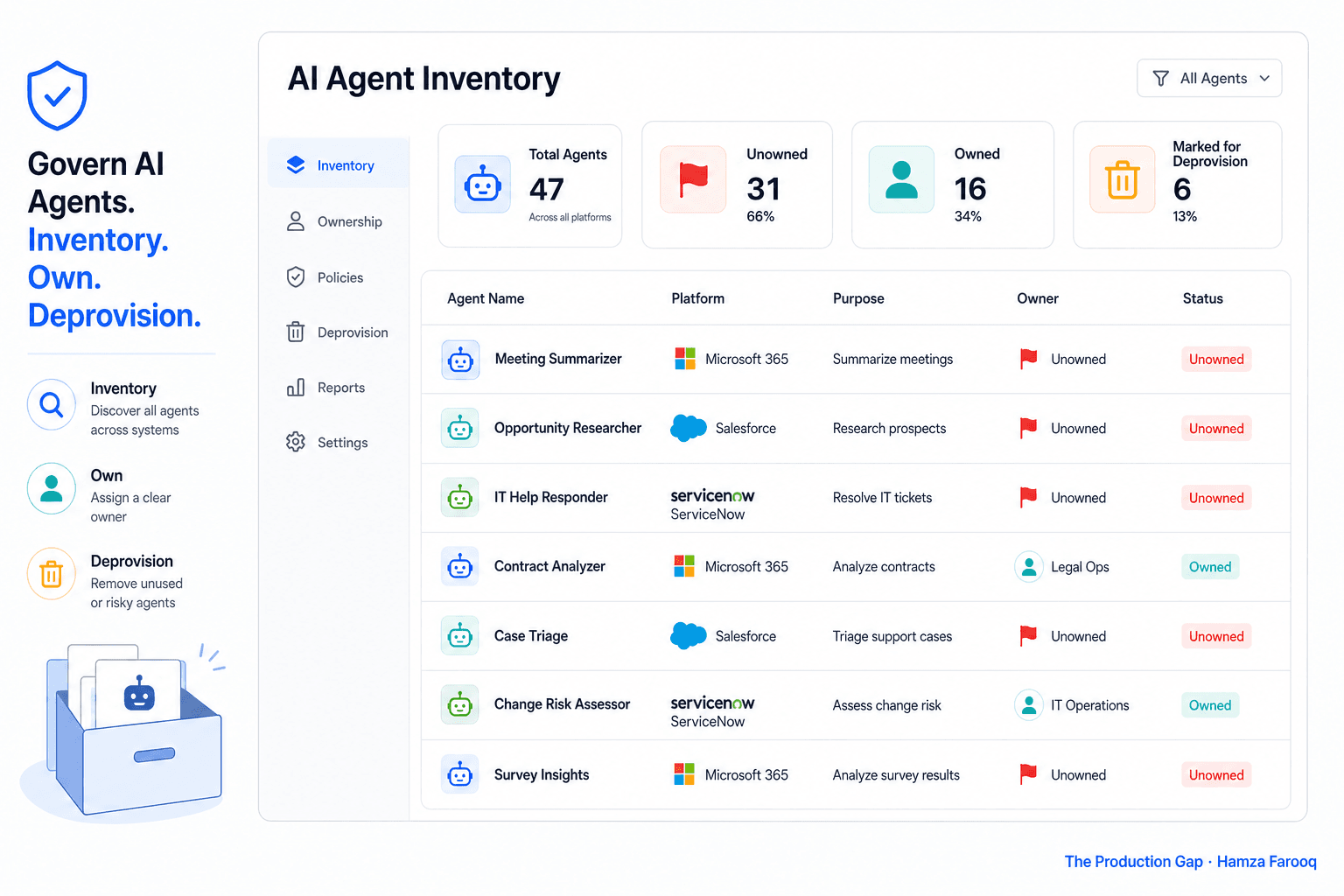
TL;DR: AI agent governance means assigning clear ownership, maintaining a live inventory, and enforcing a deprovisioning process for every autonomous agent running in your environment before untracked agents accumulate enough access and autonomy to create serious security and compliance exposure. Agent sprawl accelerates because agents are cheap to spin up, easy to forget, and rarely audited the way traditional software is. Controlling it requires treating each agent like a privileged service account: catalogued, owned, and revoked on a defined schedule.
Key Takeaways
- Agent sprawl is already here: Enterprises are adding AI agents faster than anyone can track them, a board-level issue as of mid-2026.
- Inventory is the non-negotiable first step: You cannot govern what you have not found.
- Every agent needs a named human owner: Without clear ownership, no one is responsible when an agent misbehaves or outlives its purpose.
- Old SaaS playbooks do not cover this: Shadow IT governance was built for software that sits still, not agents that act autonomously.
Introduction
SAP published dedicated board-level guidance on agent sprawl in August 2026, a signal that AI agent governance has moved from IT backlog to executive mandate . CIOs are actively reworking governance strategies because agent volumes have outpaced the controls they already have. This article gives practitioners a concrete framework built around three disciplines: inventory, ownership, and deprovisioning.
What exactly is agent sprawl, and why has it crossed the board-level threshold in 2026?
Agent sprawl is the uncontrolled proliferation of AI agents faster than enterprises can inventory, own, or deprovision them, and it has crossed into board-level territory because autonomous agents act on data rather than just consume it.
Low-code and no-code platforms have reduced agent creation to the point where any team with a subscription can spin up a credentialed, permissioned agent before IT knows it exists. MintMCP documents at least seven distinct governance problems that compound as agent counts grow, problems that simply do not appear in pilot deployments.
This is substantively different from previous shadow IT waves. A rogue SaaS app sits still until someone opens it; a rogue agent books meetings, sends emails, and modifies records, continuously, with no one watching. The gap between "created" and "governed" is where liability accumulates, and right now that gap is wide open across enterprise environments.
Why do shadow AI agents represent an identity debt problem, not just an inventory gap?
Shadow AI agents create identity debt because every unmanaged agent is a persistent, credentialed non-human principal whose permissions outlive the project and the employee that created it.
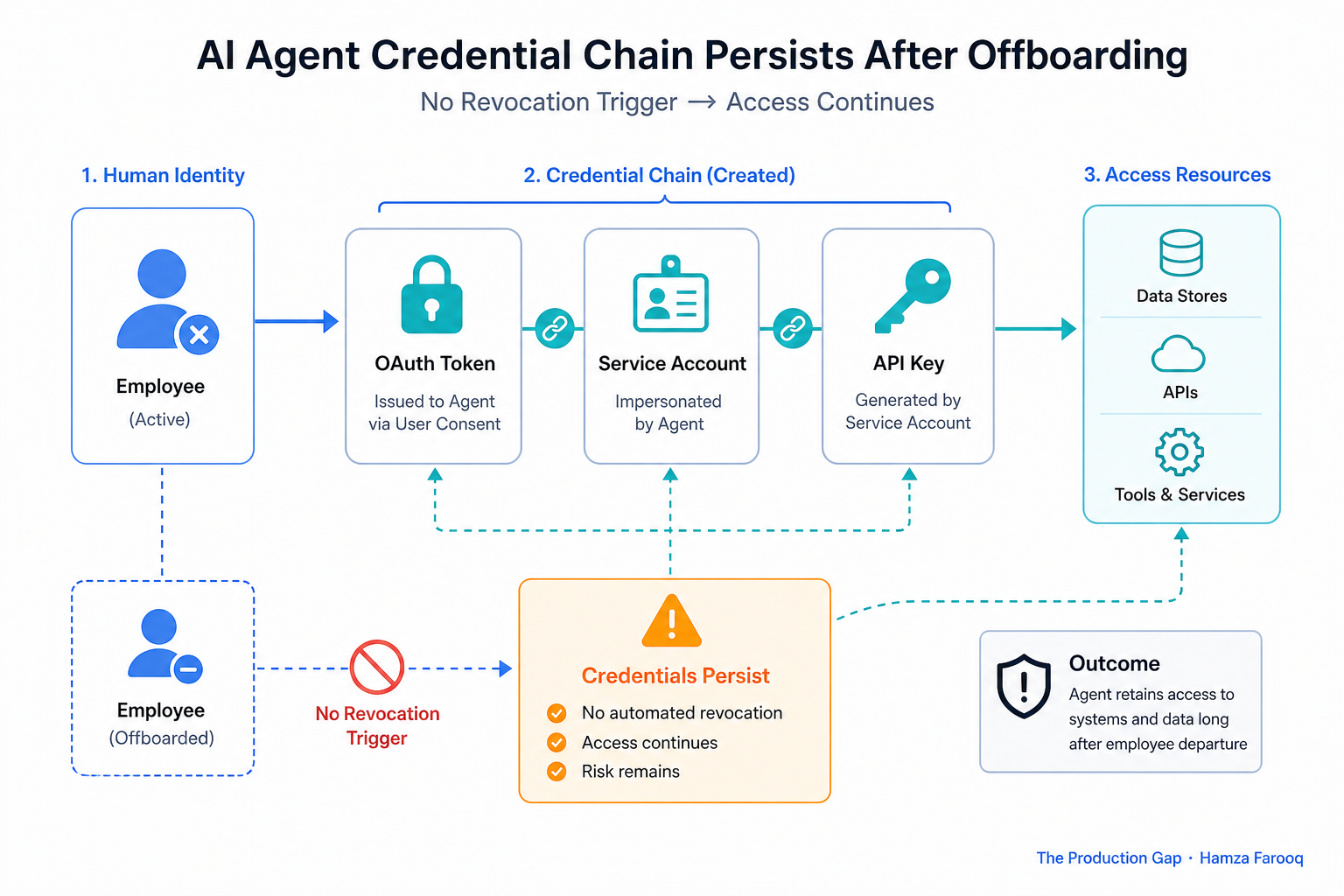
Every agent carries a live identity: a service account, OAuth token, API key, or managed identity with access to email, CRM records, or file shares. The Cloud Security Alliance formally documented this in April 2026 as a distinct security concern, separate from traditional shadow IT.
To illustrate how this plays out in practice, consider a composite scenario drawn from patterns described in practitioner communities: a team member builds an agent to auto-draft follow-up emails, then leaves the organization. The departing employee's agent continues running, still authenticated under a service account tied to that person, still pulling CRM data, still sending emails no one is reviewing. Nobody flags it because nobody is looking.
Existing SaaS playbooks fall apart here. Retiring an agent is not the same as retiring an app. You have to revoke its identity, audit its action history, and verify that whatever it did downstream is clean. That discipline does not exist by default in most enterprise environments, and organizations are running agents right now that assume someone has built it.
How do you actually build an agent inventory across a mixed-platform enterprise?
Building an AI agent inventory requires a platform-by-platform discovery sweep followed by mandatory ownership assignment, and that sweep has to run continuously, not once as a project.
Structuring this work across three sequential phases is the most reliable approach in practice, and the framework below represents the author's synthesis of the governance patterns documented across the sources cited in this article.
Phase 1, Discover: Pull agent registries from every platform in use, including agent admin consoles, OAuth token issuance records, and API gateway access logs. Flag any agent without a traceable creator immediately.
Phase 2, Own: Every agent gets a named human owner, not a team, a person. No owner means immediate suspension. Document purpose, data scope, and permission set in a central registry.
Phase 3, Deprovision: Define expiration triggers at registration, including project closure, employee departure, or 90-day inactivity, whichever comes first. Revoke credentials in the identity provider, not just the agent platform, then audit for residual access downstream.
| Platform | Discovery Method | Identity Type | Deprovision Path |
|---|---|---|---|
| Microsoft 365 / Copilot Studio | Agent admin console; Power Platform admin logs | Managed identity / service principal | Revoke service principal; disable managed identity in identity provider |
| Salesforce Agentforce | Agentforce setup audit trail; Connected App OAuth logs | OAuth 2.0 token / named credential | Revoke Connected App access; deactivate named credential |
| ServiceNow Now Assist | Agent catalog; IntegrationHub audit logs | Service account / OAuth provider | Disable service account in user management |
| Custom / API-based agents | API gateway access logs; OAuth token issuance records; secret manager audit trails | API key / OAuth client credential | Rotate/revoke in API gateway or secrets manager; audit downstream calls |
What does a realistic agent governance policy look like from day one?
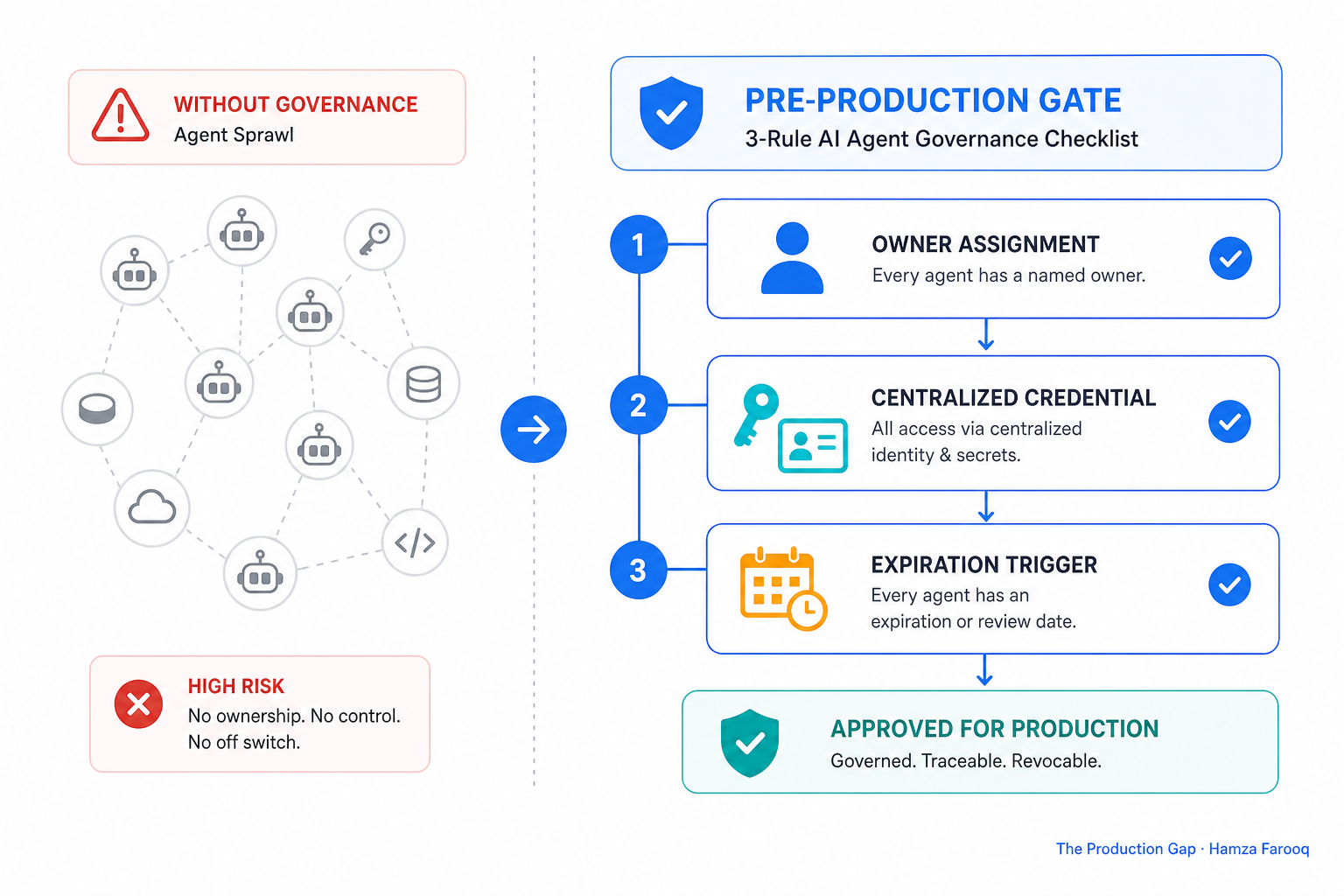
A realistic day-one AI agent governance policy has three enforceable rules: no agent ships without a named owner, no agent credential lives in a personal account, and every agent has a documented expiration trigger.
The three rules below represent a practical framework used in this guide, synthesized from the governance approaches cited throughout this article. They are offered as a starting structure, not as externally measured requirements.
Rule 1, No agent ships without a named owner. That owner is accountable for what the agent does and what it can access, not just who pressed deploy.
Rule 2, No agent credential lives in a personal account. All agents authenticate through centrally managed service principals or managed identities, never through an individual's SSO session or personal API key. This one control prevents the departed-employee scenario from recurring.
Rule 3, Every agent has a documented expiration trigger. Project end date, employee departure, or 90-day inactivity, whichever comes first. The trigger fires an automated revocation workflow, not a Jira ticket someone may ignore.
Guild.ai's practitioner framework argues that agent sprawl is a symptom, and the root failure is the absence of a governance strategy. Attaching these three rules to existing change management gates, so no agent receives a production service account without clearing the checklist, embeds governance at the credential-issuance layer, where it is harder to bypass than a policy document that arrives six months after deployment.
FAQ
Q1: Who should own an AI agent, the team that built it, IT, or a dedicated AI governance function? A named individual on the building team owns the agent; IT holds a secondary governance role at the credential layer. A dedicated AI governance function sets policy, but ownership stays with the builder.
Q2: How is shadow AI agent governance different from traditional shadow IT governance? Shadow IT handles software that sits still; shadow AI agents autonomously modify records and send communications without human initiation. Existing SaaS playbooks have no mechanism to audit an agent's action history, revoke a non-human identity, or verify that a deprovisioned agent left no residual downstream effects. The Cloud Security Alliance documented this as a formally distinct security concern in April 2026.
Q3: How do you enforce AI usage policies against agents deployed before any policy existed? Run a discovery sweep, then apply a retroactive gate: every existing agent must register a named owner and a centrally managed credential within 30 to 60 days. Agents that cannot be attributed to an owner are suspended immediately, not grandfathered.
Conclusion
Agent sprawl is not an inventory problem with an inventory solution. Every unmanaged agent is a persistent, credentialed non-human identity that acts on enterprise data without anyone watching, and that identity does not expire when the project ends or the employee leaves. The three-phase approach, Discover, Own, Deprovision, provides the structure; the three-rule policy gate applied at credential issuance enforces it consistently.
The board-level pressure is real, the CIO recalibration is active, and the credential exposure is live across enterprise environments right now.
The agents your organization deployed before any governance policy existed are still running. Start the discovery sweep this week, not this quarter.
Learn from me
Forward Deployed Engineering Bootcamp for Full-Stack Developers, my Maven cohort. Build and ship complete AI products end to end, from React and Node.js frontends to deployed models with caching and observability. Join the next cohort →
Hire us
Traversaal.ai. We're a team of forward deployed engineers solving the toughest AI problems for Fortune 100 companies: document intelligence, agentic data platforms, and real-time web intelligence, deployed in production. Work with our team to deploy your next agentic ecosystem. Talk to Traversaal.ai →
Join us
Want to solve these problems with us? We're always looking for forward deployed engineers who want to ship production AI. jobs@traversaal.ai
