
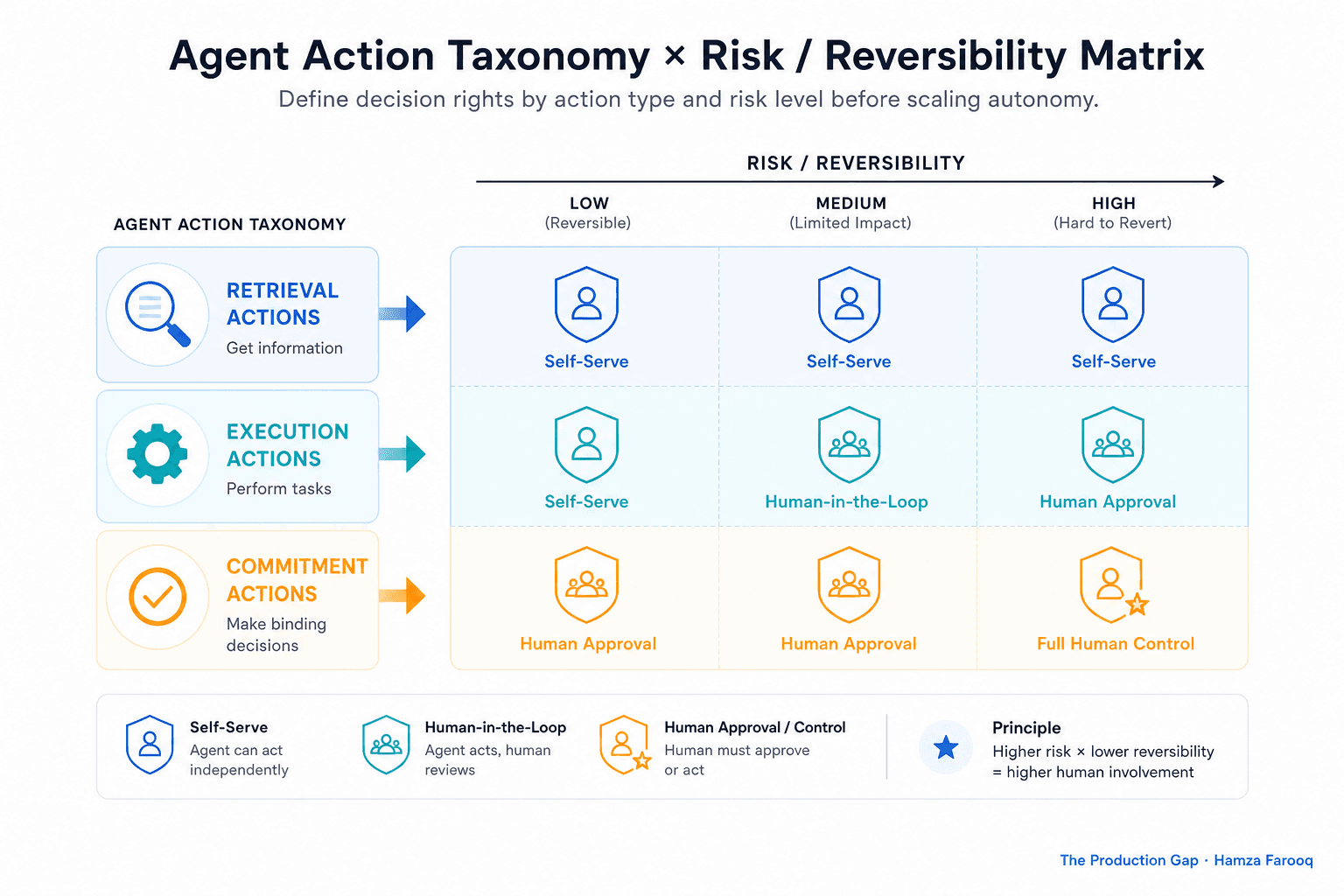
TL;DR: An AI agent governance framework is a structured rulebook that classifies every agent action by risk and reversibility to determine whether it can execute autonomously or requires human approval. Map each action against two axes, consequence severity and reversibility, to place it in the correct tier before deployment. This prevents the governance gap that leaves most enterprises exposed as they scale agent autonomy.
Key Takeaways
- Agentic governance is a different problem: governing agents means controlling actions taken across live systems, not reviewing model outputs.
- Decision rights must be defined before deployment: classifying actions by risk and reversibility creates a clear rulebook for autonomy versus human sign-off.
- Runtime governance is the critical gap: most controls focus on pre-launch behavior, but agents need continuous monitoring while actively executing.
- Agents need scoped identities: treat agents like employees with defined access levels, not superusers, to limit blast radius.
- Documented accountability chains are a practical requirement: named humans must hold defined responsibility for every agent permission scope before regulators ask who authorized what.
What is an AI Agent Governance Framework?
An AI agent governance framework is a structured rulebook that classifies every agent action by risk and reversibility to determine whether it can execute autonomously or requires human approval. Without that rulebook, organizations deploy agents that take irreversible actions across live systems with no clear record of who authorized what or at what risk level.
The Cloud Security Alliance flags the agent governance gap as a pressing enterprise security concern requiring immediate attention. The solution isn't more controls in isolation. It's a taxonomy that makes the right controls obvious.
Why is Agentic AI Governance Different from General AI Governance?
Agentic AI governance is fundamentally different because agents don't just generate outputs, they take actions across live systems that can be irreversible, compounding, and cross-organizational.
Microsoft's Cloud Adoption Framework now explicitly addresses governing and securing AI agents as a foundational enterprise architecture concern (Microsoft CAF). Palo Alto Networks similarly treats autonomous agents as introducing distinct enterprise risk vectors (Palo Alto Networks). Both organizations publishing dedicated guidance on this problem signals how quickly practitioner concern has matured.
The core challenge is that agents operate across sequences of steps. A chain of individually policy-compliant steps can still produce an outcome that no single approver reviewed as a whole. That systemic property is what makes agentic governance a distinct engineering and policy problem, not simply an extension of model evaluation.
What Decision-Rights Taxonomy Does Every AI Agent Governance Framework Need?
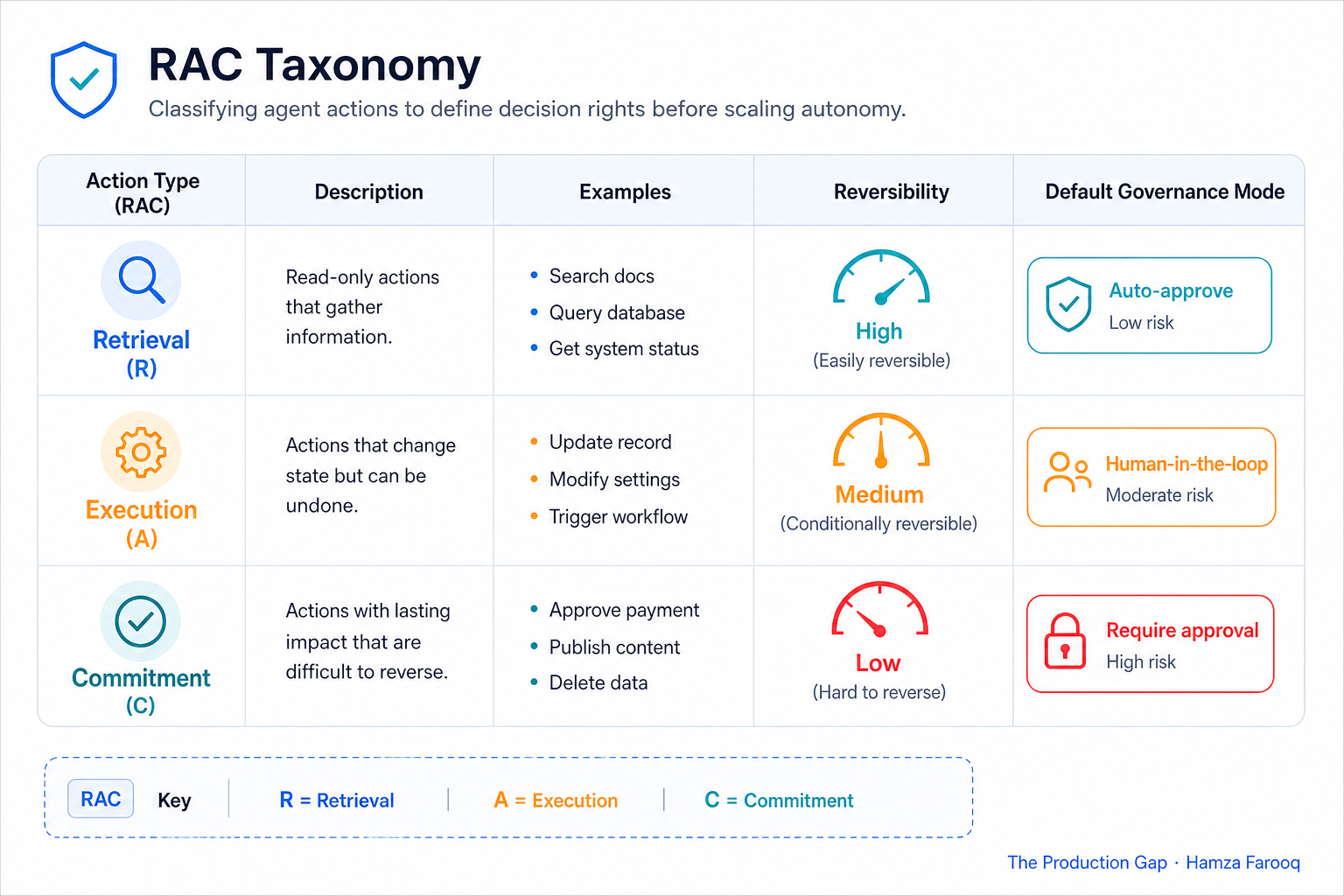
Every AI agent governance framework needs a decision-rights taxonomy that classifies every agent action as Retrieval, Execution, or Commitment, because risk levels and approval requirements become self-evident once you know the action type.
Without a shared vocabulary, governance turns political. Teams argue about which actions need human sign-off rather than reading the answer from a taxonomy. That process breaks down entirely when dozens of agents are running across different teams.
The RAC Taxonomy:
- Retrieval: Read-only, fully reversible. Example: pulling customer data to draft a summary. Autonomous by default.
- Execution: Write operations with bounded, reversible consequences. Example: updating a CRM record. Autonomous with logging and anomaly monitoring.
- Commitment: Irreversible or high-stakes. Example: issuing a refund over threshold, sending a contract. Human approval required.
| Action Type | Example | Reversible? | Default Governance |
|---|---|---|---|
| Retrieval | Query customer record | Yes | Autonomous |
| Execution | Update ticket status | Mostly | Autonomous + logged |
| Commitment | Approve vendor invoice | No | Human approval required |
| Commitment (high-risk) | Modify IAM role | No | Dual sign-off required |
Once every agent capability maps to RAC, human-in-the-loop requirements become engineering specs rather than policy debates. In practice, that shift removes a significant source of friction from governance implementation.
What Does Runtime Governance for AI Agents Actually Require?
Runtime governance means continuously monitoring, intercepting, and logging agent actions while they are actively executing, not just reviewing behavior before deployment or after an incident.
In production, agents hit unexpected inputs and edge-case system states that no pre-launch test predicted. Practitioners in 2026 identify runtime governance as the single most critical missing layer in enterprise deployments . Pre-deployment controls are necessary but insufficient on their own.
Three requirements close that gap:
Action interception: A middleware layer evaluates each action against the RAC Taxonomy before execution. If a Commitment action triggers without human approval, it is blocked, not logged after the fact. Logging after execution is forensics, not governance.
Anomaly detection on action sequences: Flag statistically unusual sequences, such as an agent that normally runs three Execution actions per session suddenly initiating forty. Volume and velocity thresholds catch misuse that action-level rules miss.
Least-privilege identity scoping: Agents must operate with credentials scoped to exactly the systems their current task requires, similar to contractors with time-boxed, role-specific access rather than permanent broad permissions.
How Do You Assign Accountability When an AI Agent Makes a Consequential Error?
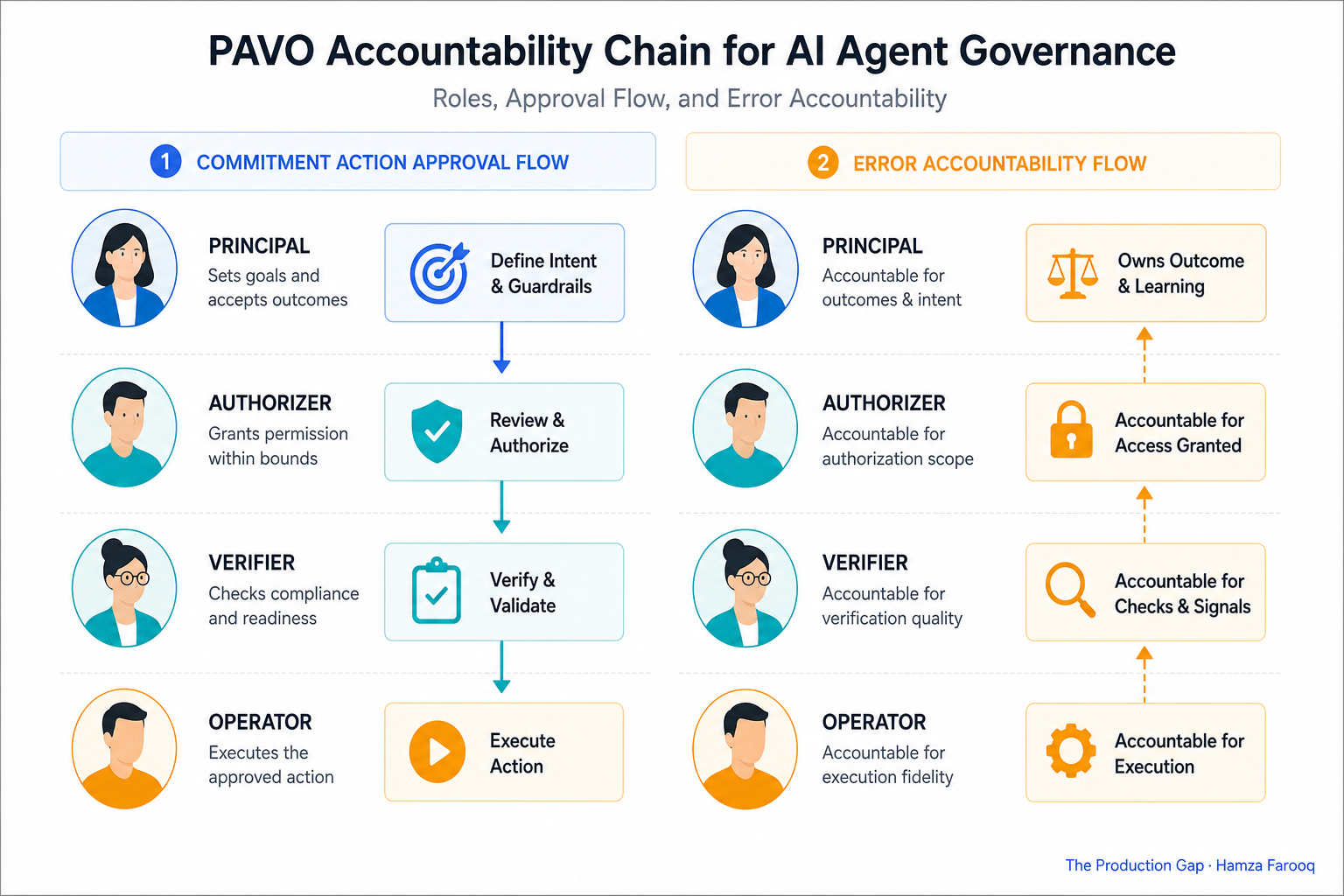
When an AI agent makes a consequential error, accountability belongs to the human role that authorized the agent's permission scope, not to the model, the vendor, or the engineering team.
Documented decision rights matter because auditors and internal reviewers need evidence of who authorized what, at what risk tier, and with what verification. Treating that documentation as a practical requirement from day one is a sound operational posture regardless of the specific regulatory environment your organization operates in.
The PAVO Model:
- Principal: Business owner who defined the agent's goal and authorized its use case.
- Authorizer: Product or platform leader who approved the agent's permission scope and RAC classification.
- Verifier: Human who approved a specific Commitment action at runtime.
- Operator: Technical team responsible for the runtime monitoring layer.
When an error occurs, trace up the PAVO chain. The first broken link, meaning the role that approved something without sufficient controls, is where accountability lands. That traceability is only possible if decision rights were documented before the agent was deployed.
FAQ
Q1: Which AI agent actions should always require human approval? Any Commitment action, defined as irreversible, financially consequential, externally visible, or modifying access permissions, requires human approval by default. So does any Execution action crossing a pre-defined threshold of dollar value, data sensitivity, or blast radius.
Q2: How do you build a decision-rights matrix that scales across multiple enterprise systems? To build a decision-rights matrix that scales, classify every agent action as Retrieval (read-only), Execution (bounded write), or Commitment (irreversible or high-stakes) using the RAC Taxonomy described in this guide, then layer financial materiality and data sensitivity as secondary risk dimensions. Apply classification at the capability level, not the use-case level, so the same rule follows an action type regardless of which agent triggers it.
Q3: What is runtime governance and why is it different from model governance? Runtime governance monitors and intercepts agent actions while executing in production. Model governance evaluates behavior before deployment. Practitioners identify runtime governance as the single most critical missing layer in 2026 enterprise deployments. Both are necessary; neither substitutes for the other.
Q4: What does a mature AI agent governance model look like? Four observable properties: every action is classified before deployment; Commitment actions cannot execute without a documented approval step; runtime monitoring actively intercepts out-of-policy actions rather than logging them after the fact; and named humans hold documented accountability for every agent permission scope.
Conclusion
Enterprises behind on AI agent governance usually skipped the definitional step and built policies around an action vocabulary no one shares. Approval workflows that don't specify which action types they govern create the appearance of oversight without the substance.
Build the RAC Taxonomy first. Apply the PAVO chain to every Commitment action type. Then build your runtime monitoring layer so it enforces rules everyone already agrees on.
Start this week: List every tool-call your most consequential deployed agent can make, classify each as Retrieval, Execution, or Commitment, and name the Authorizer for each Commitment action. That single exercise will surface your governance gaps faster than any audit.
Learn from me
Agentic AI for Product Managers, my Maven cohort. Learn how to design, evaluate, and ship reliable AI systems: the technical fluency PMs need to lead agentic products, no engineering background required. Join the next cohort →
Hire us
Traversaal.ai. We're a team of forward deployed engineers solving the toughest AI problems for Fortune 100 companies: document intelligence, agentic data platforms, and real-time web intelligence, deployed in production. Work with our team to deploy your next agentic ecosystem. Talk to Traversaal.ai →
Join us
Want to solve these problems with us? We're always looking for forward deployed engineers who want to ship production AI. jobs@traversaal.ai
