
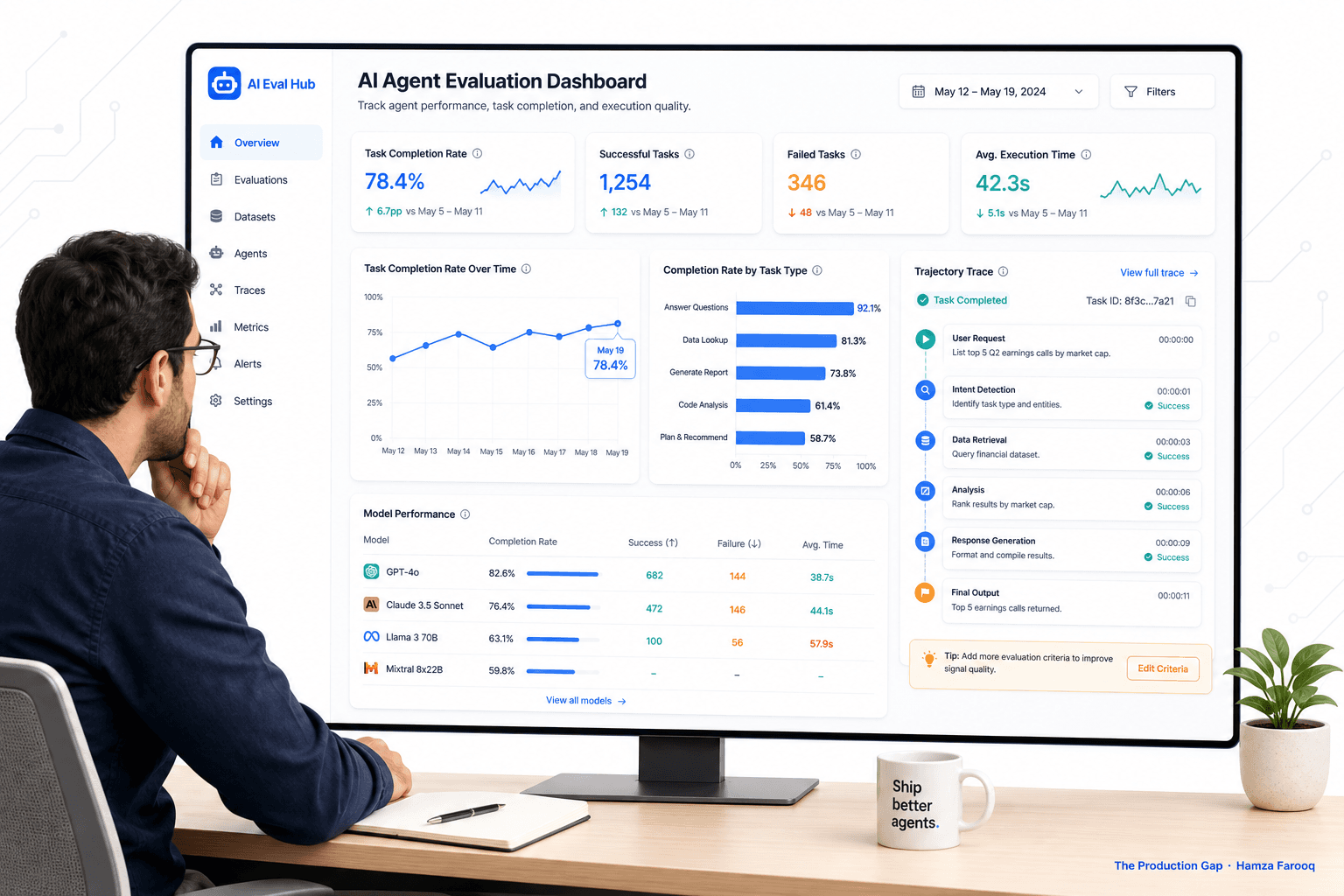
TL;DR: AI agent evaluation works by testing your agent's reasoning steps, tool use, and goal completion-not just its final output accuracy. Traditional metrics fail because agents make sequential decisions where early errors compound, so you need trajectory-based, task-completion, and safety evals matched to your development stage before shipping to production.
Key Takeaways
- Accuracy alone will mislead you: A pass/fail score can't reveal whether an agent took the right steps to reach the right answer.
- Trajectory evaluation is the real signal: Judging the path, which tools, in what order, tells you far more than checking the final output.
- Define "done" before you measure anything: Without a clear completion definition, your eval results can't be trusted or compared.
- LLM-as-judge is useful but not self-sufficient: It needs human spot-checks to stay reliable.
- Golden datasets should exist before launch: A curated set of test cases with known outcomes is the foundation of any eval process.
- PMs own the criteria, not just the results: Deciding what "good" looks like is a product decision, not an engineering one.
Introduction
Building an AI agent is expected from every team in 2026. What separates teams that ship confidently from those that scramble is knowing whether the agent works before real users touch it. The failure modes are already familiar: hallucinated tool calls, runaway loops, tasks that looked complete but weren't. Someone answers for those failures. Increasingly, that someone is the PM.
Eval tooling, Braintrust, LangSmith, Weights & Biases Weave, has matured enough that the question has shifted from "how do we even measure this?" to "how do I, as a PM, get involved without writing code?" This blog gives you that mental model.
Why evaluating an AI agent is nothing like evaluating regular software
Agents don't follow a fixed path. They make sequential decisions, call tools, and accumulate errors across steps. A correct final answer can hide a completely broken process.
Traditional software testing checks whether your GPS gave you the right destination. Agent evaluation audits every turn along the way. An agent that reaches the right answer via six wrong steps isn't just inefficient, it may have exposed sensitive data, sent an irreversible API call, or quietly deleted a record.
The math makes this concrete: at 95% accuracy per step, a six-step task completes correctly only ~74% of the time end-to-end. At ten steps, you're below 60%. A single headline accuracy number hides this compounding reality entirely.
Three failure categories traditional evals never catch: (1) tool call correctness, did the agent invoke the right tool with the right parameters?; (2) step order logic, did it do things in the right sequence?; (3) error recovery, when a tool failed, did the agent handle it or barrel forward? Agents fail plausibly, which is what makes traditional QA instincts insufficient here.
The four types of AI agent evals every PM should know
No single eval type covers everything. The right approach layers methods, each catching what the others miss.
Task completion rate: did it actually finish?
Task completion rate measures whether the agent achieved its intended outcome end-to-end, and it's the first metric to define, because without it, every other number measures progress toward an undefined goal.
A real completion definition specifies: required output format, information that must be present, constraints that can't be violated, and who has authority to call it done. "Summarize the issue and draft a reply" is a description, not a definition. This is a product decision. It belongs in a spec you write.
Completion rate is best measured against a golden dataset: 50–100 curated tasks with pre-approved correct outcomes, built two to three weeks before launch with a domain expert. Without one before launch, you're measuring against untested assumptions rather than known standards.
Trajectory evaluation: did it take the right path?
Trajectory evaluation judges the sequence of steps an agent took, which tools it called, in what order, with what inputs, and it's the eval type most PMs don't know exists until something goes wrong in production.
Think of it as the flight data recorder for your agent: not "did the plane land?" but "did the pilot follow the correct checklist, in order?" Tools like LangSmith and Weights & Biases Weave surface these step-by-step traces visually. Your job as PM is to define what the correct trajectory looks like for your most common task types before engineering writes a single eval script.
A trajectory mismatch is often more serious than a wrong final output. If the agent consistently reaches the right answer via an unexpected path, you got lucky, and you won't always.
LLM-as-judge: scaling evaluation without scaling headcount
LLM-as-judge uses a separate language model to score your agent's outputs against a rubric. It's the most practical way to evaluate at scale, but only if you know its limits.
The mechanic: write a rubric, pass the agent's output to a capable model like GPT-4o or Claude, get a structured score back. This scales to thousands of test cases without human reviewers. Braintrust has made this particularly accessible for non-engineering teams.
The limit you can't ignore: LLM judges prefer longer outputs, are sensitive to framing, and miss factual errors in specialized domains. Human spot-checks on a random 10–15% sample are required to keep scores honest. If judge scores and human scores diverge by more than a few percentage points, your rubric needs work before you trust the numbers.
Human evaluation: the ground truth you still need
Human evaluation is the only method that validates whether output is actually correct in context, not just plausible-sounding, and no automated method fully replaces it.
This doesn't mean reviewing every output forever. Establish structured human review against your golden dataset before launch, then shift to statistical sampling in production. Domain experts, not engineers, should do the reviewing. A customer success rep will spot a bad support draft that an LLM judge scores 9/10.
How to stand up a lightweight eval process before your first launch
| Step | What you do | Who owns it | When |
|---|---|---|---|
| Define task completion | Write explicit success and failure criteria per task type | PM | Before any evals are built |
| Build a golden dataset | Curate 50–100 representative test cases with approved outputs | PM + domain expert | 2–3 weeks before launch |
| Instrument trajectory logging | Ensure every step is logged and queryable | Engineering | During development |
| Run LLM-as-judge at scale | Apply rubric scoring to golden dataset and new runs | Engineering + PM | Pre-launch and continuous |
| Human spot-check | Review 10–15% of judge-scored outputs | Domain expert | Weekly post-launch |
Sequence matters here. Teams that skip step one and jump to instrumentation end up measuring what's easy to log rather than what determines business value. A bad eval framework, one that measures the wrong thing precisely, is worse than none, because it creates false confidence and accelerates shipping broken agents.
The PM's role: you own the criteria, not just the results
The biggest gap in most eval processes isn't a missing tool, it's a missing decision about what
Learn from me

Agentic AI for Product Managers, my Maven cohort. Learn how to design, evaluate, and ship reliable AI systems: the technical fluency PMs need to lead agentic products, no engineering background required. Join the next cohort →
Hire us
Traversaal.ai. We're a team of forward deployed engineers solving the toughest AI problems for Fortune 100 companies: document intelligence, agentic data platforms, and real-time web intelligence, deployed in production. Work with our team to deploy your next agentic ecosystem. Talk to Traversaal.ai →
Join us
Want to solve these problems with us? We're always looking for forward deployed engineers who want to ship production AI. jobs@traversaal.ai
