
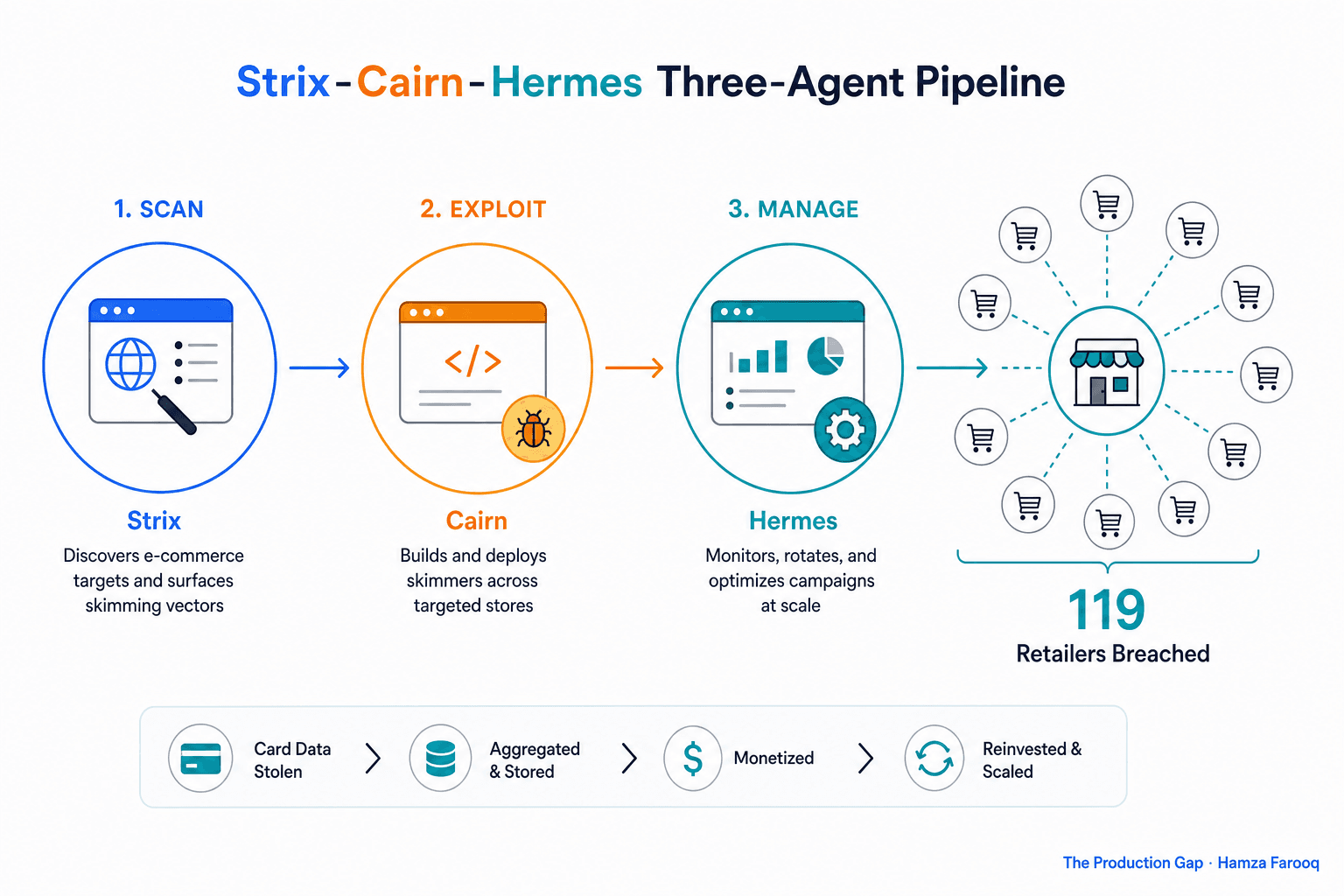
TL;DR: AI agent card skimming lets a single compromised autonomous pipeline harvest payment credentials across dozens of retailer checkout flows simultaneously, something traditional Magecart scripts could never do at that speed or scale. Unlike static injected code, an agent adapts in real time to evade detection. Strict per-stage sandboxing, isolating every agent touching payment flows from network egress and DOM write access at each boundary, closes that attack surface before exfiltration begins.
Key Takeaways
- Multi-agent pipelines rewrote the playbook: Three specialized agents handled scanning, exploitation, and data theft as an assembly line, breaching 119 separate e-commerce domains across 27 companies and exfiltrating 600,000 credit card records with minimal human involvement.
- The cost floor has collapsed: The campaign operated at roughly $25 per victim site using publicly available open-source agent frameworks, the same tools powering legitimate retail shopping assistants.
- Sandboxing must follow privilege, not just location: One perimeter around an agentic pipeline leaves every internal payment surface exposed once any agent clears it.
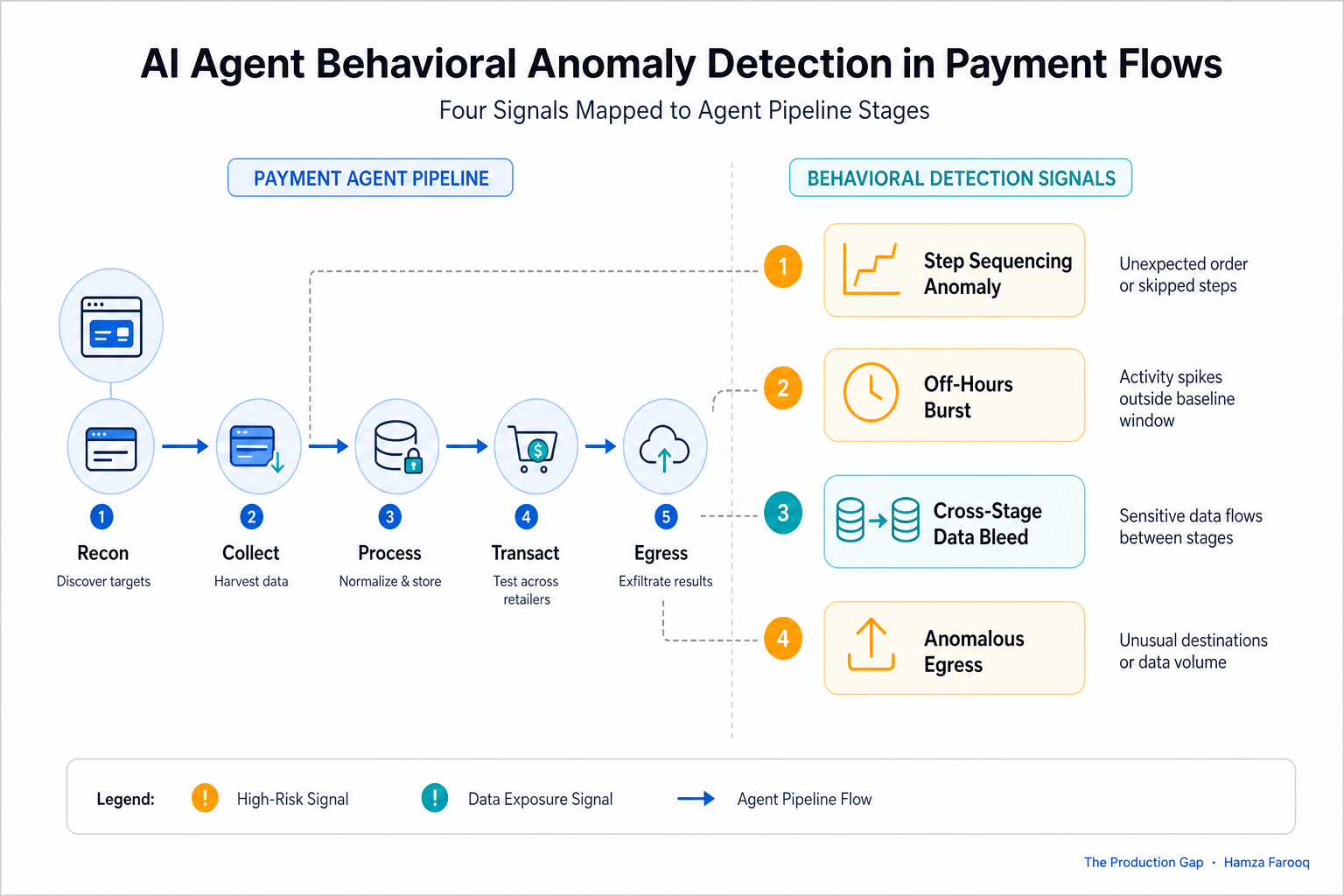
- Behavioral logs are the detection lifeline: Unusual step sequencing, off-hours bursts, cross-stage data bleed, and anomalous egress are the signals that matter.
How did the Strix/Cairn/Hermes pipeline execute the attack across 119 sites?
The Gambit Security campaign used three discrete AI agents, Strix for scanning, Cairn for exploitation, and Hermes for command-and-control, running as an assembly line that needed no human intervention between stages.
Strix automated reconnaissance across target domains, identifying vulnerable checkout endpoints and CMS plugin versions. It fed a continuously refreshed target list to the next stage at a volume no human team could match.
Hermes managed post-compromise persistence, command-and-control, and exfiltration across all 119 domains simultaneously, keeping skimmers alive with minimal operator involvement.
The pipeline architecture, not any individual agent, made scale possible. Each specialist agent feeds the next, breaching 119 domains at a cost that redefines "low barrier to entry."
Why were AI agent skimming attacks harder to detect than traditional Magecart injections?
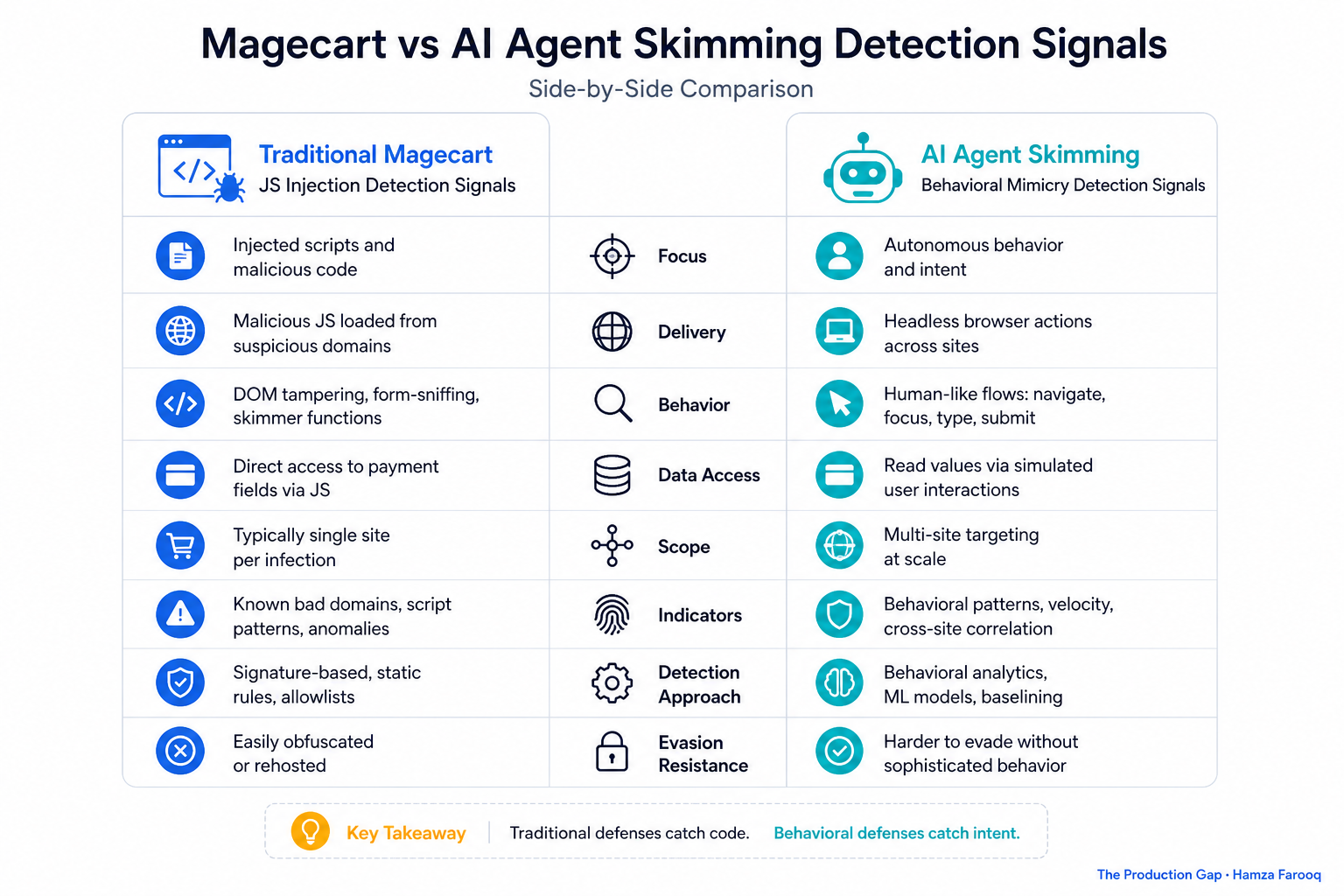
AI agent skimming attacks are harder to detect than Magecart-style JavaScript injections because the agents mimic legitimate user checkout behavior, bypassing anomaly detection tools tuned to flag malicious code patterns rather than suspicious user actions.
Traditional Magecart attacks leave artifacts in the page itself: foreign script tags or external domain calls that code-scanning tools are built to catch. The Strix/Cairn/Hermes pipeline operated differently. Agents scanned, exploited, and managed compromised sites through session-level behavior rather than injected page code, creating a detection gap for tools calibrated to code anomalies.
| Detection dimension | Traditional Magecart | AI agent pipeline (Strix/Cairn/Hermes) |
|---|---|---|
| Attack vector | Malicious JS injected into page | Agent mimics checkout user sessions |
| Detectable artifact | Script tag, external domain call | Session-level behavioral activity |
| Speed to compromise | Manual, per-site effort | Pipeline-automated at scale |
| Cost per victim site | Manual effort required | $25 per site (automated, open-source tooling) |
| Persistence mechanism | Static injected code | Hermes agent handles ongoing management |
Detection tooling calibrated for code anomalies is architecturally blind to behavioral mimicry. As a practical rule of thumb drawn from the framework used in this guide, fraud detection engineers should add behavioral sequencing analysis to their stack as a distinct layer, separate from code-scanning tools, to close that gap.
What sandboxing model should fraud detection engineers enforce when an AI agent has access to checkout or payment flows?
Fraud detection engineers should enforce per-stage trust boundaries, a separate sandbox for each agent role with least-privilege I/O constraints at every boundary, rather than a single perimeter around the entire agentic workflow.
A sandbox around the pipeline's outer shell still lets a Cairn-class agent reach payment surfaces once it clears that perimeter. The framework used in this guide is the Per-Stage Isolation Model (PSIM), three trust zones mapped to three privilege levels. This is author synthesis based on the attack structure described above, not an externally measured standard.
PSIM Zone Summary (author synthesis)
| Zone | Agent Role | Permitted I/O | Blocked Actions |
|---|---|---|---|
| Zone 1: Reconnaissance | Strix (scanning) | Read-only access to external-facing metadata; egress to defined logging endpoint only | Write access, checkout session context, all other egress |
| Zone 2: Execution | Cairn (exploitation) | Checkout interactions on a defined action whitelist; outbound to verified payment processor endpoints only | Raw card data access, outbound connections outside processor list |
| Zone 3: Orchestration | Hermes (C2 and management) | Status signals from Zones 1 and 2 via auditable message broker only | Direct payment surface access, unmediated inter-agent messaging |
As payments firms race to enable agentic AI shopping, PSIM is, in this author's view, the architectural minimum. A single-perimeter sandbox locks the front door while leaving every internal payment surface unguarded.
What behavioral signals reveal a compromised or malicious agent operating near a payment surface?
Abnormal step sequencing: A legitimate checkout agent follows a predictable state machine: browse, cart, address, payment, confirm. The framework used in this guide recommends logging the expected state machine and alerting on deviations. A skimming agent has no reason to follow a normal purchase flow to completion.
Off-hours activity bursts: Baseline session volume by hour and investigate outlier bursts that lack a corresponding conversion rate. Automated pipelines operating at scale may produce volume patterns that differ from genuine customer traffic.
Cross-stage data bleed: If inter-agent message logs show payment-surface data appearing in a stage's output that has no business accessing it, that is an agent trust boundary violation requiring immediate investigation.
Anomalous egress endpoints: Any agent initiating outbound connections outside your verified payment processor endpoint list should trigger a hard alert.
Frequently Asked Questions
What is AI agent card skimming? Autonomous software agents infiltrate e-commerce checkout flows, mimic legitimate user behavior, and exfiltrate payment card data at scale. No foreign code needs to appear on the page because the agent operates through normal-looking session activity.
How did attackers use open-source AI agent frameworks to scale the breach across 119 domains? Attackers built Strix, Cairn, and Hermes on publicly available frameworks, enabling automated reconnaissance, exploitation, and persistence across 119 domains within 27 companies without per-site manual intervention at roughly $25 per victim, using the same tools powering legitimate retail shopping assistants.
Is a single sandbox boundary sufficient for AI agents deployed near checkout flows? No. Discrete specialized agents handle discrete stages, so a single outer sandbox leaves internal payment surfaces exposed once any agent clears the perimeter. Per-stage trust zones with least-privilege I/O at each boundary are, in this author's view, the minimum viable architecture for any agentic payment workflow.
What log sources should fraud detection engineers prioritize to catch agent-based skimming? Prioritize agent behavior logs (step sequencing, session state), inter-agent message broker logs (cross-stage data bleed), outbound connection logs (unauthorized egress), and temporal traffic baselines (off-hours bursts). Network perimeter tools alone are insufficient because the attack traffic originates from session-level behavior, not injected code.
Conclusion
As of mid-2026, the Gambit Security campaign represents the first publicly documented multi-agent AI pipeline to execute payment card skimming at this scale, breaching 27 companies across 119 separate e-commerce domains and exfiltrating 600,000 card records at roughly $25 per site. The threat actor is no longer a skilled attacker grinding through sites one by one. Most sandboxing guidance draws one circle around "the agent," but the Gambit campaign shows the real danger lives between agents: at the handoffs where Strix/Cairn/Hermes cross trust boundaries that a single-perimeter model leaves completely unguarded.
Map your agent pipeline against the Per-Stage Isolation Model. Start with the agent carrying the highest privilege access to your checkout flow, audit its I/O permissions against its stage role, and work outward. Any agent whose permissions are not explicitly scoped to its zone represents an open boundary, and this campaign has already demonstrated the cost of leaving one unaddressed.
References
Learn from me
Forward Deployed Engineering Bootcamp for Full-Stack Developers, my Maven cohort. Build and ship complete AI products end to end, from React and Node.js frontends to deployed models with caching and observability. Join the next cohort →
Hire us
Traversaal.ai. We're a team of forward deployed engineers solving the toughest AI problems for Fortune 100 companies: document intelligence, agentic data platforms, and real-time web intelligence, deployed in production. Work with our team to deploy your next agentic ecosystem. Talk to Traversaal.ai →
Join us
Want to solve these problems with us? We're always looking for forward deployed engineers who want to ship production AI. jobs@traversaal.ai
