
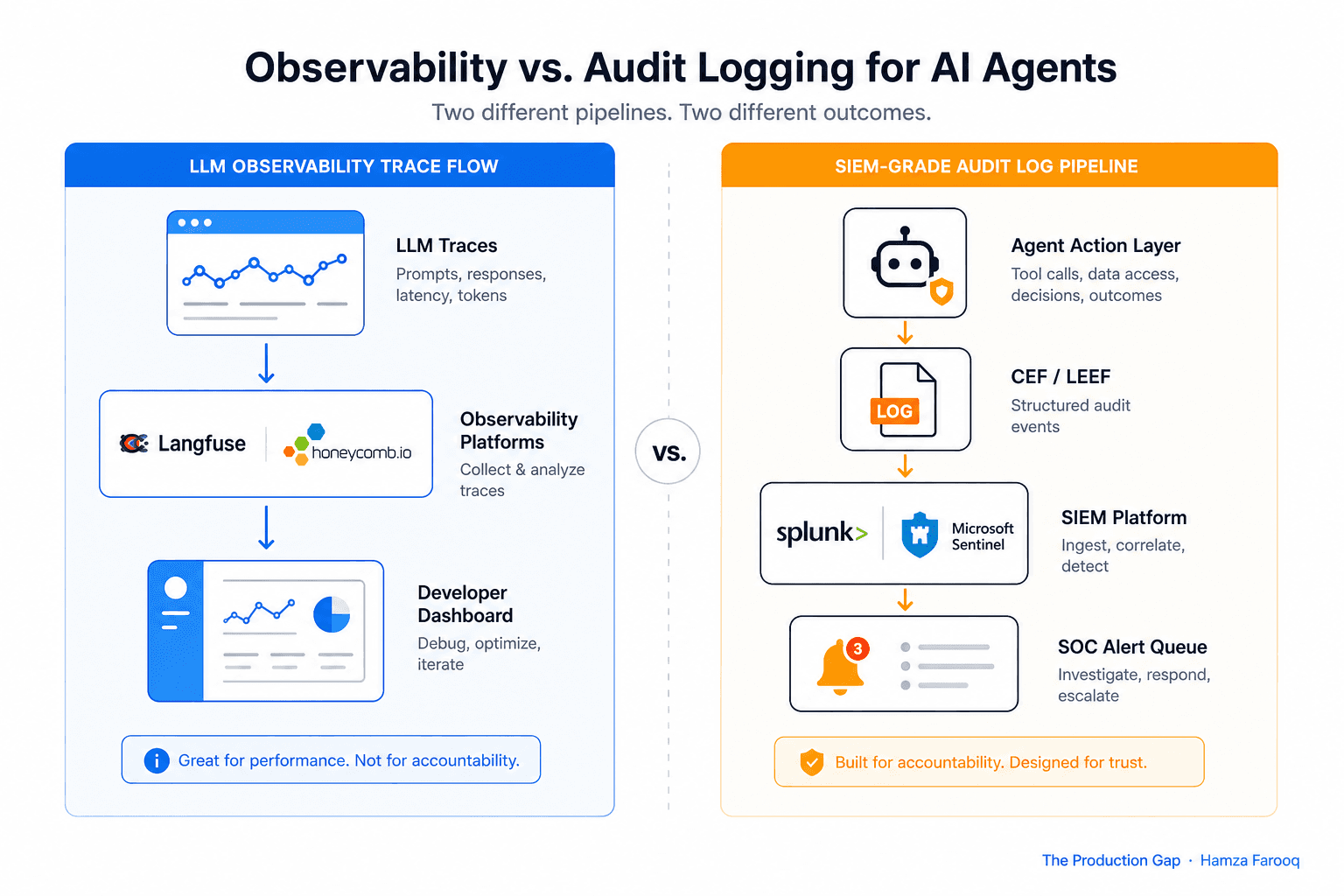
TL;DR: AI agent audit logging splits into two disciplines: LLM-trace observability captures latency and prompt chains for debugging; compliance-grade SIEM integration produces tamper-evident, identity-attributed records that survive an audit or incident investigation. Regulated environments require SIEM from day one, retrofitting it creates legal and security gaps no observability tool can close.
Key takeawaysObservability traces are not audit logs: Langfuse and Honeycomb capture performance data, not tamper-evident, identity-attributed records a security team requires.Wire SIEM in on day one: Retrofitting compliance-grade logging forces expensive architectural changes most enterprise clients will not wait for.Log at the action layer: Every tool invocation, permission escalation, external API call, data read or write, and decision branch point must be a discrete, attributable event.Logging gaps block enterprise deals: Default agent output consistently fails what regulated clients' security teams require.
Does the question your logging answers match the question your auditor is asking?
Security teams distinguish immediately between a developer trace and a compliance-grade audit pipeline (and that distinction determines whether your deployment clears procurement or stalls it. Google's 24/7 agents analyze data and take consequential action today. These systems assess loans, triage patients, and execute decisions inside regulated enterprises) the categories that trigger HIPAA and FCRA obligations.
One log is a debugging tool. The other is a legal record. The gap produces blocked deployments, failed SOC 2 audits, and incidents with no defensible chain of custody. Closing it is an architectural decision that must happen before you write the first tool call.
What is the actual difference between LLM observability and compliance audit logging?
LLM observability traces capture latency, token counts, and prompt-response chains for developer debugging. Compliance audit logs capture identity-attributed, tamper-evident records of consequential actions that a SOC can ingest, alert on, and produce during an audit.
Langfuse and Honeycomb answer: why did the model behave that way? SIEM audit logs answer: who authorized this action, on what data, and can we prove the record has not been altered?
A tool call to a patient records API shows the gap. A Langfuse trace captures it as a span, input, output, latency. A SIEM-grade log captures it as a discrete signed record: agent identity, user session principal, exact PHI field accessed, UTC timestamp, and a hash linking it to adjacent events. One tells a developer why the call was slow. The other tells a HIPAA auditor whether the access was authorized.
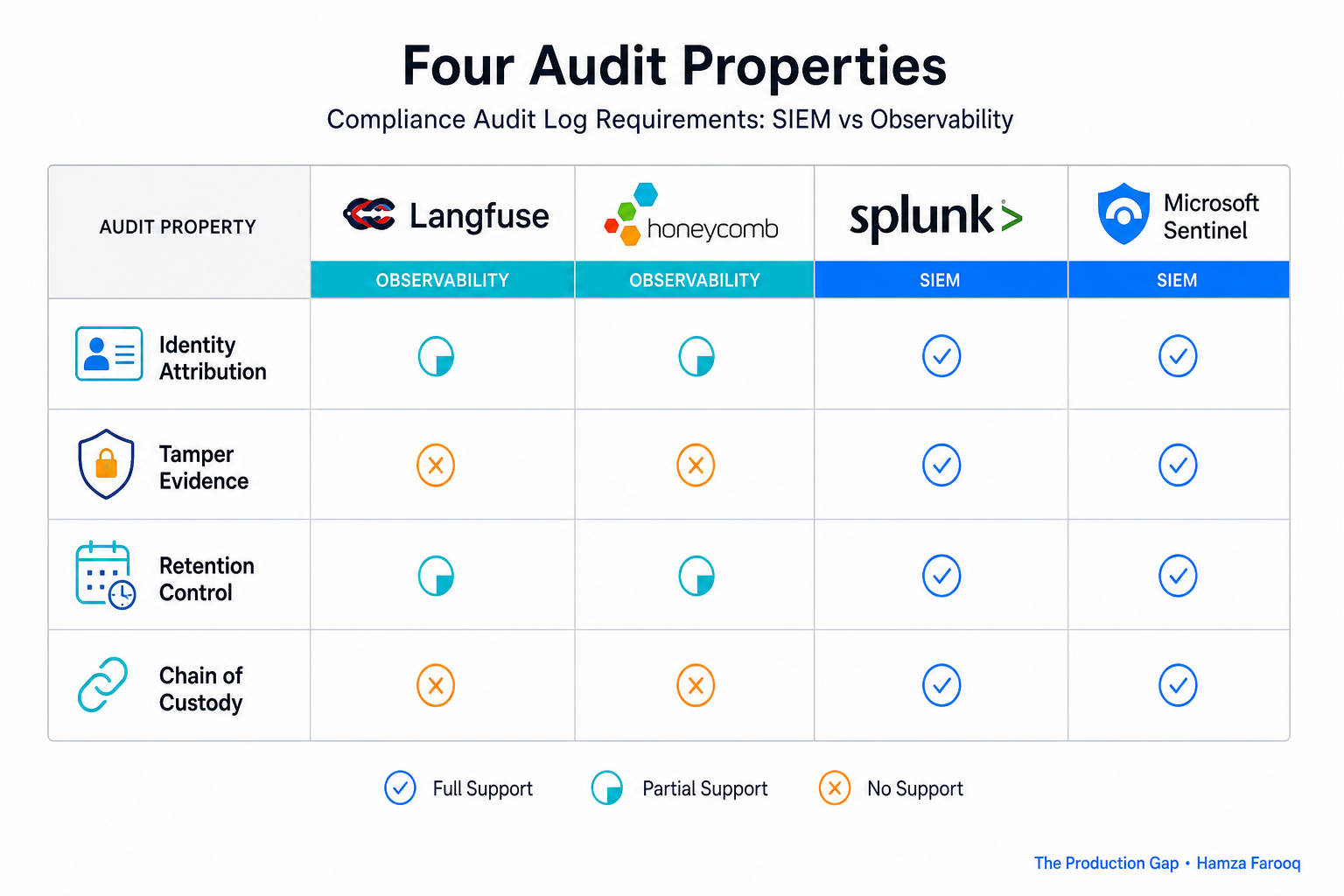
The Four Audit Properties framework defines minimum criteria for compliance-grade evidence: (1) Identity Attribution, every event tied to an actor and principal; (2) Tamper Evidence, cryptographic chaining or WORM storage; (3) Retention Control, enforced minimum windows per applicable regulation; (4) Chain of Custody, sequential event ordering that survives export. Observability tools are not designed to satisfy these properties, that is a scope statement, not a criticism.
| Audit Property | Langfuse | Honeycomb | Splunk (SIEM) | Microsoft Sentinel |
|---|---|---|---|---|
| Identity Attribution | Not a design goal | Not a design goal | Required field | Required field |
| Tamper Evidence | Mutable trace store | Mutable trace store | WORM or signed | Immutable workspace |
| Retention Control | Manual or plan-limited | Manual or plan-limited | Policy-enforced | Policy-enforced |
| Chain of Custody | Span-based, not sequential | Span-based, not sequential | Indexed event order | Indexed event order |
| SOC 2 or HIPAA admissible | No | No | Yes | Yes |
"We have traces" and "we have an audit trail" are not the same sentence. Your client's security team knows the difference on sight.
What specific events must an AI agent emit for SOC and compliance visibility?
An AI agent must emit discrete, attributable log events for every tool invocation, permission escalation, external API call, data read or write, and decision branch point, each tied to an actor identity and session principal, not buried in a prompt-response trace.
Most frameworks instrument the LLM layer. The SOC needs events at the action layer. The TPEDA Event Schema (author synthesis) defines the minimum categories a compliance-grade agent log must cover:
- Tool invocations, which tool, which parameters, which session. Detects unexpected capability use.
- Permission escalations, any request for elevated scope or credential. Enables privilege-abuse detection.
- External API calls, destination, method, response code. Enables data-exfiltration and lateral movement detection.
- Data reads and writes, record ID, classification level, field names. Required under HIPAA and PCI-DSS.
- Decision branch points, when the agent chose between paths or invoked a sub-agent. Provides the behavioral auditability a regulator will demand.
Why does retrofitting SIEM logging after deployment create an architecture problem, not a configuration task?
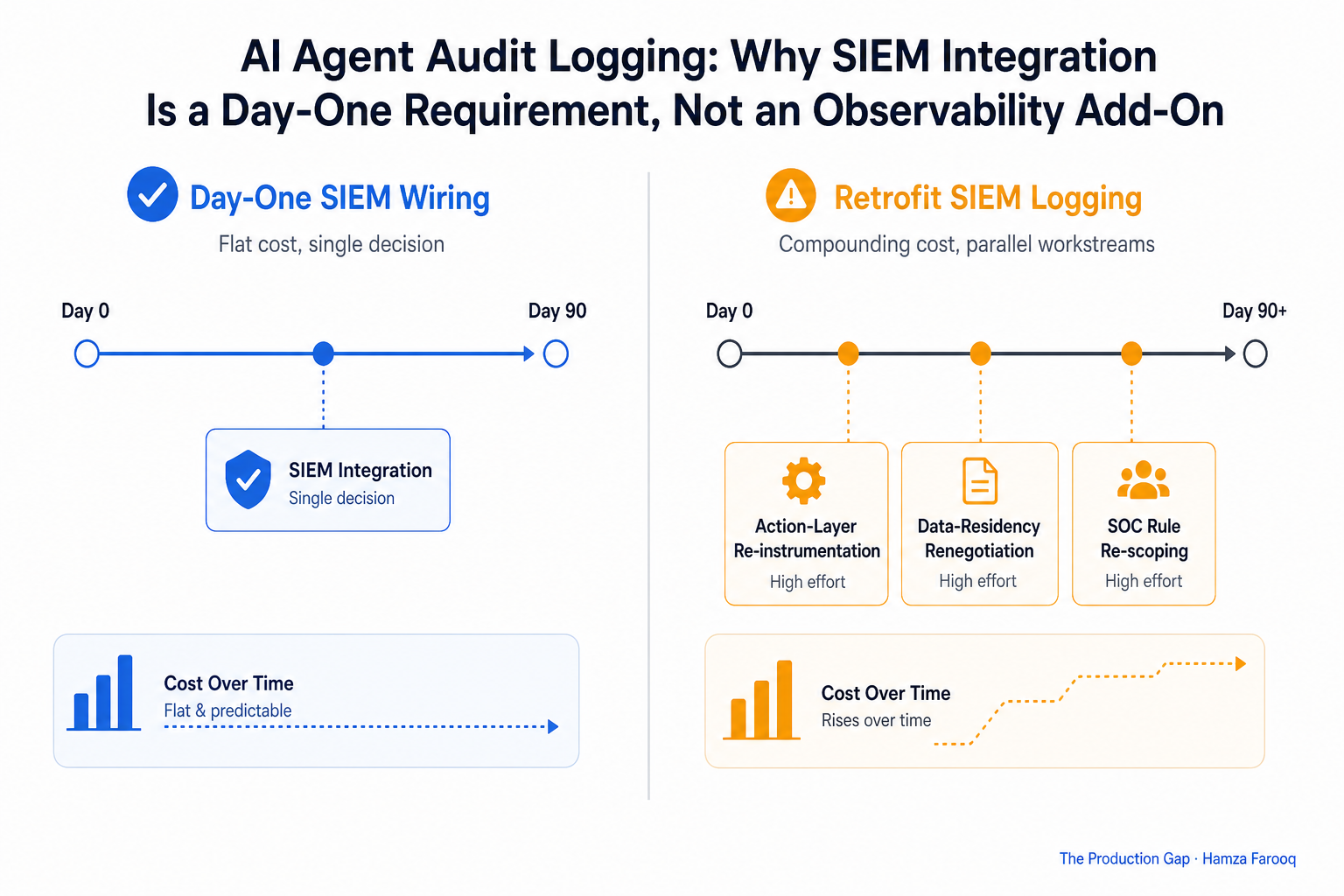
Retrofitting SIEM-grade audit logging into a deployed agent requires re-architecting event emission at the action layer, renegotiating data-residency requirements, and re-scoping SOC detection rules, three parallel workstreams on a timeline you do not control.
Re-architecting event emission is not a pull request (adding hooks at every tool call and data access point across live integrations is a substantial engineering effort. Data-residency renegotiation pulls legal and procurement back into a project everyone considered closed; a Langfuse-hosted log stream is not automatically acceptable for routing to an on-premises Splunk instance or a specific Sentinel Azure region. SOC detection rule re-scoping runs entirely outside your control) the client's SOC must map, test, and validate every new event type against their existing schema.
Building the TPEDA event schema and a format transformation layer at project start avoids all three workstreams becoming a blocking retrofit.
What log format and transport do SIEM platforms actually require from an AI agent?
SIEM platforms require structured, field-validated log formats (not raw JSON) and a SOC engineer receiving unformatted agent output must build a parser, map field names, validate required fields, and establish source trust before a single alert fires.
The fix is a thin, stateless transformation layer wired at the action layer on day one: receive TPEDA events, stamp the required format headers, forward via syslog over TLS or HTTP Event Collector. Built at project start, it is a contained effort. Built as a retrofit, it is a blocking workstream.
Frequently asked questions
What is the difference between AI agent observability and AI agent audit logging for compliance? Observability captures developer-facing performance data, latency, token counts, prompt chains. Compliance audit logs capture identity-attributed, tamper-evident action records formatted for SIEM ingestion. They answer different questions for different audiences and cannot substitute for each other in a regulated environment.
Why can't Langfuse or Honeycomb traces substitute for SIEM-grade audit logs? Using the Four Audit Properties framework, observability tools are not designed to provide identity attribution, tamper evidence, enforced retention, or chain of custody, properties that disqualify them as legal evidence or reliable SOC alert sources.
How do I integrate an AI agent's action logs into Splunk or Microsoft Sentinel? Build a stateless transformation layer at the action layer that converts TPEDA events to the required SIEM format and forwards them via syslog over TLS or an HTTP Event Collector endpoint. Do not route compliance events through the LLM observability layer.
What events must an AI agent log to satisfy a SOC 2 or HIPAA audit? Every tool invocation, permission escalation, external API call, data read or write on covered records, and decision branch point, each stamped with actor identity, session principal, UTC timestamp, and sequential event ID. HIPAA additionally requires field classification and authorization context for any PHI access.
Conclusion
The observability-versus-audit-log gap is an incentive problem as much as a technical one. Observability ships fast and satisfies the stakeholders in the room. SIEM integration stays invisible until the audit or the incident, at which point you are managing three parallel retrofit workstreams on a timeline you do not control.
The TPEDA schema and a format transformation layer are a contained engineering effort on day one. AI agents are already taking consequential decisions inside regulated enterprises, which means the audit obligations are active now.
Your agent can do everything the demo promised, but it will not reach production in a regulated environment until the SOC can see what it is doing.
Add SIEM log destination, event schema, and format requirements to your project discovery checklist as a day-one infrastructure decision, not a post-MVP ticket.
Learn from me
Forward Deployed Engineering Bootcamp for Full-Stack Developers, my Maven cohort. Build and ship complete AI products end to end, from React and Node.js frontends to deployed models with caching and observability. Join the next cohort →
Hire us
Traversaal.ai. We're a team of forward deployed engineers solving the toughest AI problems for Fortune 100 companies: document intelligence, agentic data platforms, and real-time web intelligence, deployed in production. Work with our team to deploy your next agentic ecosystem. Talk to Traversaal.ai →
Join us
Want to solve these problems with us? We're always looking for forward deployed engineers who want to ship production AI. jobs@traversaal.ai
