
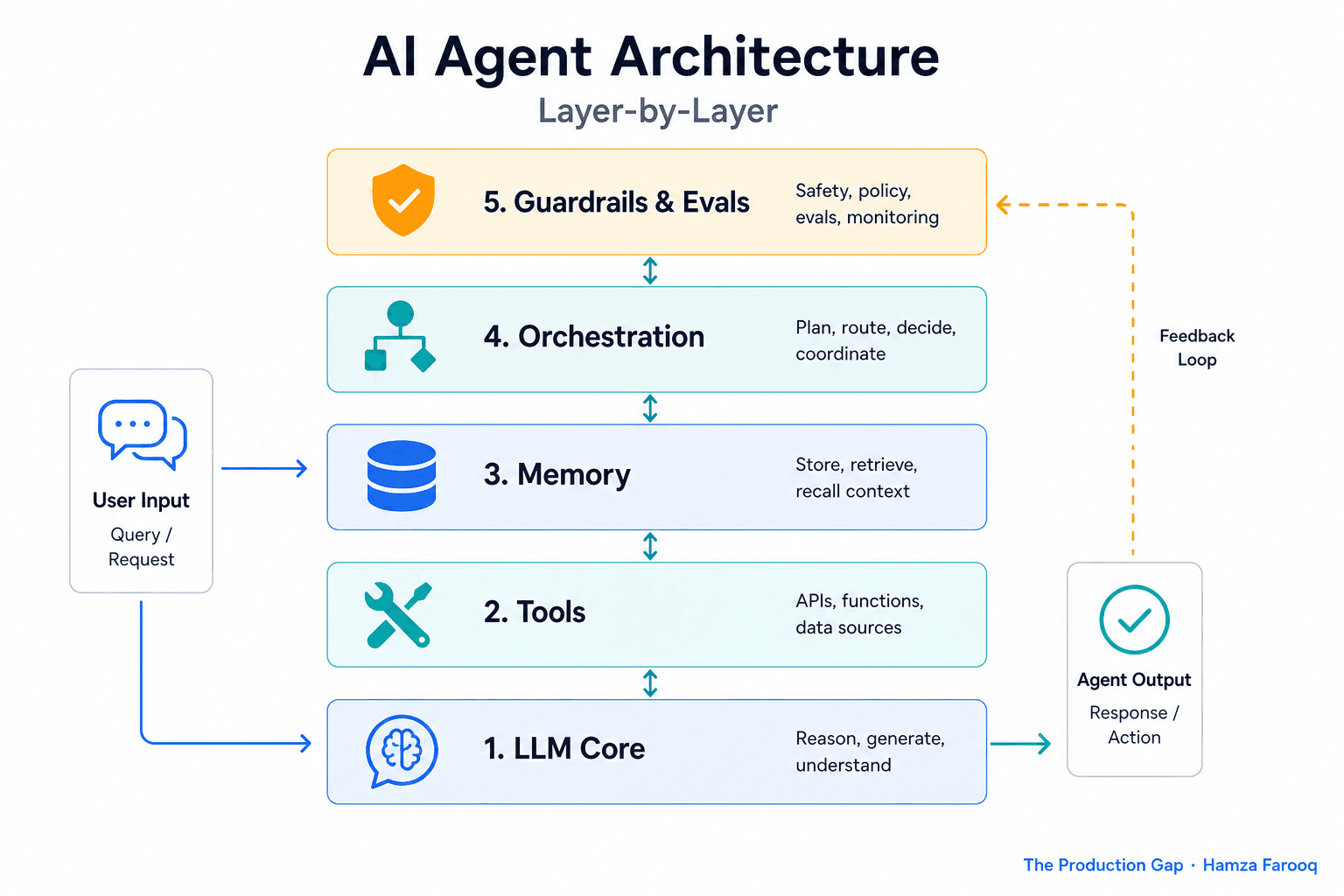
TL;DR: AI agent architecture explained comes down to six stacked layers: a foundation model that reasons, tools that act on the world, memory that persists context, an orchestration loop that plans multi-step tasks, guardrails that enforce boundaries, and evals that catch failures before users do. Product managers who understand how these layers interact can scope features accurately and prevent costly production surprises.
Key Takeaways
- The LLM is just one layer: The model handles reasoning, but a working agent also needs tools, memory, and safety controls.
- Tools are how agents act: Without APIs, databases, or search, an agent can only talk, it cannot change anything.
- Memory has hard limits: Context windows fill up fast; long-term memory requires deliberate design choices.
- Orchestration determines complexity: Single-agent loops work for simple tasks; multi-agent pipelines enable complex workflows and multiply debugging surface area.
- Guardrails and evals solve different problems: Guardrails block bad outputs in real time; evals measure whether the agent is doing the right thing over time.
- Architecture gaps cause post-launch failures: Scoping memory, tool reliability, and safety layers early reduces the risk of failures that surface only after launch.
Why does AI agent architecture matter for product managers?
Product managers who cannot describe how the six layers of an AI agent interact will struggle to scope features accurately, challenge timelines with evidence, or diagnose failures after launch.
Most PMs can describe what an AI agent does. The ones who get sidelined in architecture reviews cannot explain why it failed, and the answer is almost never the model.
Google Cloud publishes architectural guidance for choosing agentic AI components, a signal that these are mainstream PM concerns now, not research experiments. IBM defines agentic architecture as the structural approach that shapes how AI models are automated within a system. The gap between demo-quality agents and production-reliable ones lives almost entirely in the layers most PMs never learn to discuss. This guide uses the Agent Stack mental model (model, tools, memory, orchestration, guardrails, and evals) so you can scope accurately, challenge timelines with evidence, and stop nodding along in architecture reviews.
What are the six core layers of an AI agent, and what does each one actually do?
Think of it as a person at a whiteboard. The LLM is the thinking layer. But thinking without hands does not ship anything, and every other layer gives the model hands, memory, guardrails, and a manager.
Layer 1 - Foundation model (LLM): The reasoning core. It interprets instructions, plans steps, and selects which tool to use next. Swapping models is rarely the fix when something breaks in production.
Layer 2 - Tools: The action layer, APIs, database queries, web search, code execution. Without tools, the agent can only generate text.
Layer 3 - Memory: The context layer, covering both the active session window and any long-term storage the system retrieves across sessions. This layer has hard limits; more on those below.
Layer 4 - Orchestration: The coordination layer, governing how the agent moves through a reasoning-action cycle and, in multi-agent systems, how sub-agents hand work to each other.
Layer 5 - Guardrails: The safety layer, real-time filters applied to inputs and outputs before users are affected.
Layer 6 - Evals: The measurement layer, the structured process for determining whether the agent is doing the right thing at scale and over time.
Each layer has its own failure mode, build cost, and owner. Treating any of the six as optional is a scope decision with direct business risk consequences, and this framework used in this guide names all six so that none can be quietly deferred.
When should you use a single-agent loop vs. a multi-agent pipeline, and why does it matter for scoping?
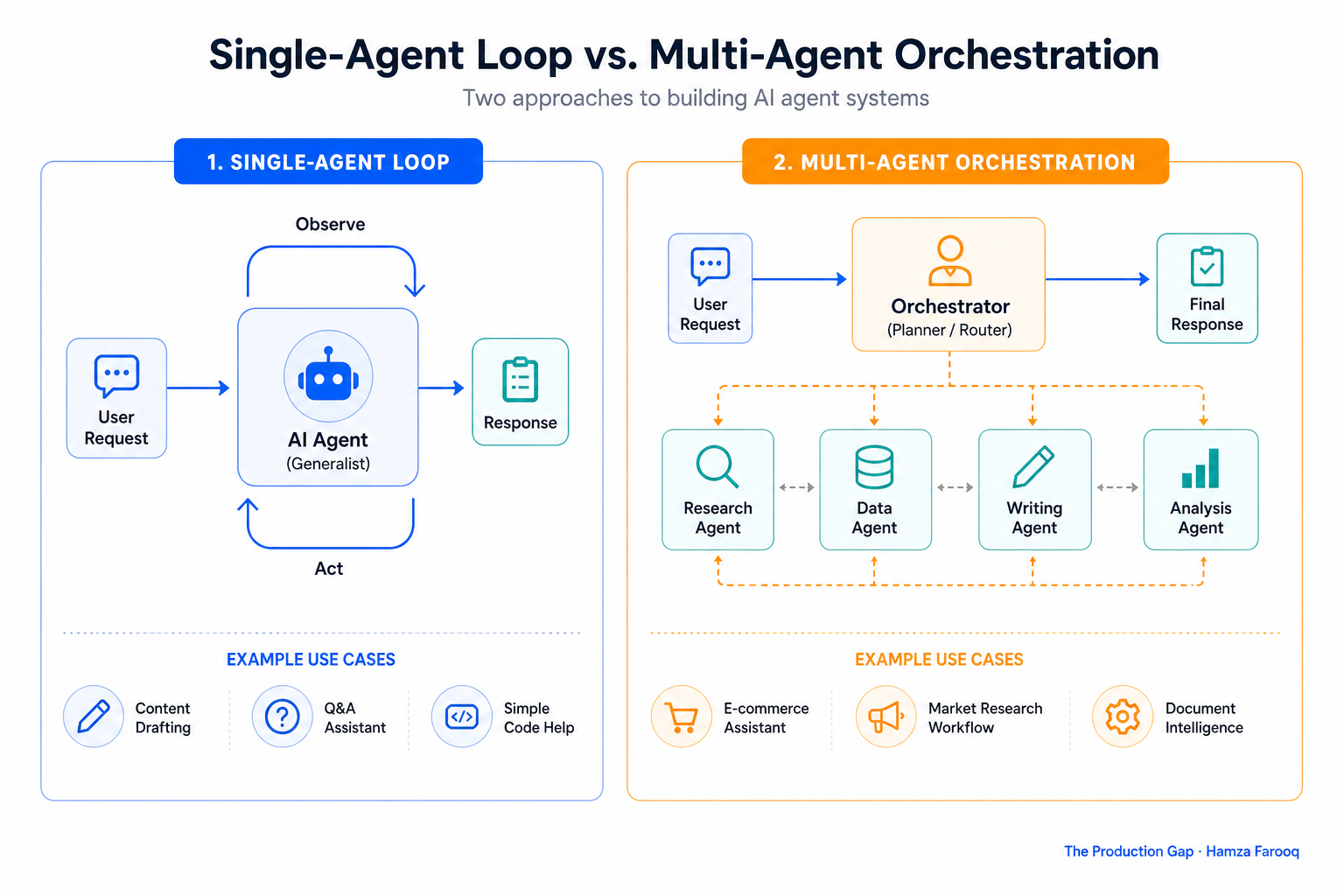
A single-agent loop handles one task end-to-end; a multi-agent pipeline assigns specialized sub-agents to distinct steps, which enables more complex workflows but multiplies debugging surface area and latency in ways that directly affect sprint scope.
Galileo describes AI agent architecture as "the structural blueprint determining how autonomous systems perceive, think, and act," and that blueprint looks fundamentally different at each orchestration tier.
Agent Orchestration Patterns, Author Synthesis
| Pattern | Best for | Complexity | Failure mode |
|---|---|---|---|
| Single-agent loop | Contained, single-domain tasks (e.g., summarize a document) | Low | Prompt drift, context overflow |
| Multi-agent pipeline | Multi-step workflows with distinct sub-tasks (e.g., research, then draft, then QA) | Medium to High | Inter-agent miscommunication, compounding errors |
| Hierarchical agents | Enterprise workflows with routing logic across many domains | High | Orchestrator failure cascades to all sub-agents |
Multi-agent architectures are not always better. They make sense when sub-tasks are genuinely separable and when you have evaluation infrastructure to monitor each agent independently. In a research-to-report workflow, a misrouted handoff from the orchestrator can compound silently across all three agents before a human sees the output, a failure mode that does not exist in a single-agent loop. Match orchestration complexity to task complexity and default to the simpler pattern until evidence demands otherwise.
Why do guardrails and evals deserve earlier scoping than most teams give them, and how should PMs approach both?
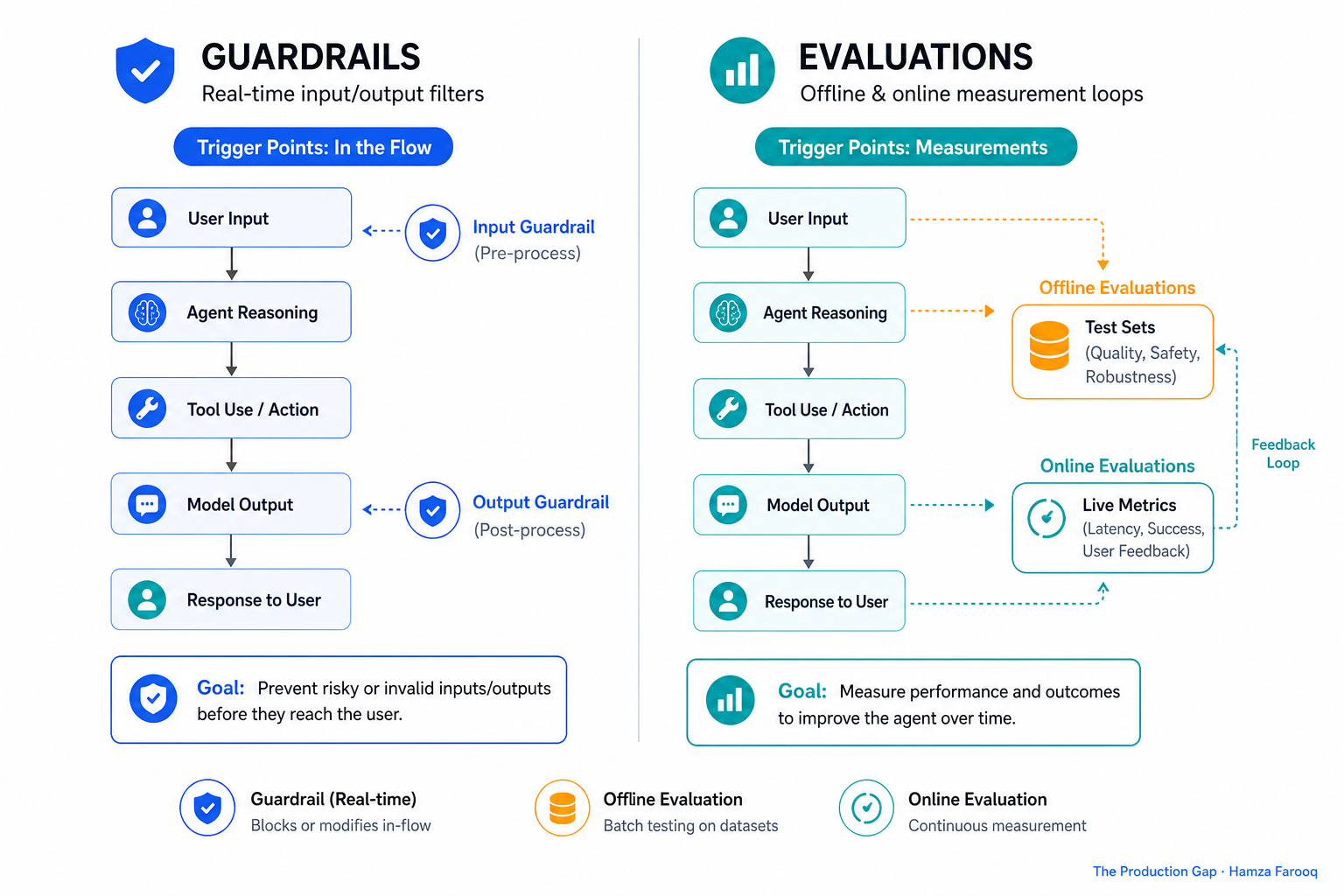
Guardrails are real-time filters that block bad outputs before users see them; evaluations measure whether the agent is doing the right thing at scale, and treating either as a post-launch concern is a scope decision with direct business risk consequences.
An agent works in a demo because sessions are short and inputs are clean. In production, inputs are messy, sessions run long, and edge cases appear, typically before anyone has instrumented a way to detect them.
Guardrails operate at two points. Input filters block jailbreaks, PII exposure, and off-topic queries before they reach the model. Output filters check responses for toxicity, hallucination markers, and policy violations before delivery.
The question worth raising in every architecture review is not "which model are we using?" but "what is our evaluation strategy, and who owns it?"
FAQ
Q1: What is the simplest way to explain AI agent architecture to a non-technical stakeholder?
An AI agent is a language model given hands and a memory. The model thinks, tools let it act, memory preserves context, orchestration sequences the steps, and guardrails keep it safe. Every production agent needs all six layers to be reliable.
Q3: What is the difference between single-agent and multi-agent orchestration, and how does it affect my PRD?
Single-agent and multi-agent orchestration represent distinct levels of system complexity that map directly to different PRD scope requirements. A single-agent loop runs one model through a reasoning-action cycle for a contained task and is faster to scope and easier to debug. A multi-agent pipeline chains specialized sub-agents under an orchestrator and requires evaluation infrastructure for each agent independently. Default to single-agent until task complexity genuinely demands otherwise.
Q4: How do I push back on a launch timeline when I think evals have not been properly scoped?
Ask two questions in the architecture review: "What is our ground-truth dataset?" and "What accuracy threshold defines a successful launch?" If the team cannot answer both, evals have been deferred rather than scoped. Frame that gap as an unresolved acceptance criterion in the PRD, not as technical debt, so it is visible to stakeholders before the timeline is locked.
Conclusion
An AI agent is a six-layer system, and each layer has its own failure mode, build cost, and owner. Scoping memory constraints, tool integration reliability, guardrails, and evaluation strategy early, rather than treating any of the six as post-launch concerns, is where production readiness is actually determined.
The PMs driving agent roadmaps walk into architecture reviews and ask: which tools does this agent have access to, and what happens when one fails? How does memory degrade over a long session? What is our eval strategy, and who owns it? Those questions do not require a CS degree. They require the six-layer Agent Stack mental model this guide has laid out.
Your next step: Add one section to your current agentic feature PRD: "Evaluation Strategy and Acceptance Criteria." Define what correct behavior looks like, how you will measure it, and who monitors it after launch. That single addition will do more for your roadmap's reliability than any model upgrade.
Learn from me
Agentic AI for Product Managers, my Maven cohort. Learn how to design, evaluate, and ship reliable AI systems: the technical fluency PMs need to lead agentic products, no engineering background required. Join the next cohort →
Hire us
Traversaal.ai. We're a team of forward deployed engineers solving the toughest AI problems for Fortune 100 companies: document intelligence, agentic data platforms, and real-time web intelligence, deployed in production. Work with our team to deploy your next agentic ecosystem. Talk to Traversaal.ai →
Join us
Want to solve these problems with us? We're always looking for forward deployed engineers who want to ship production AI. jobs@traversaal.ai
