
Introduction
TL;DR: Agentic web search infrastructure requires crawling freshness layers, source trust scoring, and deduplication at scale because classic RAG pipelines structurally fail on the open web across three axes: stale indexes return outdated facts, adversarial content poisons retrieval without trust filtering, and web-scale document volumes overwhelm pipelines built for curated corpora. These concrete primitives replace RAG's static assumptions with systems designed for a living, hostile, and massive information environment.
Quick answer: Classic RAG pipelines fail on the open web because they assume a trusted upstream curator. Agentic web search infrastructure replaces that assumption with three explicit primitives: crawl-time freshness capture, source trust scoring, and semantic deduplication at web scale.
Verified context: IT infrastructure is defined as the hardware, software, and networking components enterprises rely on to effectively manage and run their IT environments, establishing that infrastructure is a system-level concern encompassing multiple interdependent components, a framing directly applicable to the layered stack required for agentic web search.
Key Takeaways
- Classic RAG fails on the open web because it lacks crawl-time trust metadata. The pipeline encodes an implicit curator that the open web does not provide.
- Staleness is a structural defect, not a tuning problem. Without a freshness layer, agents surface outdated content as current fact because the index captures no recency signal.
- Web-scale deduplication requires fundamentally different tooling than enterprise RAG. Billions of live pages, mirrors, and scraped reposts cannot be handled by the syntactic methods that work across thousands of internal documents.
- Agentic retrieval requires three primitives absent from classic RAG: crawl freshness capture, provenance tracking, and pre-index adversarial filtering.
- Silent failure is the most operationally costly property of this mismatch. A poisoned or stale retrieval returns a high-confidence result; the agent proceeds and the failure propagates without a logged warning.
- Migration should start at the crawl layer, not the retrieval layer. Patching the retriever leaves the trust-assumption collapse intact.
Why Does Classic RAG Structurally Fail on the Open Web?
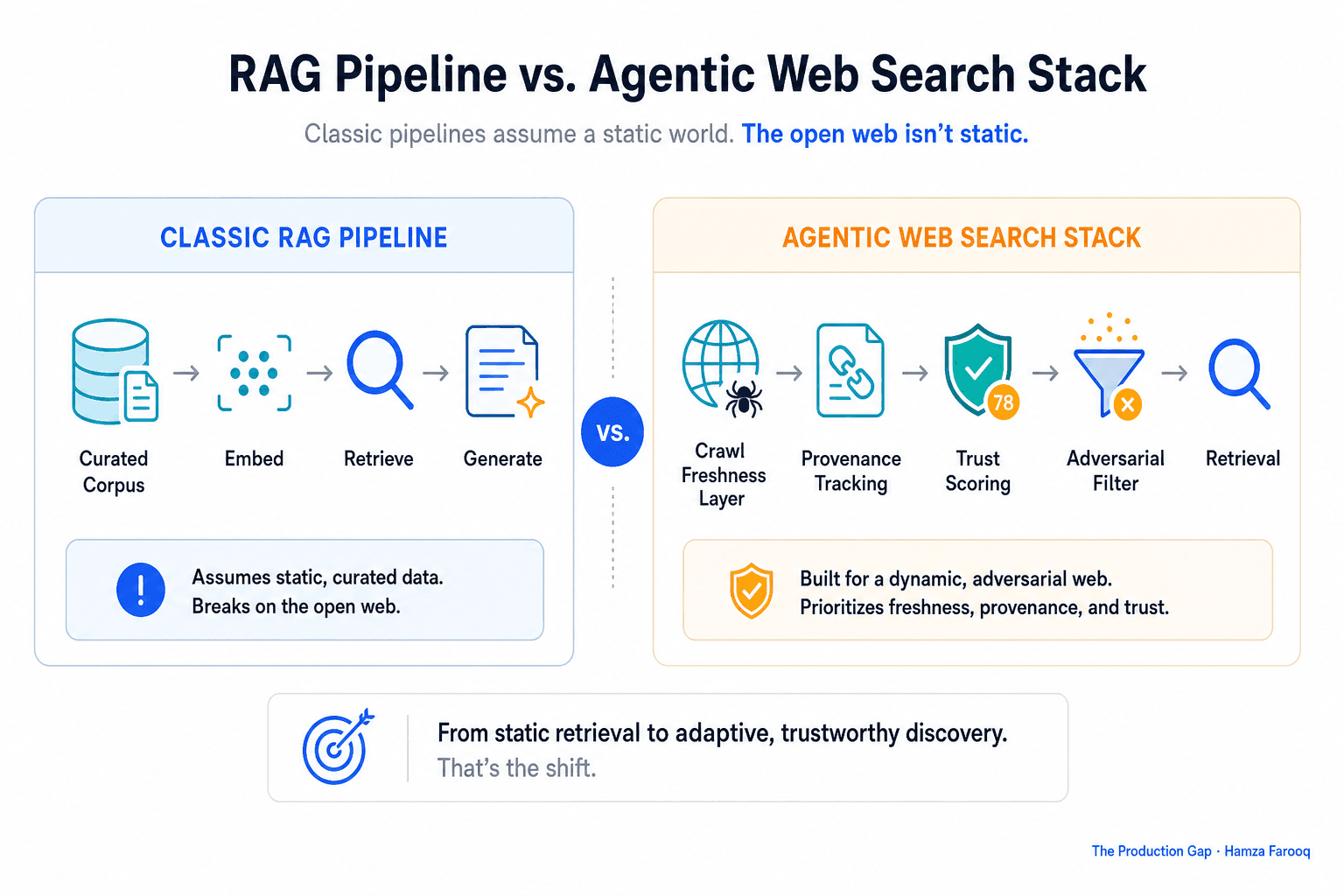
Classic RAG fails on the open web because it was designed around an implicit trusted upstream curator, an assumption that collapses the moment the corpus becomes the live internet.
Classic RAG was built for bounded, human-curated document sets. The embedding index encodes that trust as a given. Replace the curated corpus with the open web and you lose the entire trust model, and nothing in the standard pipeline detects that loss.
Staleness is the first failure axis. A document embedded at crawl time carries no signal about age relative to query time. An agent researching a live regulatory change will retrieve the highest-cosine-similarity chunk, possibly months stale, and cite it as current fact.
What Infrastructure Primitives Does Agentic Web Search Actually Require?
Crawling freshness layer: Capture publication timestamp, last-modified headers, crawl-recency delta, and change-velocity signal as first-class metadata. Agents can then apply freshness-weighted retrieval, deprioritizing documents whose recency falls below a threshold relative to the query's temporal sensitivity.
Source trust scoring: In this guide's framework, trust scoring should happen at crawl time and update dynamically rather than being applied only at query time. Useful signals may include domain authority trajectory, citation graph provenance, and content structure anomaly detection, though the specific signals teams weight will depend on their domain and threat model. A domain's score should degrade when adversarial patterns appear at re-crawl, regardless of historical reputation.
Web-scale deduplication: Enterprise RAG handles near-duplicates across thousands of documents. Web-scale deduplication runs the same problem across billions of pages, including mirrors, scraped reposts, and content multiplied to inflate retrieval frequency. Syntactic deduplication addresses surface-level copies; semantic deduplication collapses pages with different surface text but identical factual claims into a single retrievable unit.
Table 1: Classic RAG vs. Agentic Web Search Infrastructure, Feature Comparison
| Dimension | Classic RAG (curated corpus) | Agentic web search infrastructure |
|---|---|---|
| Trust model | Implicit (curator upstream) | Explicit (computed per source, per crawl) |
| Freshness signal | None (static index) | Freshness-weighted, crawl-time captured |
| Deduplication scope | Thousands of docs, syntactic | Billions of pages, semantic and syntactic |
| Adversarial threat model | Not designed for | First-class filter at crawl and retrieval |
| Provenance tracking | Optional metadata | Required pipeline primitive |
| Failure mode | Silent high-confidence error | Logged, scored, routable |
These three primitives do not enhance a RAG pipeline. They replace architectural assumptions RAG never made explicit.
How Should Teams Migrate from Classic RAG to Agentic Web Search Architecture?
Patching tends to address symptoms while leaving the trust-assumption collapse intact. A query-time spam classifier still operates on documents that entered the index without provenance metadata.
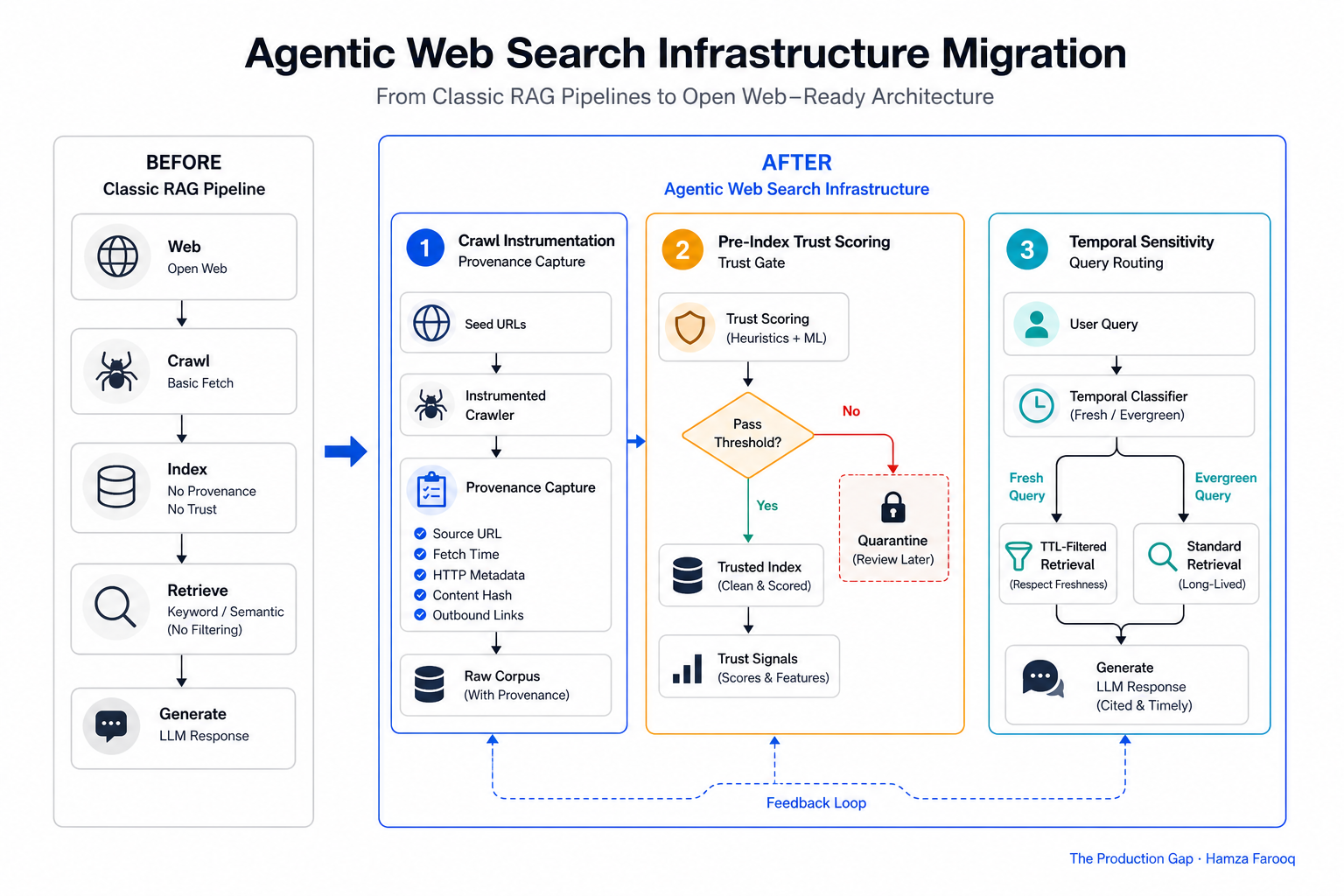
Step 1, Instrument the crawl, not the retriever: Capture provenance signals at crawl time: source domain, crawl timestamp, change-velocity, HTTP headers, link graph position, and content structure fingerprint. Store these as indexed, queryable fields, not free-text footnotes.
Step 2, Introduce trust scoring as a pre-index gate: Documents below a configurable trust threshold should not enter the primary retrieval index. Quarantine them in a secondary index so they cannot silently compete with trusted documents on similarity alone. This change targets the largest class of adversarial content failures at the point before they can reach retrieval.
Step 3, Add temporal sensitivity classification at the query layer: Classify each incoming query as time-critical or time-stable. Route time-critical queries through a freshness-filtered path that hard-excludes documents beyond a defined recency threshold; route time-stable queries through the broader index with freshness as a soft re-ranking signal.
A practical rule of thumb worth noting: high-traffic domains can still contain documents with adversarial structural characteristics. Domain-level trust is a coarse proxy, which is why document-level scoring is worth treating as a required primitive rather than an optional enhancement.
Frequently Asked Questions
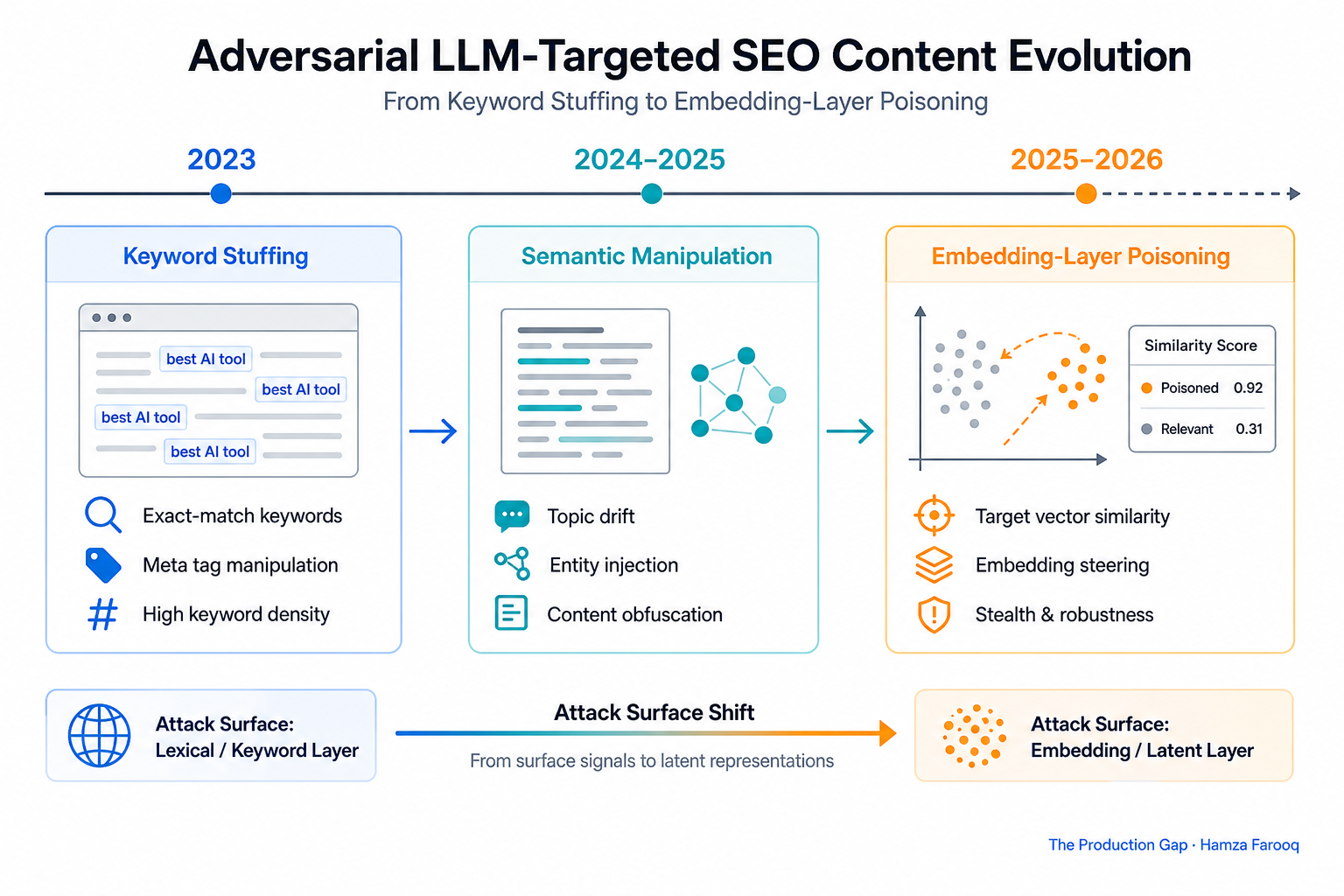
Q: What specific failure modes emerge when a RAG pipeline indexes live web content? Stale content is retrieved with high confidence because the index captures no freshness signal. Adversarially optimized content can outscore accurate content because similarity is not a truth signal. Both failures are silent: the pipeline returns a confident answer with no logged warning.
Q: How should source trust scores be computed and updated for open-web retrieval? Compute trust scores at crawl time from signals such as domain authority trajectory, citation graph provenance, and content structure anomaly detection. Update scores at re-crawl. As a practical rule of thumb in this guide's framework, a domain's score should degrade automatically when adversarial patterns appear, regardless of historical reputation.
Q: How do you detect adversarially optimized content at retrieval time? Detection should happen at crawl time using content structure fingerprinting and anomaly signals, with retrieval-time classifiers serving as a secondary filter rather than the primary defense. Retrieval-time-only detection means adversarial documents have already entered the index and can influence results before any classifier runs.
Q: What does a purpose-built agentic web search stack look like compared to a classic RAG pipeline? Classic RAG flows from corpus ingestion to embedding to vector storage to retrieval to generation, with trust implicit in the corpus. Agentic web search inserts three layers before the vector store: crawl freshness capture, a pre-index trust scoring gate, and semantic deduplication. Retrieval then operates on a corpus with explicit, queryable trust metadata rather than inherited curatorial assumptions.
Conclusion
This problem is easy to miss because failure is indistinguishable from success at the surface: the agent returns an answer with citations and high similarity scores. Agentic web search is not primarily a retrieval engineering problem. It is a trust arbitration problem. Classic RAG deferred that arbitration to a human curator; when the open web becomes the corpus, that deferral has nowhere to land.
Before extending any pipeline to live web retrieval, audit for three structural absences: crawl-time provenance capture, pre-index trust scoring, and semantic deduplication. If any one is missing, the agent is operating on a trust model the open web has already broken.
Learn from me
Agent Engineering Bootcamp: Developers Edition, my Maven cohort. Advanced agentic RAG, multi-agent orchestration, memory, evals, and guardrails. Take agents from prototype to production. Join the next cohort →
Hire us
Traversaal.ai. We're a team of forward deployed engineers solving the toughest AI problems for Fortune 100 companies: document intelligence, agentic data platforms, and real-time web intelligence, deployed in production. Work with our team to deploy your next agentic ecosystem. Talk to Traversaal.ai →
Join us
Want to solve these problems with us? We're always looking for forward deployed engineers who want to ship production AI. jobs@traversaal.ai
