
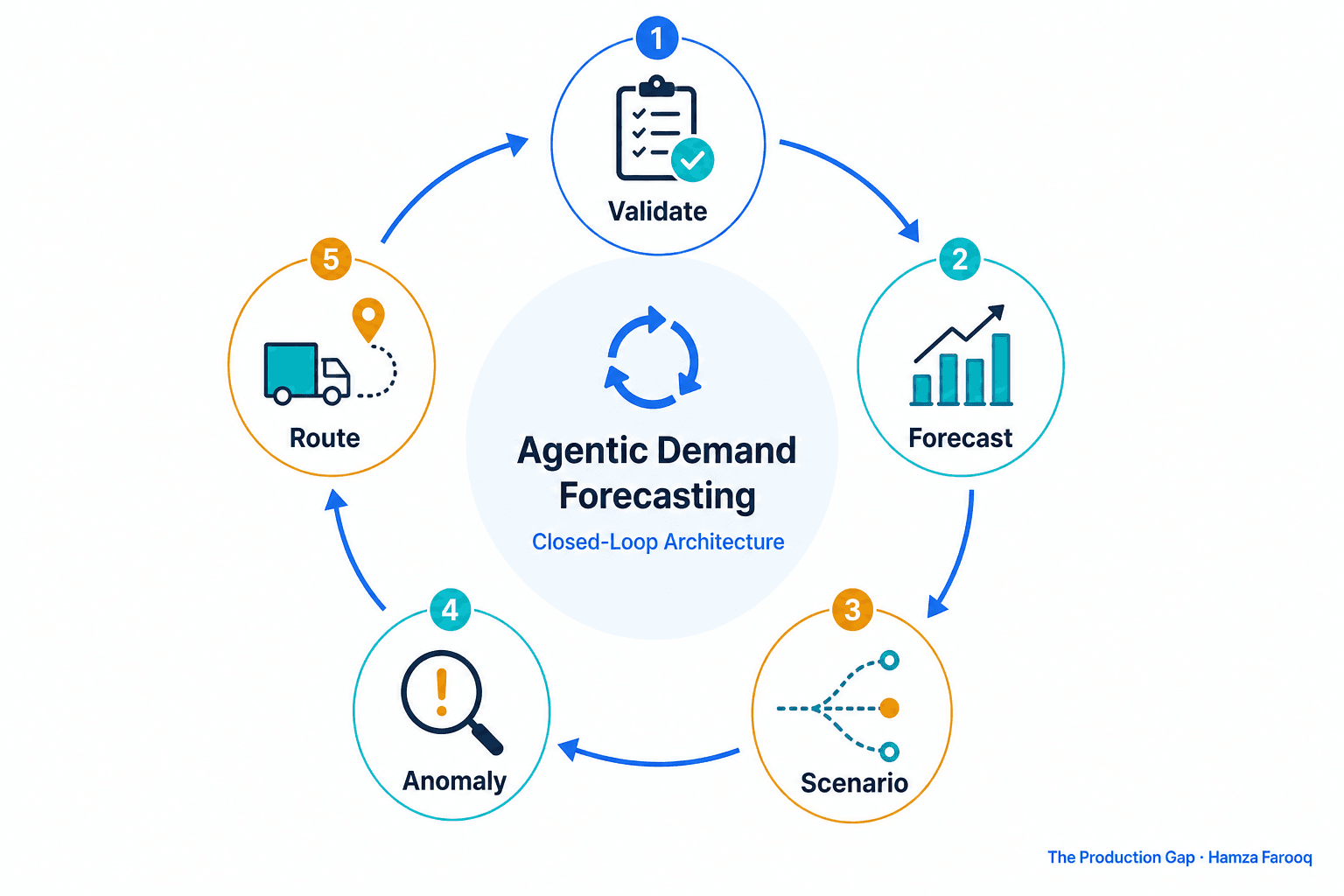
TL;DR: Agentic demand forecasting replaces static point forecasts with a self-correcting closed loop that continuously validates incoming data, generates probabilistic forecasts, models scenarios, flags anomalies, and routes decisions to the right systems or humans. This architecture eliminates the lag and manual intervention that make traditional forecasting brittle, allowing enterprises to respond to demand signals in near real time without rebuilding models from scratch each planning cycle.
Key Takeaways
- Point forecasts are obsolete: volatile demand requires a continuous, self-correcting loop, not a monthly number.
- Validation is the first line of defense: bad inputs caught before forecasting never corrupt downstream output.
- Scenario planning is built into every cycle: multiple what-if projections replace the single best guess.
- Anomaly detection runs continuously: spikes and drops are flagged in near real time, not retrospectively.
- Exception routing keeps humans in the right seat: high-stakes exceptions escalate automatically; routine decisions resolve without intervention.
- The loop sharpens as it runs, cutting forecast error and response lag simultaneously.
Introduction
Agentic demand forecasting is an active area of enterprise adoption across retail and manufacturing supply chains, a pattern observable across published platform documentation and practitioner reporting rather than a measured market statistic. Platforms including Databricks, Accenture, ABM Cloud, and Fluid AI have each published documented approaches to running autonomous forecasting agents in operational contexts. Researchers and practitioners have begun formalizing the concept, describing agentic systems as capable of autonomous market sensing and adaptive planning at a scale that static models cannot match.
The critical question is not simply whether a forecast is more accurate, but whether the architecture can act on that accuracy within the decision window that matters. Agentic AI transforms static, reactive forecasting models into dynamic, autonomous systems, but only if the full loop is wired correctly. One stage accounts for most silent deployment failures, and it is not the one vendors typically lead with.
Why do point forecasts fail in volatile demand environments?
Three problems compound across any multi-node distribution environment: signal lag (forecasts built on stale data are wrong the moment they are generated); single-scenario blindness (one number hides all upside and downside risk); and manual override chaos (ad hoc corrections introduce bias that degrades the next training cycle). This is a structural failure, not a statistical one. Agentic AI continuously monitors signals across sales, seasonality, supplier lead times, and external factors, closing exactly the gap that monthly batch cycles leave open.
What are the five stages of an agentic demand forecasting loop and how do they work?
The five stages, Validate, Forecast, Scenario, Anomaly, and Route, run continuously, each feeding its output into the next to form a self-correcting cycle. The framework described here is an author synthesis based on published platform approaches and practitioner observation.
Validate: Every incoming signal is checked for gaps, outliers, stale sources, and conflicts before any forecast runs. ABM Cloud surfaces the capability to validate data and identify risks before promotions launch, so bad input caught at this stage never corrupts what comes next.
Forecast: Multi-signal ingestion replaces single-source batch pulls. Accenture's agentic supply chain practice embeds generative demand drivers into forecasting, pulling in POS data, supplier lead times, weather, and social sentiment together. Predictions update continuously rather than on a fixed monthly cycle.
Scenario: Rather than producing a single best-guess number, the loop generates optimistic, base, and pessimistic demand projections each cycle. This is a practical rule of thumb drawn from how multi-scenario planning is described across platform documentation; specific implementation details vary by vendor.
Anomaly: Continuous monitoring flags demand spikes, drops, or pattern breaks in near real time. Agents monitor sales signals continuously for autonomous market sensing. The loop does not wait for a human to notice something is wrong.
Route: The loop determines whether an anomaly requires automated handling or human escalation, to which role, and with what SLA. This is the stage most deployments underinstrument.
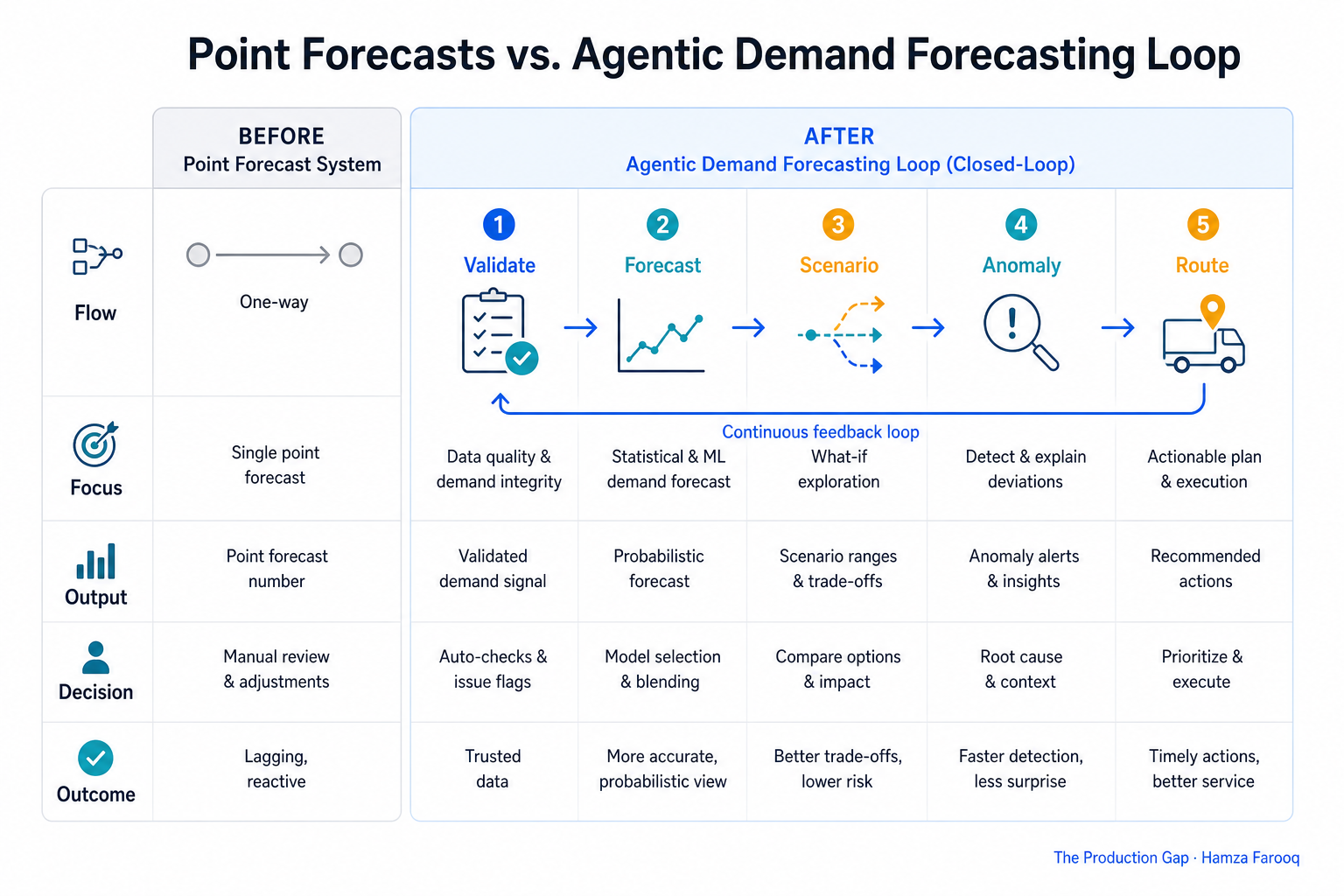
Table 1: Point-Forecast System vs. Agentic Loop, Stage-by-Stage Comparison
| Stage | Point-forecast system | Agentic loop |
|---|---|---|
| Validate | Manual data QA, pre-cycle | Continuous, automated signal checks |
| Forecast | Monthly batch, single number | Continuous, multi-signal, probabilistic |
| Scenario | Offline what-if (if at all) | Multi-projection planning built into every cycle |
| Anomaly | Detected retrospectively | Flagged in near real time |
| Route | Planner manually discovers issue | Structured escalation to defined owner |
The loop's value is not in any single stage. It is in the compounding feedback between all five. Remove one and the loop breaks.
What does the exception-routing stage actually look like in practice, and why do most deployments get it wrong?
Good exception routing requires three things, based on the framework used in this guide:
- Tiered escalation logic: A minor spike in a slow-moving SKU warrants a different response path than a large spike in a top-revenue item.
- Defined SLA per tier: Revenue-critical exceptions should carry a short, defined response window; lower-priority exceptions can queue to the next planning cycle.
- Closed-loop confirmation: The system logs whether the human acted and feeds that outcome back into the anomaly model.
Without structured escalation SLAs, an agentic AI supply chain can produce the same stockout and overstock outcomes as the point-forecast system it replaced, with more instrumentation but no better inventory results.
How do enterprises measure ROI when moving from point forecasts to an agentic forecasting loop?
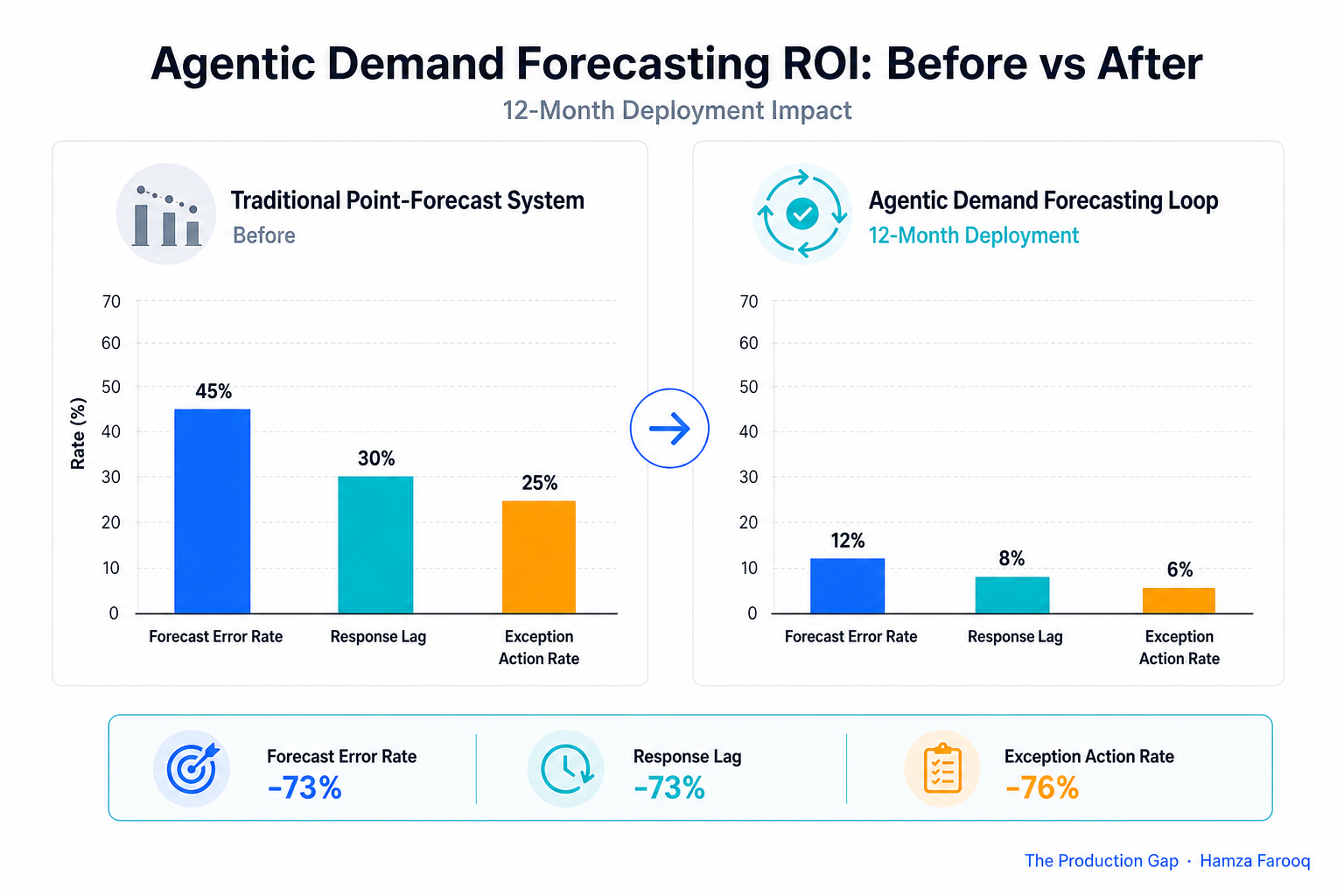
Enterprises can measure ROI across three dimensions: forecast error reduction, response lag compression, and exception action rate. The third is the one most deployments fail to track, in the author's experience.
Forecast error rate: Tracking MAPE or WAPE before and after deployment is necessary but not sufficient. An accurate forecast that updates infrequently still leaves fast-moving SKUs exposed.
Response lag: Response lag is the time from a demand signal change to an updated forecast available to planners. Databricks documents the shift from fixed monthly cycles to continuous updating explicitly, and that compression in lag is a meaningful operational difference.
Exception action rate: Exception action rate is the percentage of flagged anomalies resulting in a documented planner decision within SLA. Most enterprises do not track this metric, that is the author's observation from practitioner experience, not a measured prevalence statistic. In the author's experience, it is the most predictive indicator of actual inventory outcome improvement.
The meaningful shift after deploying a full agentic loop is not only visible in forecast accuracy. As Kagen AI describes in their analysis of agentic retail forecasting, the operational gains depend on how fast signals reach planners and how consistently those planners act on them. Forecast accuracy measures whether the AI predicted correctly; exception action rate measures whether humans responded within the decision window. If your deployment is not tracking exception action rate, you are measuring the AI loop but not the human loop, and that is where inventory outcomes actually live.
Frequently Asked Questions
What is agentic demand forecasting? Agentic demand forecasting replaces the static monthly point-forecast cycle with a continuous, self-correcting loop where autonomous agents validate data, generate probabilistic forecasts, model scenarios, detect anomalies, and route exceptions to human planners, updating continuously rather than on a fixed batch schedule.
How does the validate stage prevent forecast errors from propagating through the loop? The validate stage applies automated checks that flag gaps, outliers, and stale sources before they enter the forecast model. ABM Cloud's agentic forecasting capability specifically validates data and identifies risks before they influence planning decisions, which means errors caught here never reach the scenario or anomaly stages.
Which enterprise platforms currently support a full validate--forecast--scenario--anomaly--route workflow? As of mid-2025, Databricks, ABM Cloud, Fluid AI, and Accenture are among those with published agentic forecasting approaches. Verify current capabilities at evaluation time, as feature sets are changing rapidly.
Why does exception action rate matter more than forecast accuracy for measuring agentic loop ROI? Exception action rate matters more than forecast accuracy because a highly accurate forecast that triggers no timely planner response produces the same stockout outcome as an inaccurate one. Forecast accuracy measures whether the AI predicted correctly; exception action rate measures whether humans acted within the decision window, which makes it the real test of whether your human-in-the-loop forecasting architecture is working as intended.
Conclusion
The move from point forecast to agentic loop is an operational redesign, not a model upgrade. All five stages must be instrumented and connected. A loop with four strong stages and one broken one still fails, and the broken stage is most often Route.
Before evaluating a new platform, audit your current exception workflow: what percentage of flagged anomalies result in a documented planner decision within a defined window? If that number is unknown, design the human loop before deploying the AI one.
Map your exception-routing process against the five-stage loop described in this guide. Find which stage breaks first. That is where your deployment budget should go.
Learn from me
Agentic AI for Product Managers, my Maven cohort. Learn how to design, evaluate, and ship reliable AI systems: the technical fluency PMs need to lead agentic products, no engineering background required. Join the next cohort →
Hire us
Traversaal.ai. We're a team of forward deployed engineers solving the toughest AI problems for Fortune 100 companies: document intelligence, agentic data platforms, and real-time web intelligence, deployed in production. Work with our team to deploy your next agentic ecosystem. Talk to Traversaal.ai →
Join us
Want to solve these problems with us? We're always looking for forward deployed engineers who want to ship production AI. jobs@traversaal.ai
