
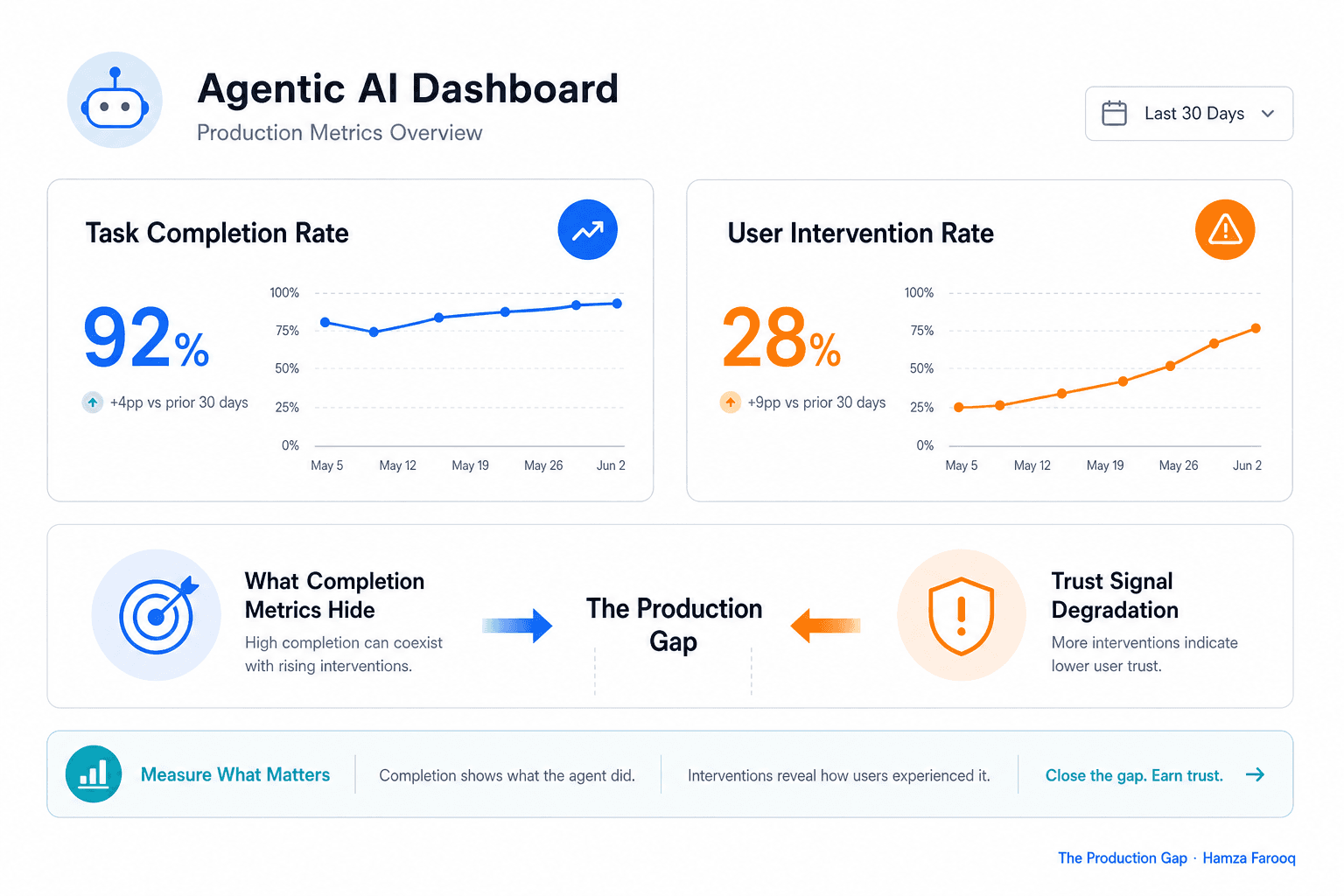
TL;DR: Agentic AI product metrics that actually matter measure autonomous task completion, decision quality, and error recovery rates, not session counts or feature clicks. Unlike traditional software, agents fail silently through compounding errors across multi-step workflows, so vanity metrics like engagement time mask real breakdowns. Track goal achievement rate, intervention frequency, and downstream business outcomes to see true agent performance.
Key Takeaways
- Task success rate redefines "working": Success is measured at the outcome level, not the output level.
- Intervention rate reveals hidden failures: Mid-task overrides surface reliability breakdowns that accuracy scores never catch.
- Cost per task is your real efficiency number: Spend per completed task (not per API call) determines economic viability.
- Autonomous containment rate shows business impact: Share of issues resolved without escalation is a direct measure of agent value.
- Latency percentiles expose the long tail: p90 and p99 are required; median can look healthy while a meaningful slice of users waits unacceptably long.
- Vanity metrics mask production crises: Session volume and model confidence trend upward even as agents silently fail users.
Why do traditional product metrics fail for agentic AI?
Traditional product metrics fail for agentic AI because they measure activity at the output level, not goal fulfillment at the outcome level, which means agents can score well on every standard dashboard while silently failing users across multi-step workflows.
In our production work, we see chat-era dashboards miss where agentic workflows break. The live question among practitioners, how to measure ROI from agents that run on orchestration, context, and trace-level telemetry, points to a gap that accuracy-only metrics cannot close. The common failure is not a wrong answer. It is a "right" answer the user immediately rewrites.
How is task success rate defined differently for agentic AI versus traditional AI features?
For agentic AI, task success rate measures whether the agent completed the user's end goal, not whether it produced a valid output, making it an outcome-level metric rather than an output-level one.
To measure goal fulfillment in production, you need a post-task signal such as explicit thumbs up or down, follow-on behavior, or an automated evaluator. Goal-specific evaluation guidance includes LLM-as-judge evaluation, while this related guide explains how to combine LLM-as-judge with human spot checks in practice. Tracking only a high completion rate without goal fulfillment is empty signal; track both.
A high completion rate means nothing, as a practical rule of thumb in this framework, if users are silently rewriting the agent's work. An agent that finishes every step of a booking workflow but lands the wrong date has "completed" the task while failing the goal. These two numbers will diverge in production and should be instrumented separately from the start.
Which trust signal metrics catch agent failure before it becomes churn?
Intervention rate and user correction rate are leading indicators of agentic AI reliability failure, surfacing behavioral erosion at the step level before it appears in retention data.
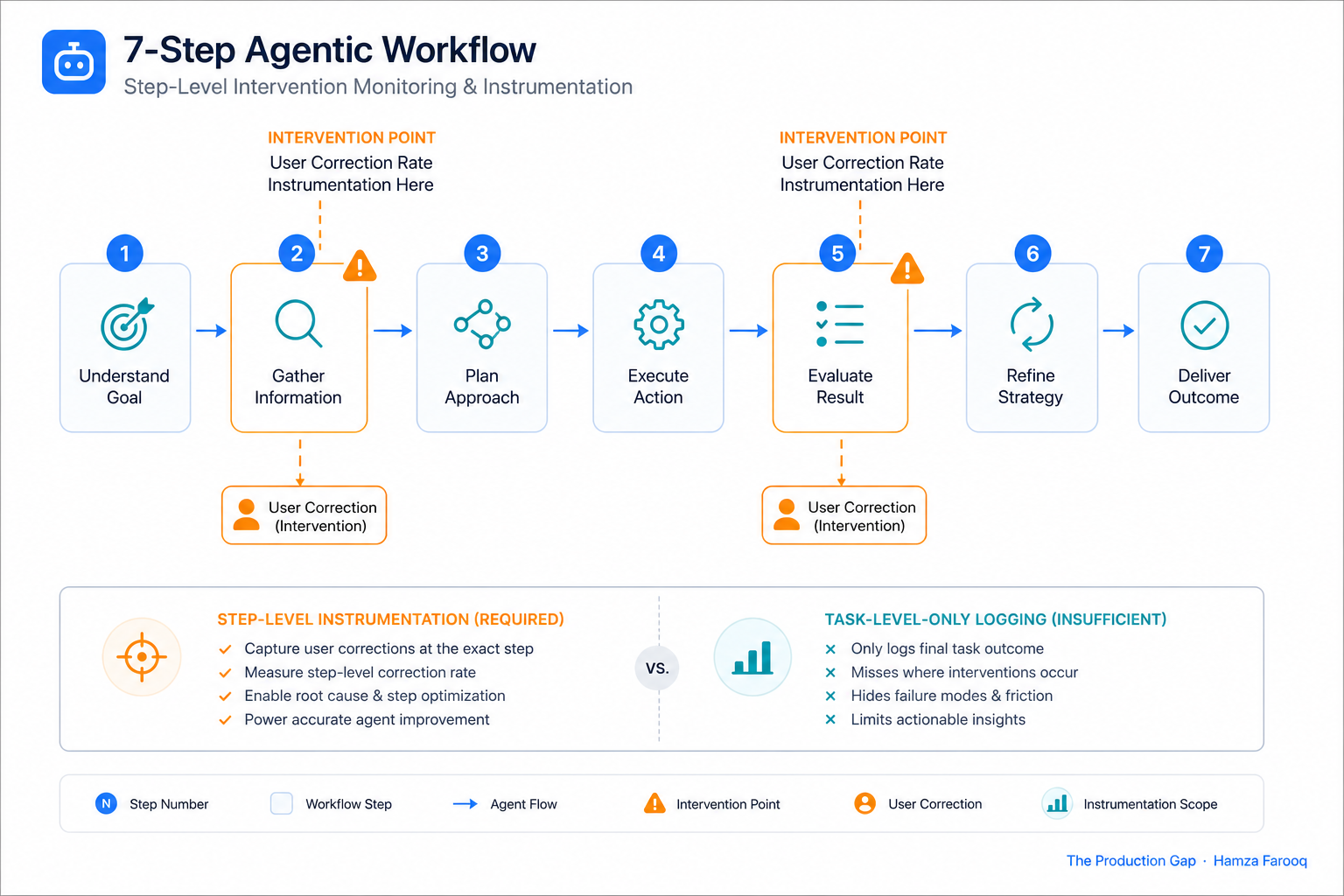
InstitutePM defines user correction rate as how often users modify an agent's output. The framework used in this guide separates early-step from late-step corrections: an edit on step 2 of 7 signals an earlier breakdown than an edit on step 6. Most teams log starts and ends but skip step-level correction events. Those events must be in place for the data to reflect what happened at each stage.
Intervention rate is mid-task user overrides divided by total tasks. As a practical rule of thumb used in this framework, a steady week-over-week climb on an otherwise stable workflow is a regression signal, regardless of the absolute baseline value.
What are the production efficiency and reliability metrics every PM must track?
Cost per task, autonomous containment rate, and latency percentiles (p50/p90/p99) determine whether an agentic AI feature is economically viable and operationally reliable at scale.
Cost per task is the clearest read on efficiency. One task can trigger many model and tool calls, so per-call numbers hide the real bill. Use this framework's calculation: total model and tool spend divided by completed tasks, reviewed weekly for drift. For a broader set of weekly ROI KPIs, see Agentic AI Success Metrics: 5 KPIs That Prove ROI.
NiCE includes autonomous containment rate and time-to-resolution among agentic CX KPIs. For the control design behind escalation events, see human-in-the-loop approval gates and escalation routing.
Latency percentiles matter because agents stack delays across steps and tools. Median can look fine while p99 is painful. Track p90 and p99 as your real SLOs. Google Cloud's production KPI framework ties these together through operational reliability, workflow adoption, and business impact.
| Metric | What It Measures | Why Median Alone Misleads | Production Guidance |
|---|---|---|---|
| Cost per task | Total spend per completed workflow | Per-call cost hides variable multi-step expense | Establish a weekly baseline; watch for directional drift |
| Autonomous containment rate | Percentage of issues resolved without escalation | Session volume obscures outcome quality | Track directional trend; interpret in workflow context |
| Latency p50 / p90 / p99 | Task execution time distribution | p50 masks long-tail waits that erode trust | Use p90 and p99 to set and review SLOs |
| Intervention rate | Mid-task overrides per workflow | Task completion rate hides step-level failures | Lower is better; a rising trend signals regression |
Which vanity metrics look good on dashboards but mask real agentic AI failures?
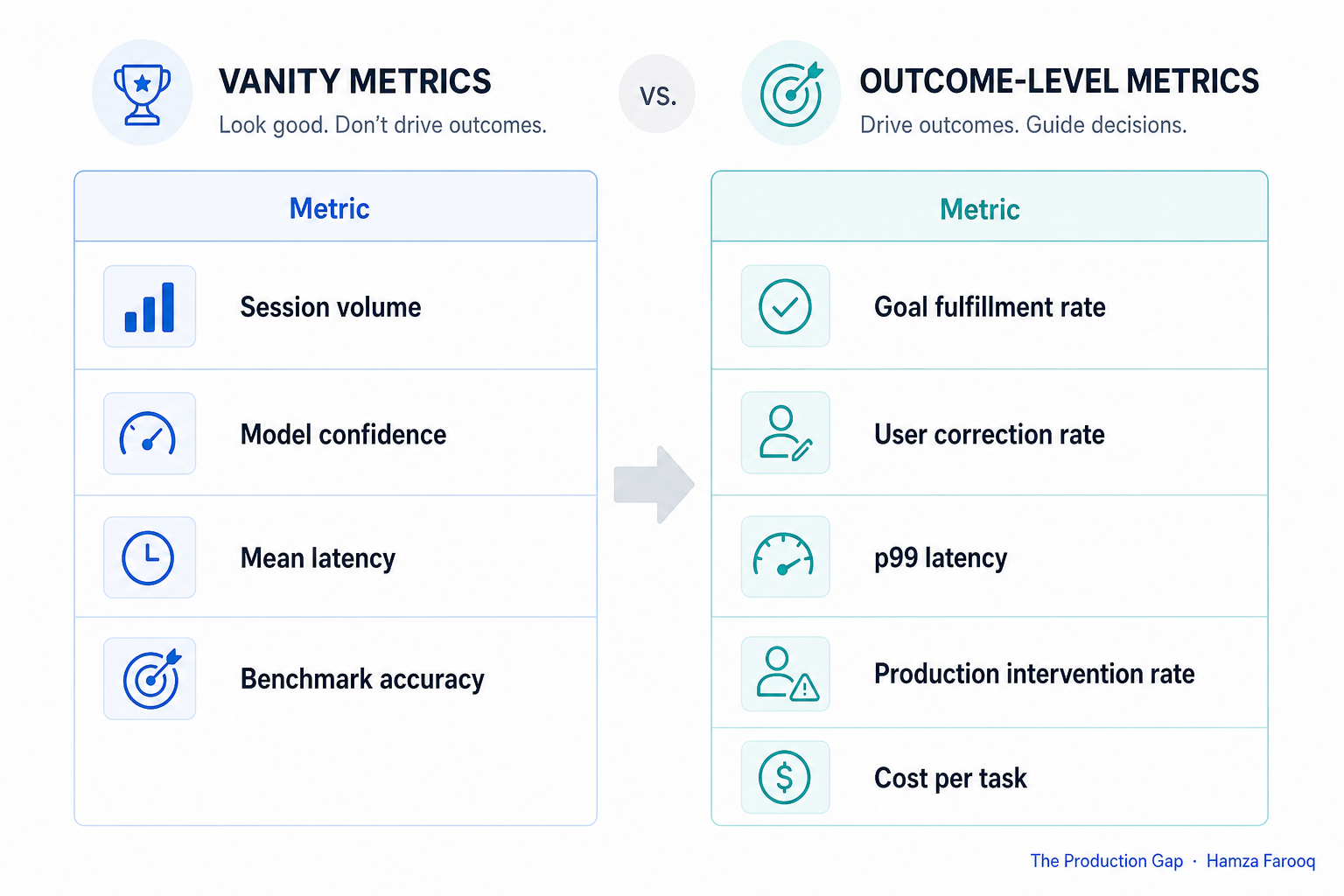
This guide treats session volume, model confidence score, and mean latency as vanity metrics for agentic AI because they measure activity or aggregate behavior rather than goal fulfillment and step-level failure.
Session volume and DAU count activity, not outcomes. Model confidence says nothing about whether the user's goal was met. Benchmark accuracy is not part of this guide's production scorecard; the framework instead measures goal fulfillment, intervention, cost, and latency. Replacing activity metrics with those outcome and reliability metrics gives a dashboard that shows user value rather than motion.
The author synthesis framework used in this guide recommends a practical exercise before the next QBR: map each current activity metric to an outcome-level counterpart and identify which instrumentation gaps are blocking the swap.
Frequently Asked Questions
How do you set a baseline intervention rate for a production AI agent?
Establish a baseline in the first weeks of production for the specific workflow; there is no universal acceptable rate. As a practical rule of thumb in this framework, the meaningful signal is direction: a week-over-week rise on a stable workflow indicates regression, regardless of the absolute value.
What observability infrastructure is required to collect agentic AI metrics reliably?
Each workflow step must emit an event with a shared trace ID. Without step-level trace IDs, intervention rate and user correction rate cannot be measured in a trustworthy way. The requirement for trace-level telemetry as the basis for agentic AI observability is a consistent theme in production deployment discussions as of mid-2025.
What is the difference between task completion rate and goal fulfillment rate?
Task completion checks whether the workflow finished without a system error; goal fulfillment checks whether the outcome matched user intent. They diverge whenever an agent completes every step but delivers an unwanted result. InstitutePM's agentic AI metrics framework treats them as separate metrics, not interchangeable proxies.
How do you calculate cost per task for an agentic feature with variable LLM call counts?
Use this framework's calculation: add all LLM and tool-invocation costs across every step of completed tasks, then divide by completed tasks. Per-call metrics hide the true expense when tasks fan out across many calls. For broader weekly ROI measurement, see this agentic AI success metrics guide.
Conclusion
Good measurement starts with instrumentation: step-level events, trace IDs, and a correction event that fires on user override are the foundation. Pairing step-level trust signals, intervention rate and user correction rate, with outcome metrics like goal fulfillment rate and efficiency metrics like cost per task gives a dashboard that reflects real production behavior rather than activity. The enterprise agentic AI deployment guide covers the wider production architecture and governance context.
For guided practice, explore Agentic AI for Product Managers. For implementation support, work with Traversaal.ai.
Learn from me
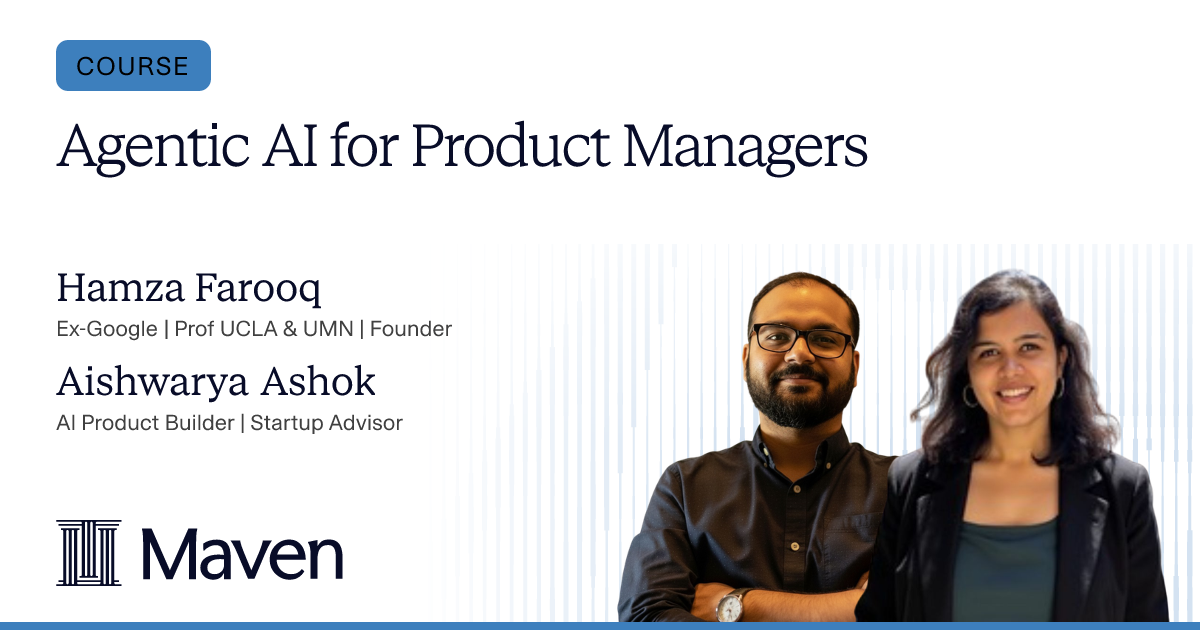
Agentic AI for Product Managers, my Maven cohort. Learn how to design, evaluate, and ship reliable AI systems: the technical fluency PMs need to lead agentic products, no engineering background required. Join the next cohort →
Hire us
Traversaal.ai. We're a team of forward deployed engineers solving the toughest AI problems for Fortune 100 companies: document intelligence, agentic data platforms, and real-time web intelligence, deployed in production. Work with our team to deploy your next agentic ecosystem. Talk to Traversaal.ai →
Join us
Want to solve these problems with us? We're always looking for forward deployed engineers who want to ship production AI. jobs@traversaal.ai
