
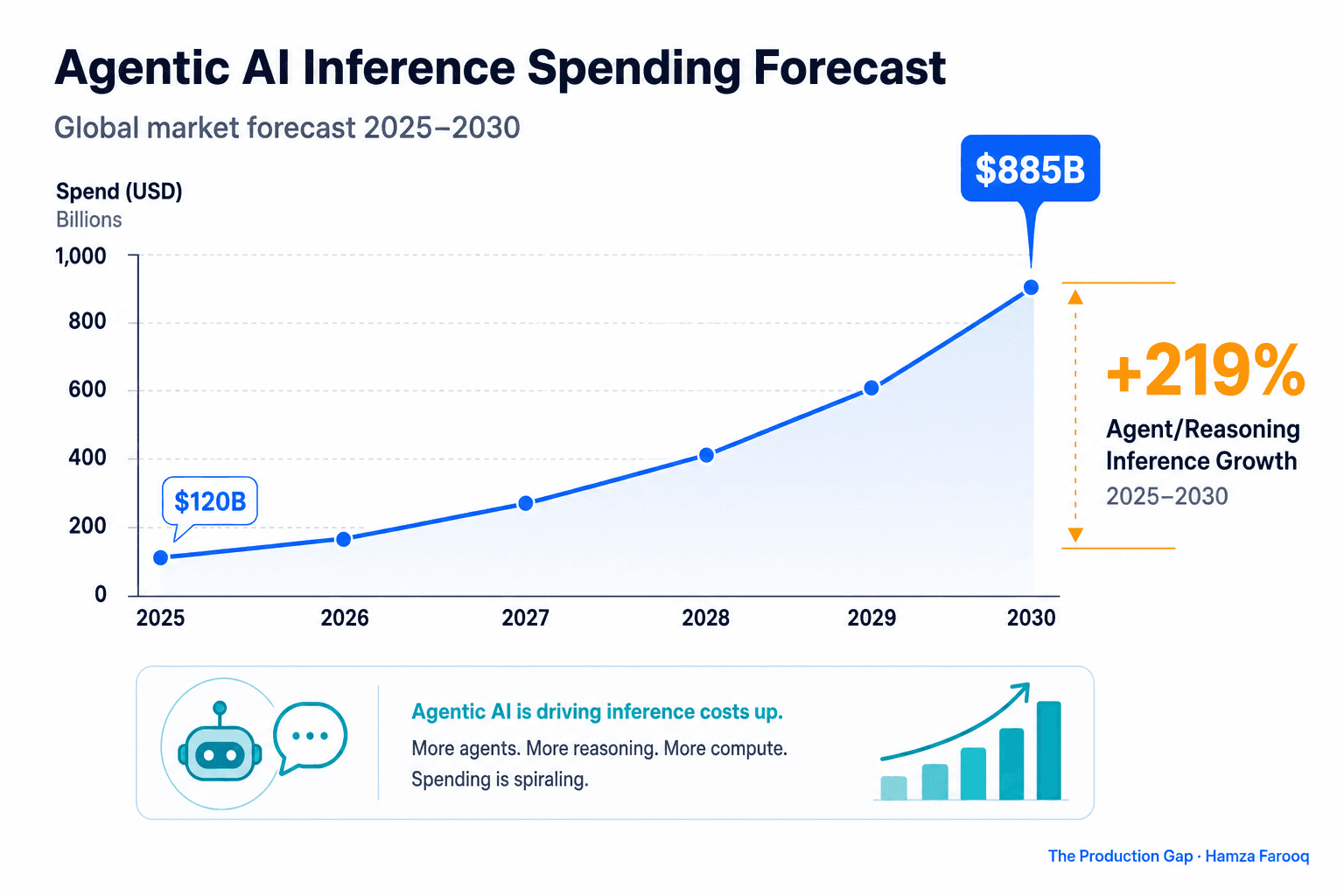
TL;DR: Agentic AI inference costs spiral far beyond simple chat because autonomous agents run multi-step reasoning loops, spawn subagents, and retry failed tool calls, multiplying token consumption per task by orders of magnitude. Without per-tenant telemetry tagging every LLM call to a specific tenant and workflow, shared platforms become cost black holes where no one is accountable. A chargeback architecture built on request-level trace IDs, tenant-scoped usage aggregation, and tiered cost allocation solves this by turning opaque platform spend into attributable, billable consumption.
Key Takeaways
- Agentic loops multiply token costs: a single agent task can consume up to 100x more tokens than a chat prompt.
- Shared platforms hide who's spending what: costs pool across tenants with no attribution by default.
- Telemetry must follow every hop: tag every model call, tool invocation, and memory read with a tenant identifier.
- Chargeback starts at the model gateway: capture per-tenant consumption at the single point all requests pass through.
- Visibility changes how developers build: teams with cost dashboards optimize loop design before the bill arrives.
- Runaway agents are a shared-platform crisis: one bad workflow drives costs every other tenant absorbs.
Introduction
Inference spending is forecast to grow from $120 billion in 2025 to $885 billion by 2030, with agent and reasoning inference growing 219 percent, and most platform teams still cannot answer finance's question: which tenant owns which cost? The 100x token gap between agentic tasks and simple chat prompts makes this a balance-sheet problem, not a rounding error. This article lays out a concrete multi-tenant chargeback architecture that platform engineers can implement without rebuilding from scratch.
Why does a single agentic task cost so much more than a direct chat prompt?
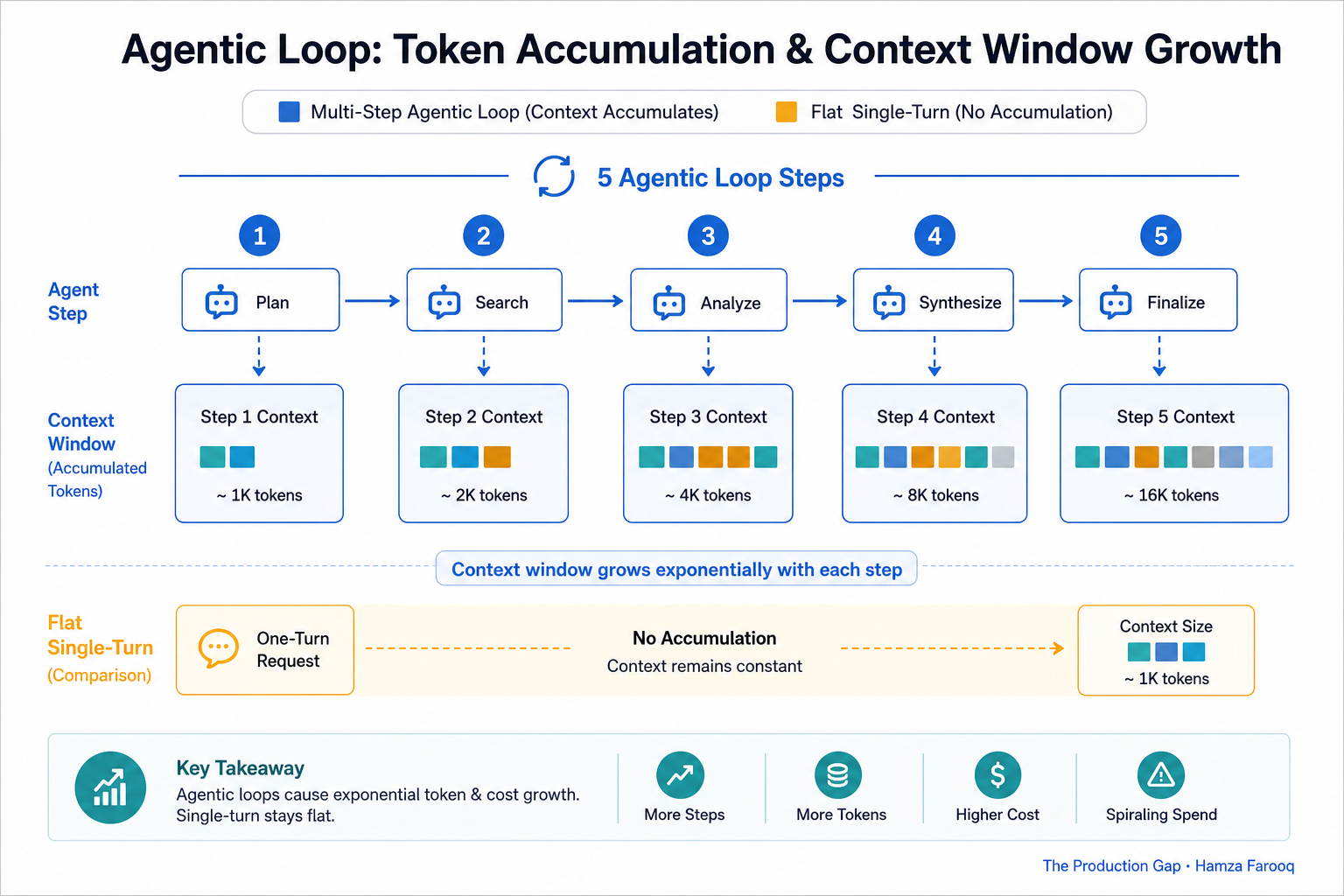
Loop depth drives the first wave of cost. Each planning-action-observation cycle re-submits an ever-larger prompt, and every loop carries full prior context forward rather than starting clean.
Context accumulation compounds that. Tool outputs, memory reads, and prior turns append with each pass, so prompt size grows with accumulated state rather than with new user input.
Tool call overhead adds another layer. Every invocation returns results that feed back into the next prompt, stacking retrieved content on top of context that already needed pruning.
Retry amplification is the most insidious driver. Poorly written agents retry failed tool responses by re-submitting full accumulated context, and a misconfigured retry policy can send costs sharply higher within a single run. Real-world metering showed roughly 250,000 tokens per run at about $0.62 per run, and practitioners said they didn't understand the cost structure until they had real metering in front of them. Top frontier models run $25–$30 per million output tokens, and output tokens dominate because loops generate them continuously.
Why do shared multi-tenant platforms create a cost-attribution crisis?
Shared multi-tenant agent platforms create a cost-attribution crisis because model calls, tool invocations, and retry loops execute through pooled infrastructure with no tenant identifier attached, making it impossible to disaggregate who drove which cost.
The pooled model gateway is where attribution first breaks down. All tenants share the same endpoint, so without instrumentation the gateway sees a stream of requests rather than tenant-tagged cost events. The invoice arrives at the platform level and finance sees a number no one can explain.
Shared orchestration runtimes like LangGraph or Temporal make it worse. They spawn tool calls and model requests without propagating a tenant context header unless the platform was explicitly built to do so, meaning multi-hop agent workflows leave no cost trail by default.
Memory and tool registry sharing creates a third blind spot. Retrieval calls and tool invocations hit shared infrastructure whose compute cost is real but never attributed to the tenant whose agent triggered them. Well-behaved tenants silently cross-subsidize whoever is running the deepest loops, and the offending team has no signal they're the problem. Even organizations like Uber have hit hard spending walls, capping per-engineer AI tooling costs at $1,500 per month, cost invisibility is not a small-team problem.
What does a concrete chargeback architecture actually look like?
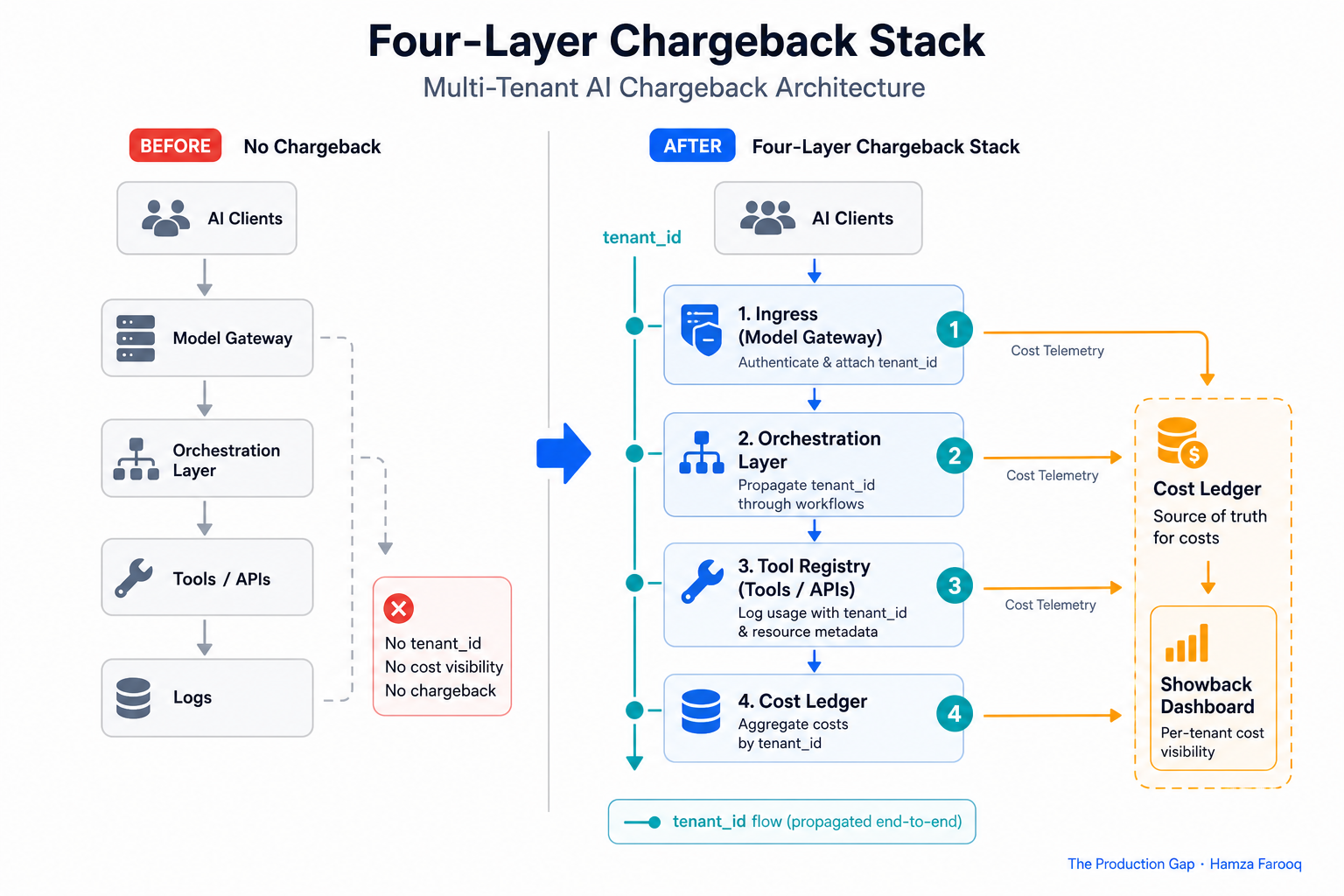
A working multi-tenant chargeback architecture instruments cost at the model gateway, propagates a tenant trace context across every orchestration hop, aggregates per-tenant metrics in a cost ledger, and surfaces them through showback dashboards before enforcing hard quotas.
| Layer | What to instrument | Telemetry signal | Enforcement action |
|---|---|---|---|
| 1. Model gateway | Tag every LLM request with tenant_id, agent_run_id, loop_step | Prompt tokens, completion tokens, model ID, latency | Hard token quota per tenant per day |
| 2. Orchestration layer | Inject trace context at workflow spawn; propagate across sub-agent calls | Loop depth, retry count, tool call count per run | Alert on loop depth > N or retry rate > threshold |
| 3. Tool and memory registry | Tag retrieval calls and tool invocations with tenant trace | Tool call count, retrieval token cost, external API calls | Per-tenant tool call budget |
| 4. Cost ledger and dashboard | Aggregate all signals into per-tenant cost events; write to time-series store | $/run, $/day, token velocity, cost percentile rank vs. peers | Showback first; hard quota enforcement second |
Gateway layer: every model call passes through it, making it the highest-leverage insertion point. A sidecar proxy wrapping the OpenAI or Anthropic SDK with tagging middleware is the lowest-rebuild-cost option, instrument here first.
Orchestration layer: trace context must be created at workflow spawn and passed through every node. OpenTelemetry baggage propagation survives async boundaries without changes to individual agent code.
Tool and memory layer: this one gets skipped most often and regretted most often. Tag retrieval at the registry level or it disappears into platform overhead permanently.
Cost ledger: start with showback before enforcing quotas. Optimization techniques can reduce inference costs by up to 462x in specific configurations, but teams cannot pursue those optimizations without seeing their own cost data first.
How does per-tenant cost visibility actually change developer behavior?
Per-tenant cost visibility changes developer behavior because it converts invisible shared overhead into a named, attributable cost the tenant's own team can see, creating direct accountability pressure to reduce loop depth, tighten retry policies, and shrink context windows before the bill escalates.
In my experience, loop depth discipline tends to follow quickly once teams can compare their own average run cost against peers. Without that visibility, there is no incentive to reduce steps; with it, the audit happens naturally.
Retry policy tightening is often the fastest win. Teams can fix a misconfigured retry policy in hours once they see cost spikes on their own dashboard, the fix is typically a single parameter, but the signal was missing before.
Context window management follows once developers can see prompt size contributing to cost per run. Pruning tool outputs and summarizing prior steps becomes a concrete engineering priority rather than a theoretical one, chargeback makes cost feel attributable rather than abstract.
Frequently Asked Questions
Why does an agentic AI task cost so much more than a simple chat prompt to the same model? Agents loop through planning, action, and observation steps, accumulating tokens with every pass. The result is up to 100x more token consumption per task, compounded further by tool calls adding retrieved content on top.
How do you instrument a shared orchestration layer for per-tenant cost tracking without rebuilding the platform? Instrument at the model gateway using a sidecar proxy that tags every request with tenant_id and agent_run_id, then add OpenTelemetry baggage propagation so the tenant identifier survives every hop without changes to individual agent code.
What telemetry signals beyond raw token count are needed to fully capture agentic inference cost? You also need loop depth, retry count, tool call count, retrieved content token volume, latency, and model ID. Frontier models at $25–$30 per million output tokens cost radically more than smaller models, and together these signals let you decompose whether a spike came from deeper loops, retry misfires, or model selection.
How do you prevent one tenant's poorly optimized agent from driving up costs absorbed by the whole platform? Three controls in sequence: showback dashboards so the offending team sees their cost rank versus peers; soft quota alerts before hard limits; then hard per-tenant token budgets enforced at the gateway. Enforcing quotas before visibility is counterproductive, teams need to understand the problem before they can fix the design.
Conclusion
The agentic inference cost crisis is already here, and on shared platforms it is invisible by default. Instrument the model gateway first, add OpenTelemetry trace propagation through the orchestration layer, stand up a per-tenant cost ledger, and ship showback dashboards before quotas. Let visibility run for 30 days, watch developers optimize their own loop designs, then enforce hard quotas at the gateway.
Agentic AI inference costs per workflow are projected to increase more than fivefold through 2028. Model price drops won't save you if agents just run deeper loops and spend the savings back.
Audit your model gateway today. If you cannot answer "which tenant sent this request?" from your current logs, you have an attribution blindspot worth fixing this sprint.
Learn from me
Forward Deployed Engineering Bootcamp for Full-Stack Developers, my Maven cohort. Build and ship complete AI products end to end, from React and Node.js frontends to deployed models with caching and observability. Join the next cohort →
Hire us
Traversaal.ai. We're a team of forward deployed engineers solving the toughest AI problems for Fortune 100 companies: document intelligence, agentic data platforms, and real-time web intelligence, deployed in production. Work with our team to deploy your next agentic ecosystem. Talk to Traversaal.ai →
Join us
Want to solve these problems with us? We're always looking for forward deployed engineers who want to ship production AI. jobs@traversaal.ai
