
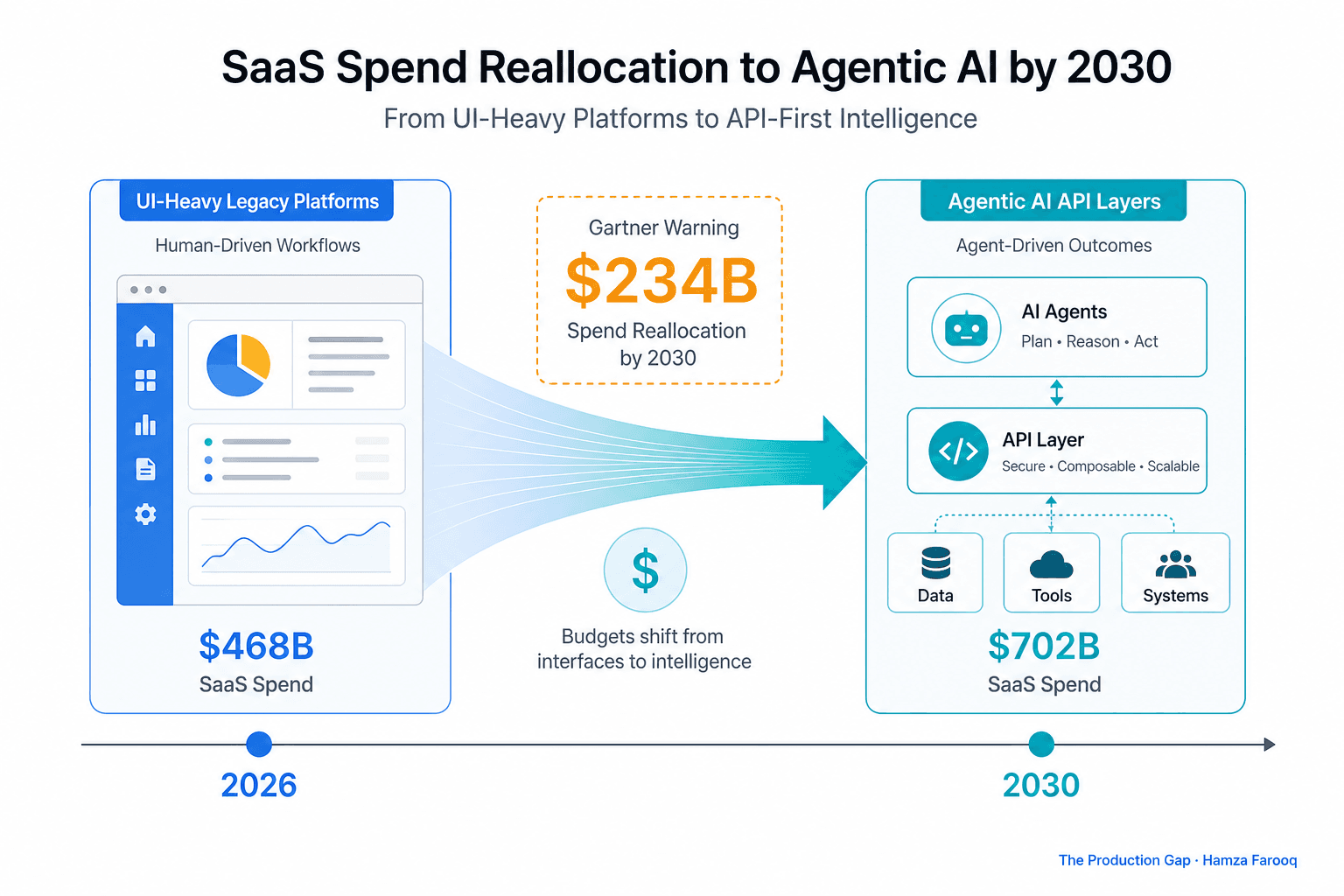
TL;DR: Agentic AI is restructuring enterprise SaaS spend by replacing human navigation workflows with API-driven agents that bypass seat licenses entirely. Vendors most exposed are those whose value lives in the interface, not in underlying data and process logic. This guide delivers three concrete tools: a UI-tax audit, the MOAT framework for build-vs-integrate decisions, and a three-move vendor negotiation playbook.
Key Takeaways
- Budget shifts away from interface-dependent vendors: Spend moves toward capability value, not UI value.
- UI-tax vendors are first in line: Any SaaS product where users log in mainly to move data is a candidate for agent replacement via API.
- Build-vs-integrate is now a core PM decision: Use a repeatable framework to decide when to layer an agent versus replace the tool.
- Agentic substitution risk is your negotiation weapon: Credible alternatives give you real leverage on pricing and contract terms.
- Incumbents are moving: Salesforce Agentforce, AWS, and IBM are shipping agent-native layers; the question is whether they move faster than buyers force the transition.
Introduction
Agentic AI's potential to redirect enterprise SaaS spend has moved from analyst discussion to boardroom agenda. Deloitte's 2026 TMT Predictions confirm agentic capabilities are maturing and SaaS vendors are actively restructuring to respond. This article delivers three outputs: a UI-tax audit to identify exposed vendors, the MOAT framework to make build-vs-integrate repeatable, and a negotiation playbook to convert that analysis into contract leverage.
What does agentic AI's pressure on SaaS spending actually mean, and what does it not mean?
The core shift is a budget reallocation away from vendors whose value is embedded in the UI, not an extinction event for enterprise software.
The mechanism is agentic arbitrage: replacing per-seat SaaS licenses with API-driven agents that perform the same workflows at lower marginal cost. AWS defines agentic AI as an autonomous system that can act independently across SaaS applications, routine workflows that once required manual click-through can be executed via API without a seat license. Vista Equity Partners puts it plainly: agentic AI transforms enterprise software from tools that support work into systems that perform it.
The practical question for any SaaS line item: how much of its value lives in the interface versus the underlying capability? That distinction determines exposure.
Which parts of your SaaS stack are UI-tax versus genuine capability moats?
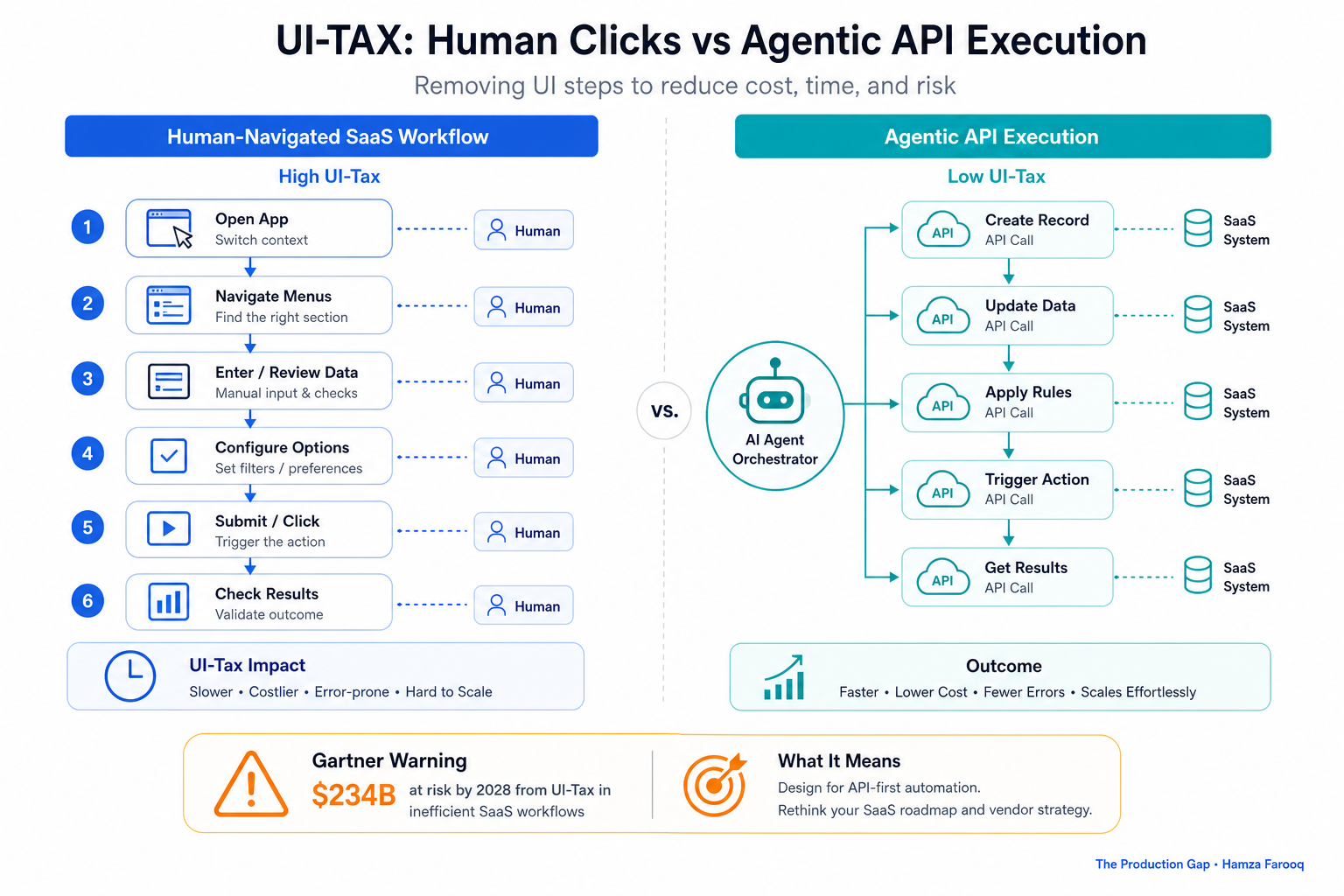
A SaaS product is a UI-tax vendor when its primary value is organizing and surfacing data accessible directly via API, those are the line items most exposed to agentic substitution.
UI-Tax Audit Table:
| SaaS Category | Primary User Activity | Agent-Substitutable? | Capability Moat? |
|---|---|---|---|
| CRM (e.g., Salesforce) | Data entry, pipeline updates | High, via API and Agentforce layer | Data network and integrations |
| ITSM (e.g., ServiceNow) | Ticket routing, field updates | High, workflow automation mature | Process logic and compliance rules |
| HCM (e.g., Workday) | Approvals, reporting, data pulls | Medium, compliance adds friction | Payroll logic, regulatory data |
| BI/Analytics (e.g., Tableau) | Dashboard navigation, exports | Medium, NLQ agents emerging | Data modeling depth |
| Vertical SaaS (niche workflows) | Judgment-heavy domain tasks | Low, context specificity high | Domain data and workflow lock-in |
Salesforce's Agentforce pivot (from "login and navigate" to "define outcomes, agents execute") is itself an acknowledgment of UI risk built into a major vendor's own product strategy. Run this audit on your top 10 SaaS line items before your next renewal and flag anything where the dominant user activity is data movement rather than judgment.
Build vs. integrate: how do you decide whether to add an agent layer or replace the tool entirely?
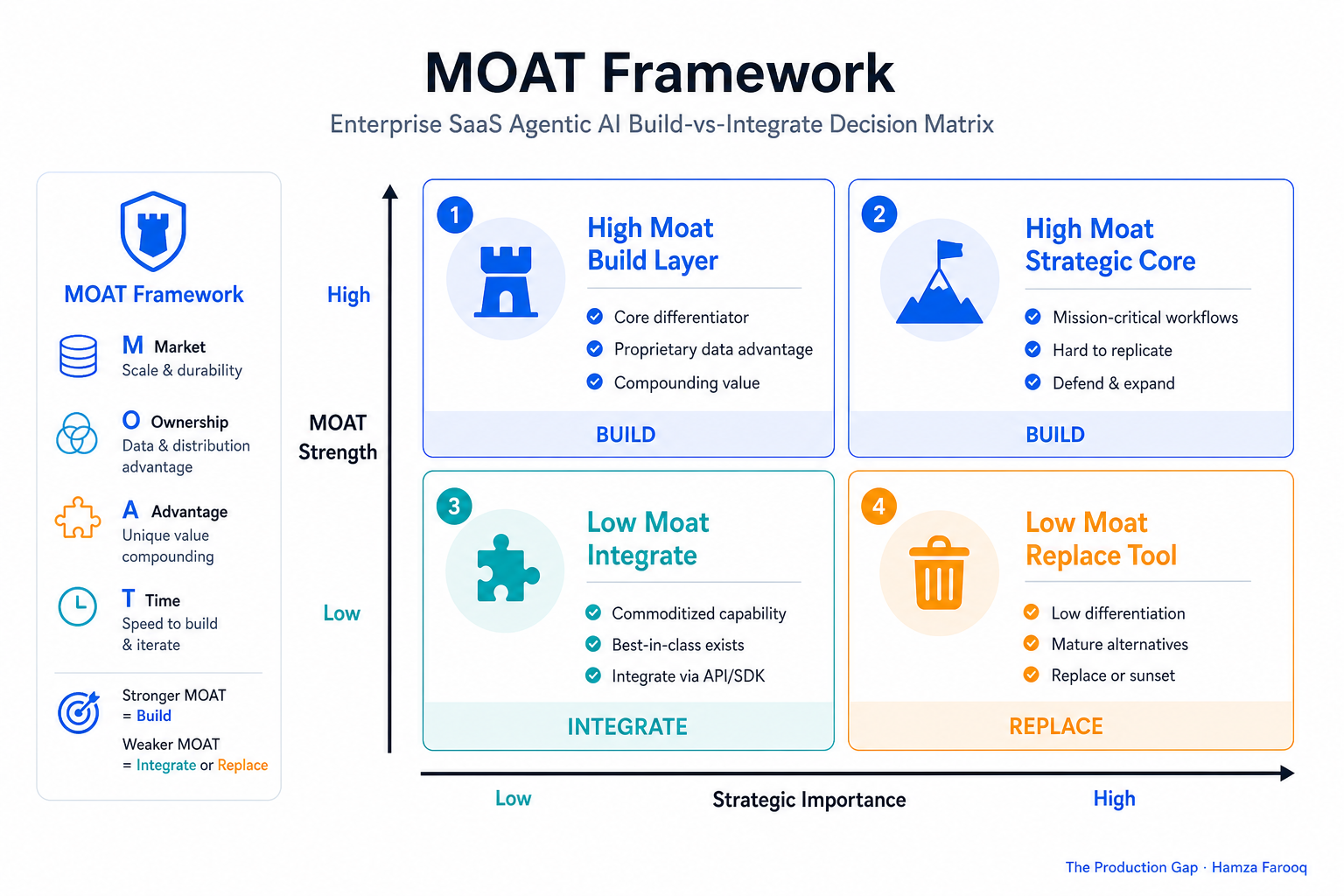
Build an internal agent layer when the underlying SaaS data and workflow logic are irreplaceable; replace the tool when the vendor's only moat is the interface your agents are already bypassing.
The MOAT Framework makes this call repeatable. It is an author synthesis, not an externally validated benchmark. The MOAT Framework for Agent-Layer Decisions:
| Dimension | Definition | Interpretation Signal |
|---|---|---|
| M: Migrate Cost | Total cost and complexity of moving data, workflows, and integrations | High migration cost favors building an agent layer rather than replacing now |
| O: Outcome Ownership | Whether the vendor or your agent stack owns core reasoning and decisions | If your agent owns the reasoning, the vendor has become infrastructure |
| A: Agent Compatibility | Quality and accessibility of the vendor's API surface | Poor API access signals friction; clean APIs signal a platform worth layering |
| T: Time-to-Substitution | How close a credible, production-ready alternative is to market | A mature alternative available now means your negotiating window is open |
Illustrative application: an HCM platform with deep embedded payroll and compliance logic carries high migration cost, build an orchestration layer now and use substitution risk at the next renewal. The four-dimension structure keeps the decision auditable across your entire stack.
How do you use agentic substitution risk as leverage in your next SaaS renewal?
The moment you can show a credible agentic alternative, you have negotiating leverage, and independent analyst attention on displacement is market validation you can bring to that conversation.
Move 1: Quantify your UI-tax exposure. Calculate what percentage of seat licenses exist mainly to support human navigation of workflows your agent stack can now execute. A concrete reduction case outperforms a vague AI threat.
Move 2: Name the alternative credibly. Arrive with a specific option: AWS agentic AI, IBM's agentic stack, or a vertical specialist in pilot at a peer organization. Deloitte's 2026 TMT Predictions confirm SaaS vendors are actively responding to this pressure, a named, researched alternative carries more weight than a general disruption reference.
Move 3: Reframe the contract structure. Push from seat-based to outcome-based or consumption-based pricing. Salesforce's agentic enterprise model is already moving this direction, use their own publicly stated pivot as the structural template for your ask.
Frequently Asked Questions
How should a product manager decide whether to build an internal agent layer or replace a SaaS tool entirely? Use the MOAT framework: score the vendor on migration cost, outcome ownership, agent compatibility, and time-to-substitution. High migration cost or deep compliance logic points toward an orchestration layer; low moat scores across all four dimensions plus a credible market alternative points toward replacement evaluation.
What negotiating tactics work when renewing SaaS contracts in light of agentic substitution risk? Quantify your UI-tax seat exposure, name a specific production-ready competitive alternative, and request a shift from seat-based to outcome-based pricing. The combination of a concrete reduction case and a named alternative is consistently more persuasive than a general AI disruption argument.
Are incumbent vendors like Salesforce and IBM moving fast enough to survive the agentic shift? They are moving, Salesforce has launched Agentforce and IBM has published its agentic framework publicly. The real risk for buyers is not vendor collapse but the narrowing of the contract restructuring window buyers currently hold.
Conclusion
Seat counts and DAU measured SaaS value when humans navigated interfaces. Agentic AI has made both proxies unreliable. The tools to respond are available now: the UI-tax audit separates interface value from genuine capability value; the MOAT framework makes build-vs-integrate repeatable; the three-move playbook turns that analysis into contract leverage.
Deloitte's 2026 TMT Predictions confirm the vendor response is already underway. The negotiating window is most open before vendors complete their agentic repositioning and close the arbitrage gap buyers currently hold.
Run the UI-tax audit on your top 10 SaaS line items this week. Score each with the MOAT framework. Bring both to your next renewal preparation. That is the analysis your CPO needs from you.
Learn from me
Agentic AI for Product Managers, my Maven cohort. Learn how to design, evaluate, and ship reliable AI systems: the technical fluency PMs need to lead agentic products, no engineering background required. Join the next cohort →
Hire us
Traversaal.ai. We're a team of forward deployed engineers solving the toughest AI problems for Fortune 100 companies: document intelligence, agentic data platforms, and real-time web intelligence, deployed in production. Work with our team to deploy your next agentic ecosystem. Talk to Traversaal.ai →
Join us
Want to solve these problems with us? We're always looking for forward deployed engineers who want to ship production AI. jobs@traversaal.ai
