
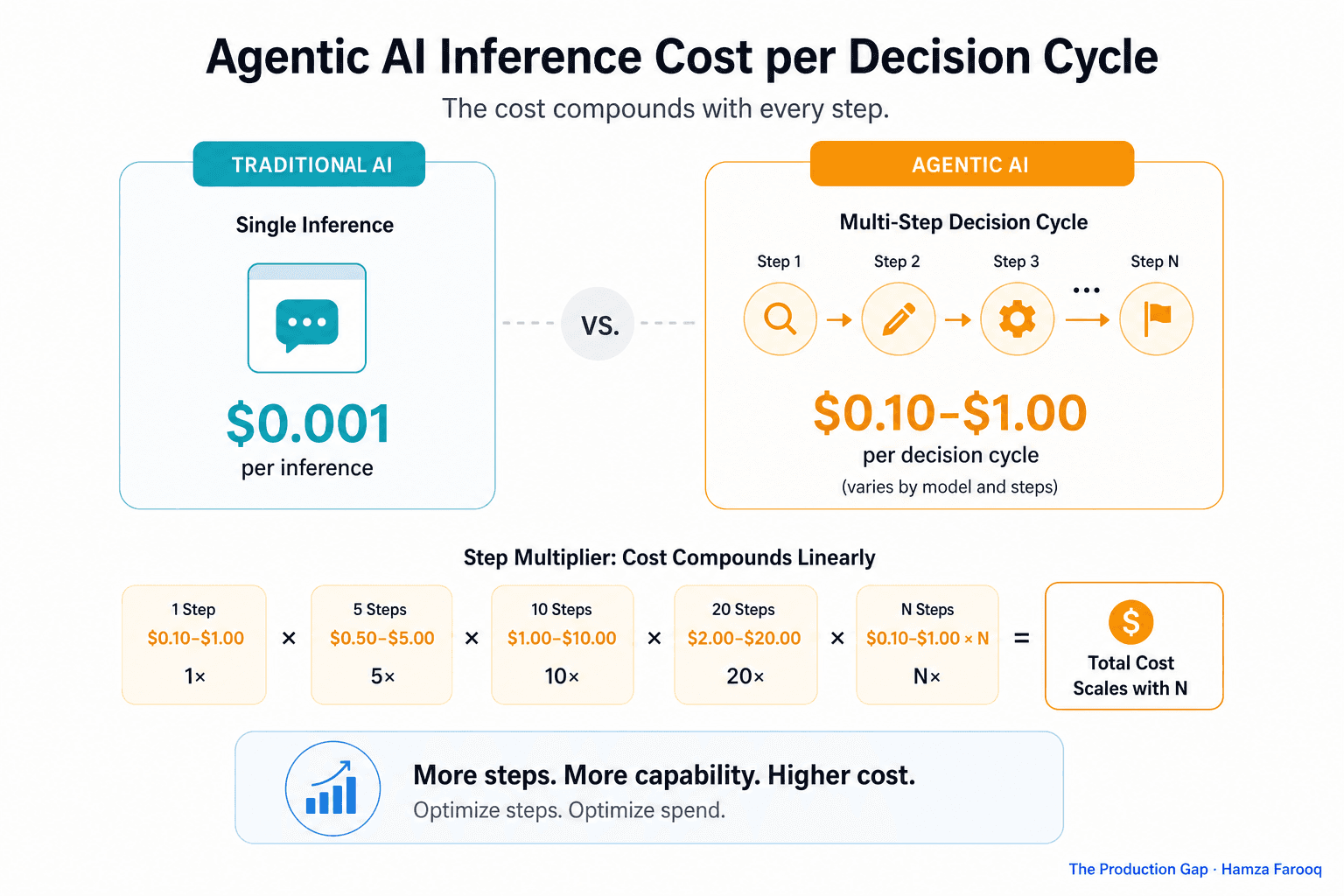
TL;DR: Agentic pipelines break LLM cost models because every planning, validation, and retry step triggers a separate billable inference call. The SLM-first routing framework in this guide classifies each pipeline step by output determinism and instruction ambiguity, routes routine steps to small language models, and reserves frontier calls for genuinely complex reasoning. This reduces per-workflow inference spend without sacrificing reliability when escalation guardrails are in place.
Key Takeaways
- Agentic cost math is broken by default: A single complex agent decision cycle costs up to $1.00; every planning or retry step multiplies that bill.
- SLM-first routing is the fix: Route routine steps to smaller models first; reserve frontier calls for hard reasoning.
- Step classification is the foundation: Sorting steps by complexity is the prerequisite for any routing framework that holds in production.
- Graceful degradation beats silent failure: An undetected wrong answer costs more than calling the frontier model upfront.
- Instrumentation turns guesswork into data: Step-level logging is the only reliable way to tune routing thresholds over time.
- FinOps frameworks now cover agentic spend: AWS, Azure, and FinOps practitioners have formally recognized agentic inference as its own cost category.
Introduction
Agentic AI has moved from pilot to production, and LLM inference cost is now a pressing business problem. Traditional inference costs roughly $0.001 per call; a single complex agentic decision cycle runs $0.10–$1.00, and multiplied across hundreds of orchestrated steps, that breaks unit economics for most enterprise AI products. AWS has formalized model-class-to-task matching and token budget enforcement as Well-Architected design principles. Azure treats runtime optimization as a core agentic FinOps capability. The SLM-first routing framework in this guide gives teams something concrete to act on, and forces a confrontation with how poorly most pipelines are currently specified.
Why does every added agent step compound your inference bill?
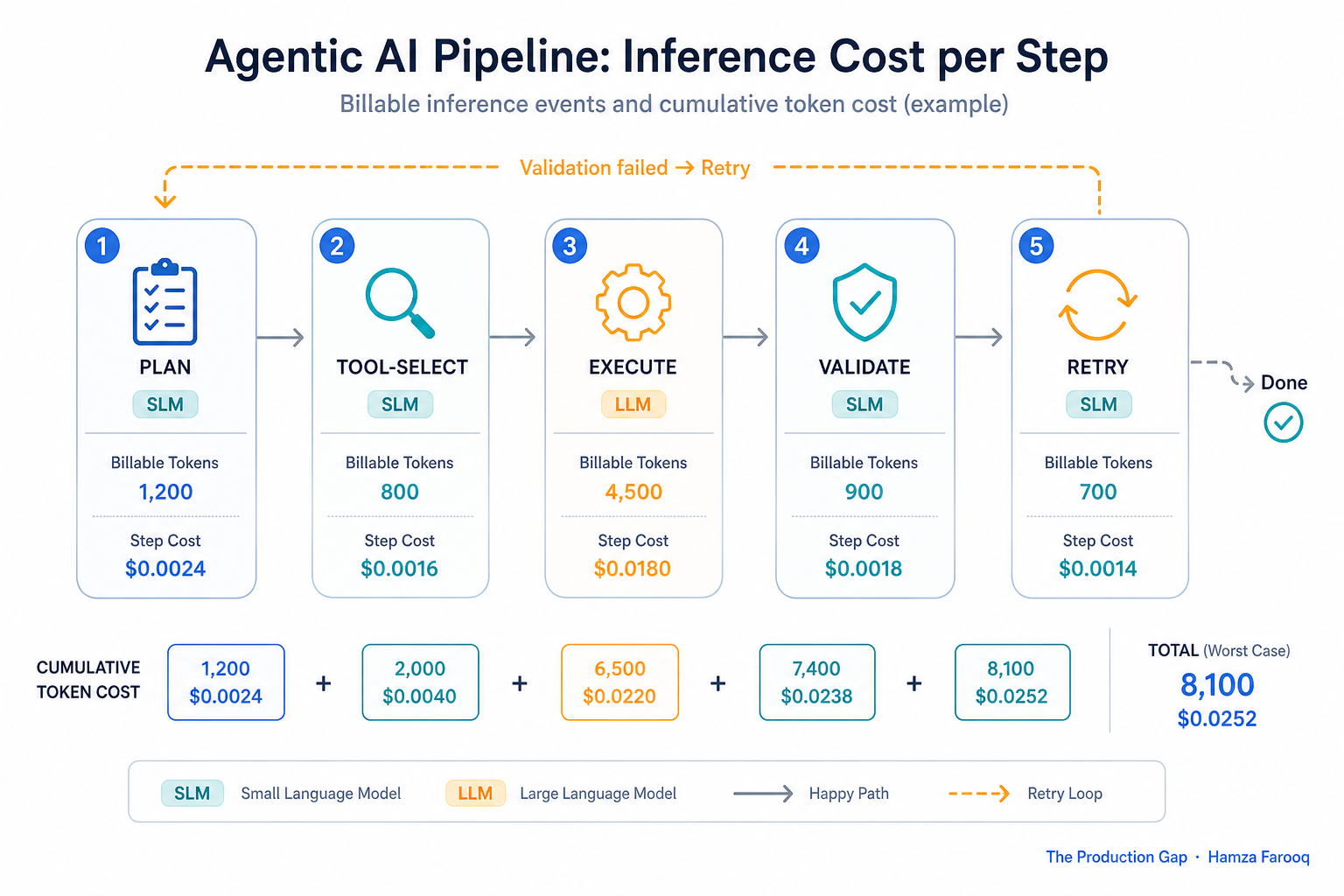
Each planning, tool-selection, retry, and validation step triggers a separate billable model call, and frontier models charge for every token in every call.
A five-step workflow costs five decision-cycle prices before counting a single retry. Retry loops are structurally unavoidable: tool failures, malformed outputs, and ambiguous instructions all generate unbudgeted calls. Context window bloat compounds this further: as agents accumulate tool outputs, token counts grow and frontier models charge for the full context on every call. TechTarget frames the problem as proportionality, costs scaling with agent verbosity rather than business value. The issue is not that frontier models are expensive per call; it is that agent architectures multiply calls in ways nobody priced into the original business case.
Which agent steps actually need a frontier model, and which don't?
Most pipeline steps, formatting, schema validation, fixed-list tool selection, deterministic extraction, can be handled reliably by small language models; frontier calls should be reserved for multi-constraint reasoning and ambiguous instruction resolution.
The Step Complexity Classification (SCC) method scores steps on two axes: output determinism (how predictable is the correct answer?) and instruction ambiguity (how much inference does the step require?). This is a practical framework synthesized from current routing and cost optimization guidance, not an externally measured benchmark.
SCC v1.0, June 2025
| Step Type | Output Determinism | Instruction Ambiguity | Recommended Model Class | Example |
|---|---|---|---|---|
| Schema formatting | High | Low | SLM | Convert JSON field to ISO date |
| Tool selection (fixed list) | High | Low | SLM | Pick from 5 predefined API calls |
| Output validation | Medium | Low | SLM | Check response matches expected schema |
| Summarization (short, structured) | Medium | Medium | SLM or mid-tier | Summarize 3-sentence tool result |
| Multi-constraint reasoning | Low | High | Frontier LLM | Resolve conflicting user intent and policy |
| Ambiguous instruction resolution | Low | High | Frontier LLM | Interpret under-specified user goal |
| Error recovery / novel failure | Low | High | Frontier LLM | Handle unexpected tool output format |
Most teams never classify steps because frontier models handle ambiguity without complaint. SLM routing forces formal specification of what each step must accomplish, and that work surfaces poorly defined steps that were previously hidden behind an expensive model's tolerance for vagueness. If you cannot score a step's determinism and ambiguity, you have not fully specified it.
How do you build a routing layer that fails gracefully instead of silently?
A production-grade SLM routing layer needs explicit confidence thresholds and structured escalation paths so that when a small model fails, the pipeline escalates rather than passing a wrong answer downstream.
The core failure mode in naively retrofitted pipelines is silent degradation: prompt templates built for frontier models cause SLMs to produce plausible-but-wrong answers, schema validation misses the nuance, and the pipeline treats it as a success. The downstream cost of that undetected failure exceeds whatever was saved on inference.
The fix is a three-layer routing guardrail:
- Output schema validation: Every SLM response is checked against a strict expected schema; failure triggers immediate escalation, not a retry.
- Confidence signaling: SLMs return a structured confidence flag; below threshold, the step auto-escalates to the frontier model.
- Cost-aware retry logic: Low-consequence failures log and continue; high-consequence steps always escalate.
The AWS Well-Architected Agentic AI Lens codifies model-class-to-task matching and token budget enforcement as architectural requirements at the routing layer. At some complexity threshold, the combined cost of SLM failure plus escalation exceeds simply routing to the frontier model upfront, and that threshold is empirical, which is why instrumentation matters.
How do you instrument an agentic pipeline to calibrate routing thresholds over time?
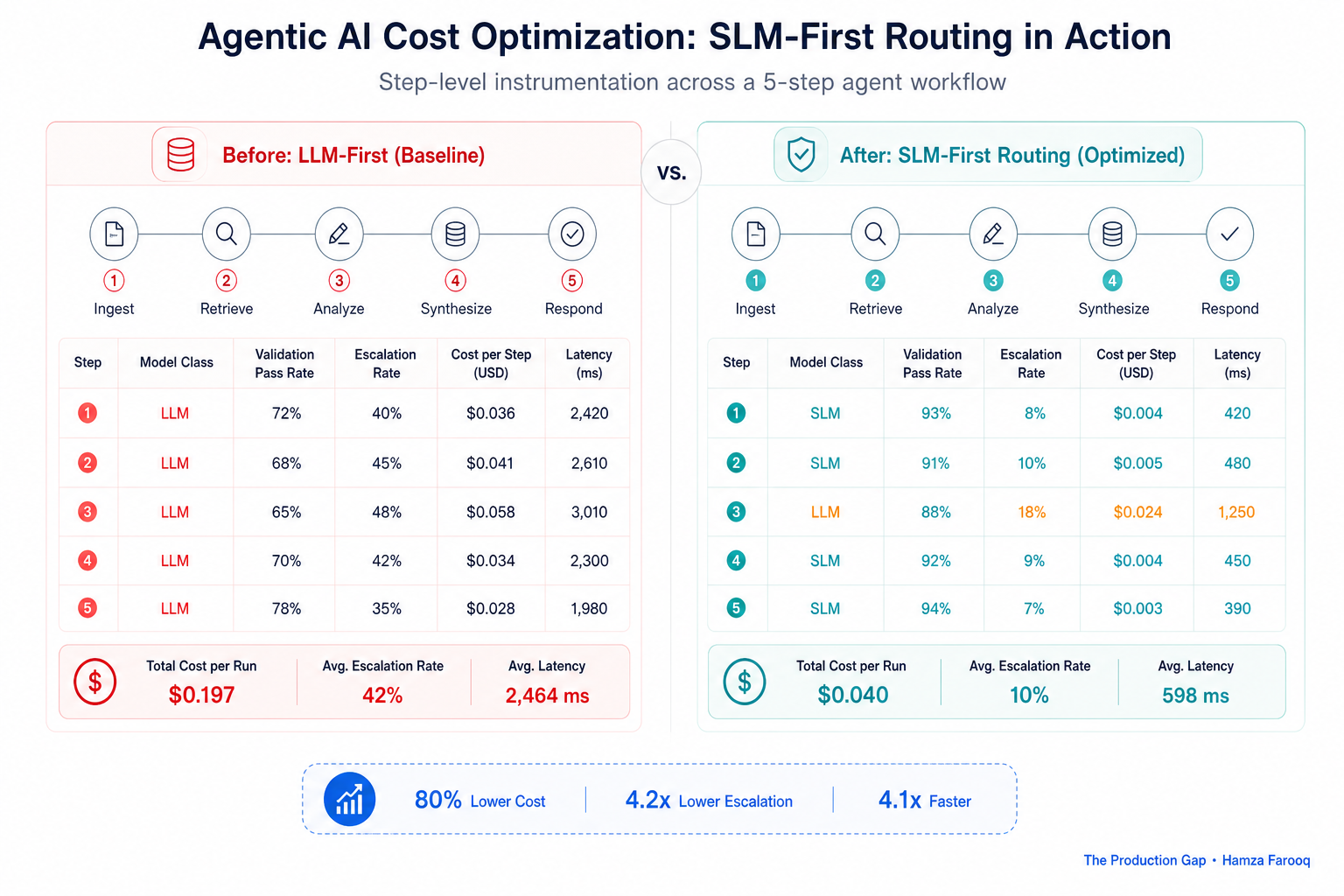
Step-level logging of model class, validation result, latency, token count, and cost is the only reliable way to calibrate SLM routing thresholds over time.
Every routing threshold in the SCC framework is a hypothesis until validated against production data. Log five metrics per step, per run:
- Model class used: SLM or frontier, every step.
- Output validation pass/fail: Did the schema check succeed?
- Escalation triggered: Yes or no, with a reason code.
- Token count and cost: Per step, not per workflow aggregate.
- Step latency: To catch when SLM failure plus retry takes longer than a frontier call would have.
Frequently Asked Questions
What is SLM-first routing in agentic AI, and why does it reduce costs?
SLM-first routing sends each agent step to the smallest model capable of completing it reliably, escalating to a frontier model only when the step requires complex reasoning or ambiguous instruction resolution. Routing routine steps to smaller models reduces per-workflow inference costs and forces step specification that tends to improve pipeline reliability as a side effect.
Which agent steps are safe to route to small models?
Steps with high output determinism and low instruction ambiguity, schema formatting, fixed-list tool selection, structured output validation, are consistently good candidates. Multi-constraint reasoning, novel error recovery, and ambiguous intent resolution should be reserved for frontier models.
At what point does the cost of SLM failure and retry exceed the savings from avoiding a frontier model call?
When the SLM escalation rate multiplied by the combined SLM-plus-frontier cost exceeds the frontier model's standalone cost for that step type, routing SLM-first is net-negative. Step-level instrumentation is the only reliable way to identify this threshold.
How do you retrofit an LLM-first agentic pipeline with SLM routing without breaking it?
Classify every existing step using the SCC framework, audit prompt templates for overbuilt complexity that will cause silent SLM failure, then add output schema validation and confidence-based escalation before reducing any model class assignment. Expect classification to surface underspecified steps a frontier model was quietly handling, those must be redesigned before any routing change is safe to deploy.
Conclusion
Teams that treat agentic AI cost optimization as a dashboard problem will keep watching their bills grow. Teams that treat it as an architecture problem build unit economics that hold at scale. AWS, Azure, and CloudZero have each formalized frameworks that reflect this distinction.
The most expensive thing in your agentic pipeline is not the frontier model. It is the unclassified step that did not need one.
Your next step: Open the SCC table above. List every step in your current pipeline that routes to a frontier model by default. Score each on output determinism and instruction ambiguity. Any step scoring high on both axes is your first SLM routing candidate, and your first instrumentation priority.
Learn from me
Agent Engineering Bootcamp: Developers Edition, my Maven cohort. Advanced agentic RAG, multi-agent orchestration, memory, evals, and guardrails. Take agents from prototype to production. Join the next cohort →
Hire us
Traversaal.ai. We're a team of forward deployed engineers solving the toughest AI problems for Fortune 100 companies: document intelligence, agentic data platforms, and real-time web intelligence, deployed in production. Work with our team to deploy your next agentic ecosystem. Talk to Traversaal.ai →
Join us
Want to solve these problems with us? We're always looking for forward deployed engineers who want to ship production AI. jobs@traversaal.ai
