
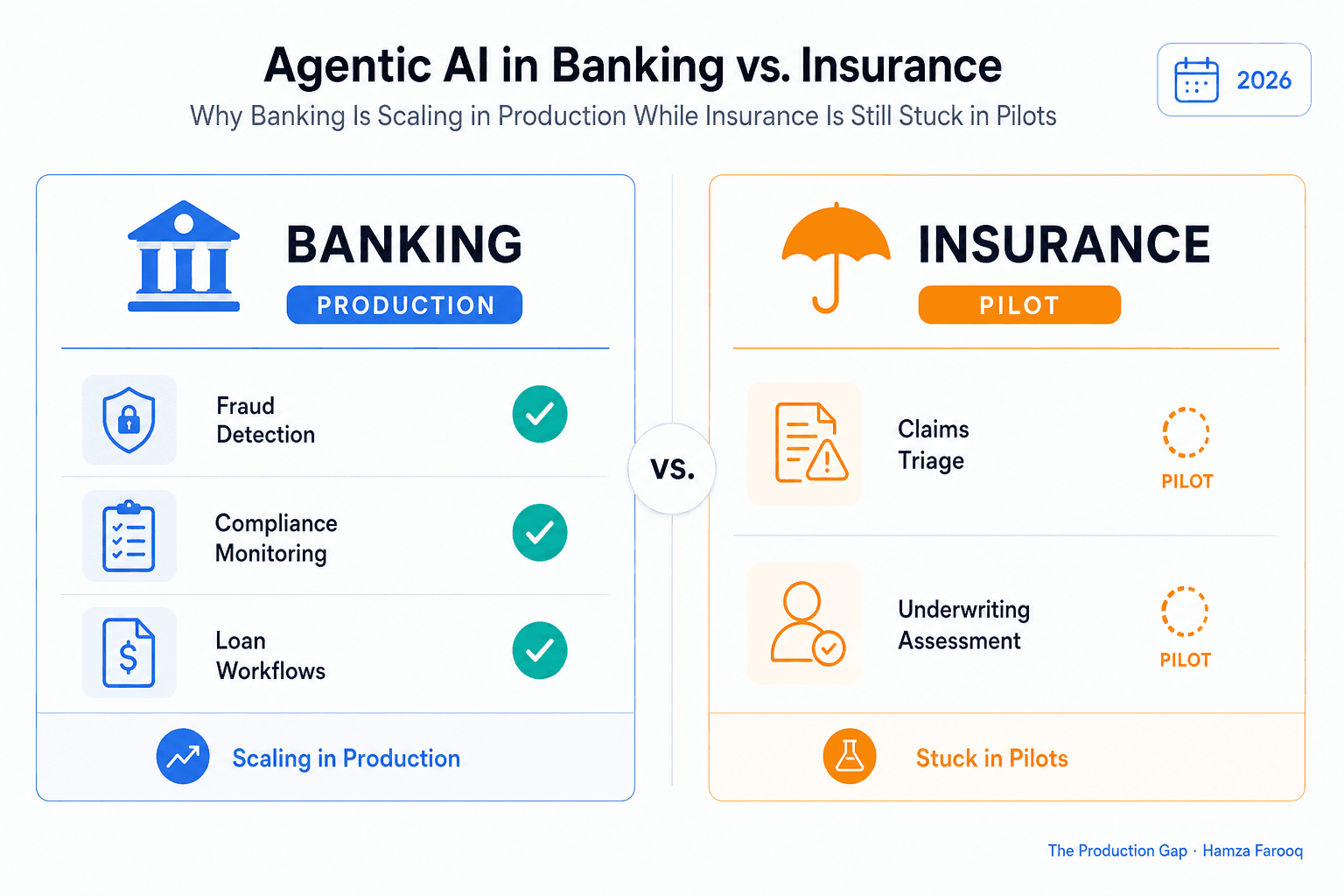
TL;DR: Agentic AI, meaning AI systems that plan, reason, and execute multi-step workflows with limited human supervision, has crossed into scaled production in banking because banks operate on structured data with reversible, auditable decisions. Insurance remains in pilots as of mid-2026 because claims decisions create immediately binding liability across 50 separate state regulatory regimes, a structural barrier that technology alone cannot clear.
Key Takeaways
- Regulatory fragmentation is the core blocker for insurance: 50 state regimes versus one federal charter that banks can satisfy centrally.
- Claims liability creates unique exposure for insurance carriers in ways that banking's reversible use cases do not face.
- Human-in-the-loop requirements differ sharply between sectors; insurance coverage decisions require review that slows autonomous deployment.
- The production gap is a legal architecture problem, not a technology problem, and closing it requires external conditions to shift, not just internal investment.
Introduction
Moody's confirms that financial services AI has entered a new phase as of 2026: systems that plan, reason, and execute complex workflows with limited human supervision. Agentic AI, in the working definition used throughout this guide, refers to AI systems capable of taking multi-step autonomous action within a defined workflow, with human intervention arriving only at specified checkpoints rather than at every step. Banks are posting real outcomes, and one study cited by Wipfli shows up to 30% cost savings and 20% revenue growth. Insurance leaders, by contrast, are still defending pilot budgets to boards that expected production timelines by now.
Which banking agentic AI use cases are already in production?
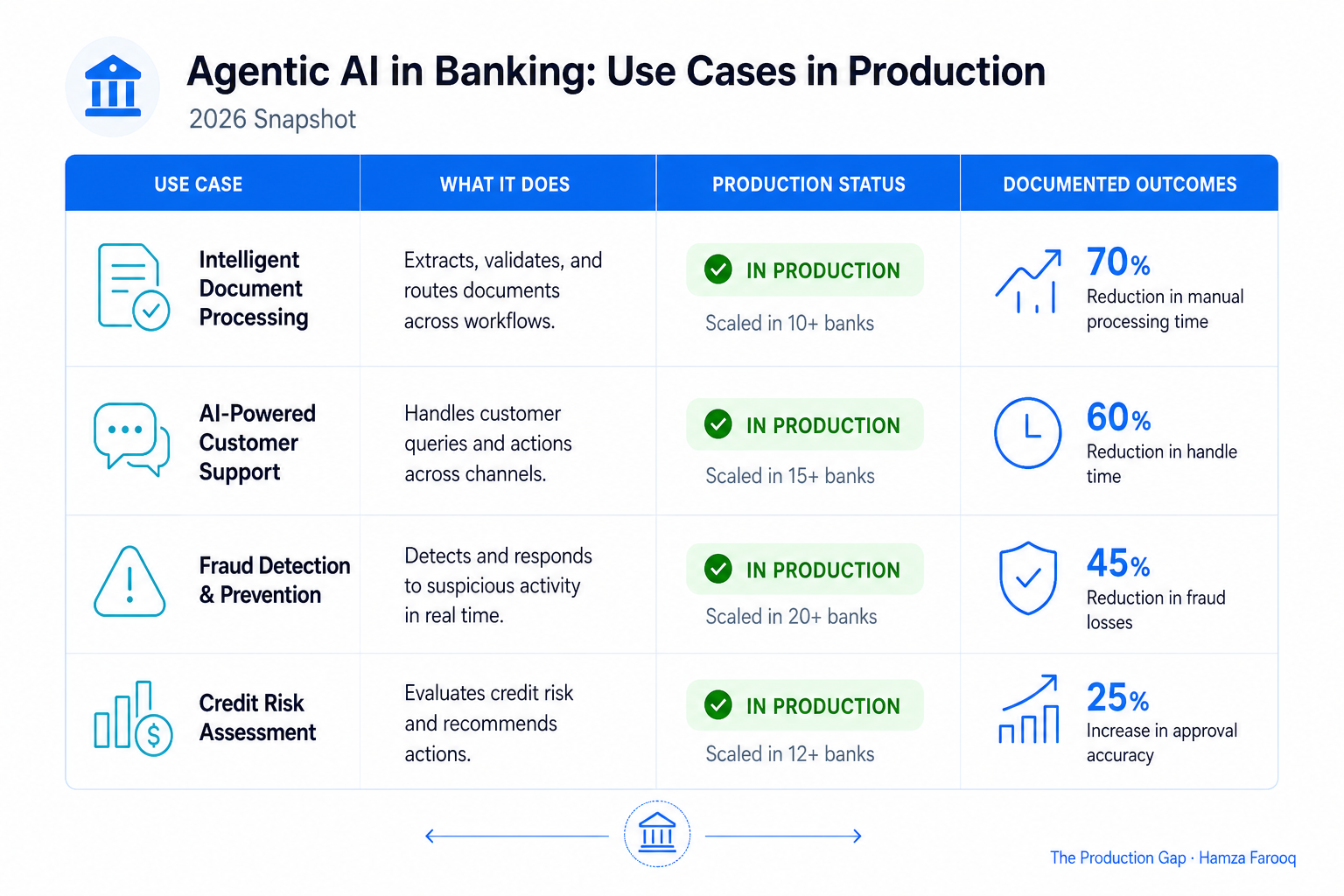
Banking's agentic AI runs in production across four use cases: fraud detection, compliance monitoring, loan pre-screening, and customer engagement. DruidAI documents banks using agentic AI to monitor regulatory updates continuously, map changes to internal policies, and trigger responses in real time, behavior that reflects infrastructure deployment, not a controlled pilot. Neurons Lab notes that these workflows run independently, with human intervention arriving only at defined decision points.
What makes banking deployment viable, as a practical rule of thumb used in this guide, is a reversibility principle: production is more defensible when an AI error can be caught and corrected before generating irreversible legal or financial consequences. A fraud flag is an input to a human decision. A loan pre-screen is not binding on either party. Insurance claims decisions, by contrast, can create immediately binding coverage determinations, a structural difference that shapes the entire production calculus.
Table 1: Agentic AI Deployment Status by Use Case, Banking vs. Insurance (2026)
| Use Case | Sector | Deployment Status (as of mid-2026) | Human Oversight Model | Error Reversibility |
|---|---|---|---|---|
| Fraud detection | Banking | Production at scale | Review triggered by AI flag | High, flag overridden pre-action |
| Compliance monitoring | Banking | Production at scale | Human validates mapped changes | High, policy update can be revised |
| Loan pre-screening | Banking | Production at scale | Human underwrites final decision | High, AI pre-screen is not binding |
| Customer engagement | Banking | Production at scale | Escalation protocols in place | High, conversation can be corrected |
| Claims triage | Insurance | Pilot or limited production | Required by most state regulations | Low, triage influences binding determination |
| Underwriting support | Insurance | Pilot or limited production | Varies by state and line of business | Medium, recommendation, not binding |
| Autonomous claims decision | Insurance | Not in broad production | Legally required in most jurisdictions | Very low, triggers bad-faith exposure |
Why is insurance converting pilots to production at a lower rate than banking?
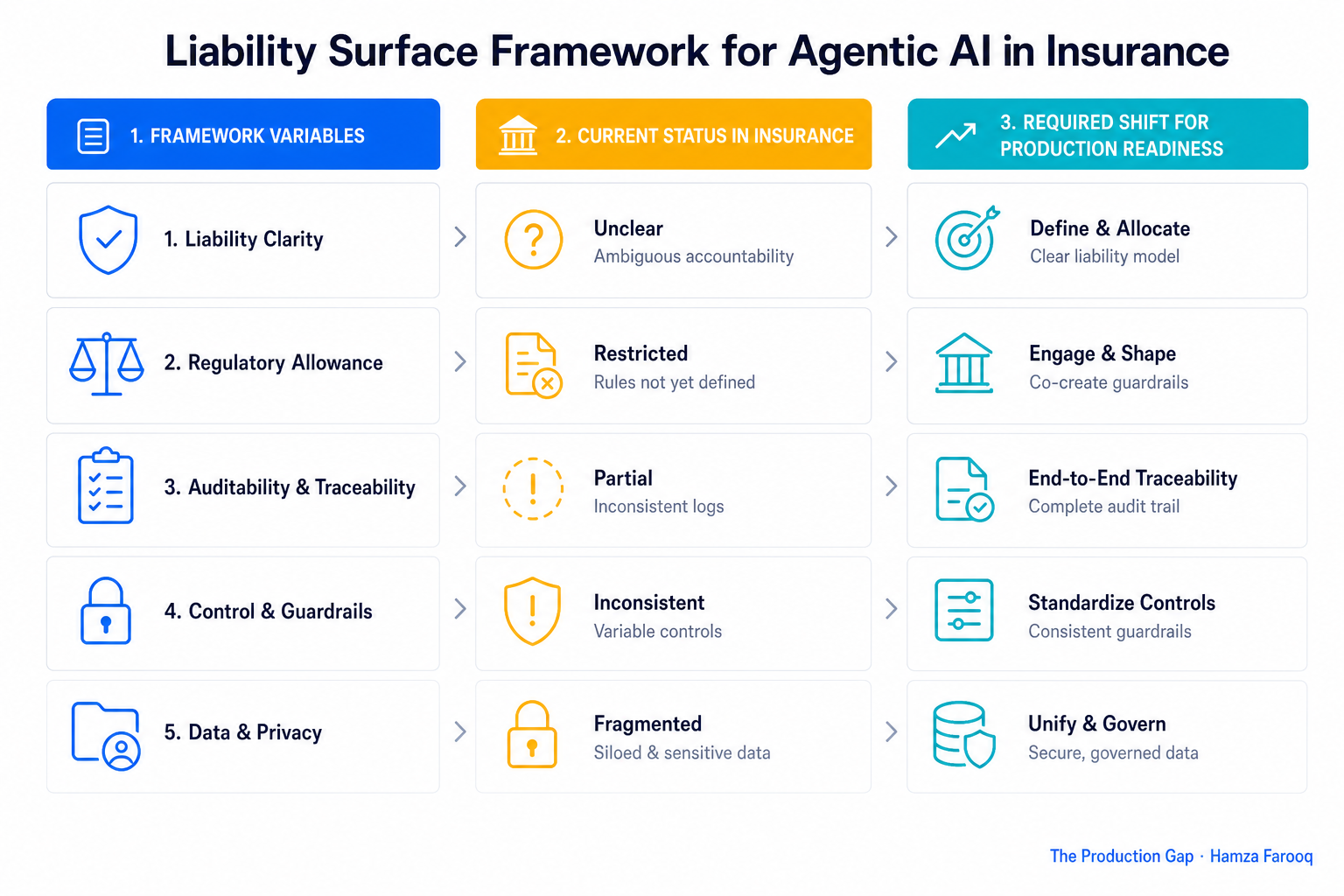
Salesforce notes that agentic AI in insurance operates "within set parameters," but those parameters are defined by 50 separate state regimes, each with its own claims-handling, disclosure, and liability requirements. A carrier operating across multiple states would need its agentic claims system to satisfy each regime's requirements independently, with no single federal charter offering a consolidated path to compliance. The Center for Democracy and Technology flags that regulatory frameworks for agentic AI in financial services are still actively developing, largely federal and maturing for banking, state-by-state and unresolved for insurance.
Kore.ai's practice of treating FSI as a combined category can obscure this divergence: banking's production numbers carry the headline while insurance's pilot-stage reality disappears into the sector average. The framework used in this guide identifies three variables that determine insurance production readiness: decision bindingness (whether AI output creates a legally binding outcome), regulatory jurisdiction count (how many separate regimes must be satisfied), and liability exposure speed (how quickly an incorrect decision creates actionable carrier risk). Insurance claims decisions score unfavorably on all three. Banking's leading use cases score favorably on all three.
What structural conditions would need to change for insurance to match banking's production rate?
Regulatory harmonization. Without NAIC model frameworks or a federal overlay establishing baseline AI decision standards, carriers face a fragmented compliance landscape that multiplies the cost and timeline of production clearance. Everest Group notes that platforms are still building integration foundations rather than deploying at scale, a pattern consistent with an industry still navigating architecture decisions before committing to production. In the author's view, harmonization would directly reduce the jurisdiction-count variable in the production readiness equation described above.
Liability safe harbors. Carriers would benefit from statutory language clarifying that AI-assisted decisions with documented human review at defined checkpoints do not automatically constitute bad-faith claims handling under applicable state law. Without that clarity, the liability exposure window remains open regardless of how well the underlying model performs, and legal teams will continue blocking production sign-off on otherwise ready systems.
Standardized human-in-the-loop architecture. "Human in the loop" currently carries different operational meanings across states and lines of business, which forces carriers to build compliance-grade review processes independently for each jurisdiction. A shared NAIC or IAIS standard defining what human review must look like for AI-assisted claims decisions would, in the author's view, allow carriers to build one architecture rather than many, and would convert AI output from a potentially binding determination into a documented reviewed recommendation.
Insurance leaders building production roadmaps around technology readiness alone are solving the wrong problem. The technology in many cases is ready; what is not ready is the legal and regulatory architecture that would let carriers deploy it without unacceptable liability exposure.
Frequently Asked Questions
Why are banks deploying agentic AI at scale while insurance carriers remain in pilot mode? Banks' leading use cases have a favorable reversibility profile: errors are typically caught before generating binding legal outcomes. Insurance claims decisions, by contrast, can create immediate liability the moment AI influences a coverage determination, making production contingent on regulatory clearance that most states have not yet provided.
What specific regulatory barriers prevent insurance from moving agentic AI to production? The core barrier is regulatory fragmentation, not technology: carriers operating across multiple states face separate claims-handling, disclosure, and liability requirements in each jurisdiction, with no consolidated federal equivalent and no standardized industry framework to accelerate multi-state clearance. A nationally deployable agentic claims system would need to satisfy each state regime independently, which substantially raises compliance cost and timeline relative to banking.
What would need to change for insurance agentic AI production rates to match banking? Three changes would be most consequential, in the author's view: state-level regulatory harmonization via NAIC model frameworks, liability safe-harbor provisions for AI-assisted claims decisions with documented human review, and a standardized industry definition of human-in-the-loop requirements for multi-state claims workflows. The bottleneck is legal architecture, not the underlying technology.
Conclusion
Vendor pitches that treat banking and insurance as interchangeable FSI categories describe a deployment reality that does not hold up under scrutiny. Banking crossed the production threshold because its leading use cases have a favorable reversibility and liability profile. Insurance has not crossed it because claims decisions score unfavorably on bindingness, jurisdiction count, and liability exposure speed simultaneously, and in ways that no current platform configuration resolves without prior regulatory clearance.
Insurance CIOs should stop benchmarking against banking deployment timelines and start tracking NAIC regulatory progress and state-level safe-harbor legislation instead. The gap is a liability architecture problem, and closing it requires external conditions to shift, not just internal investment to increase.
Want to know which insurance agentic AI deployments already shipped and what returns they generated? Read our analysis of proven returns from insurance agentic AI deployments that did ship, the use cases that cleared the liability threshold and what made them different.
Learn from me
Agentic AI for Product Managers, my Maven cohort. Learn how to design, evaluate, and ship reliable AI systems: the technical fluency PMs need to lead agentic products, no engineering background required. Join the next cohort →
Hire us
Traversaal.ai. We're a team of forward deployed engineers solving the toughest AI problems for Fortune 100 companies: document intelligence, agentic data platforms, and real-time web intelligence, deployed in production. Work with our team to deploy your next agentic ecosystem. Talk to Traversaal.ai →
Join us
Want to solve these problems with us? We're always looking for forward deployed engineers who want to ship production AI. jobs@traversaal.ai
