
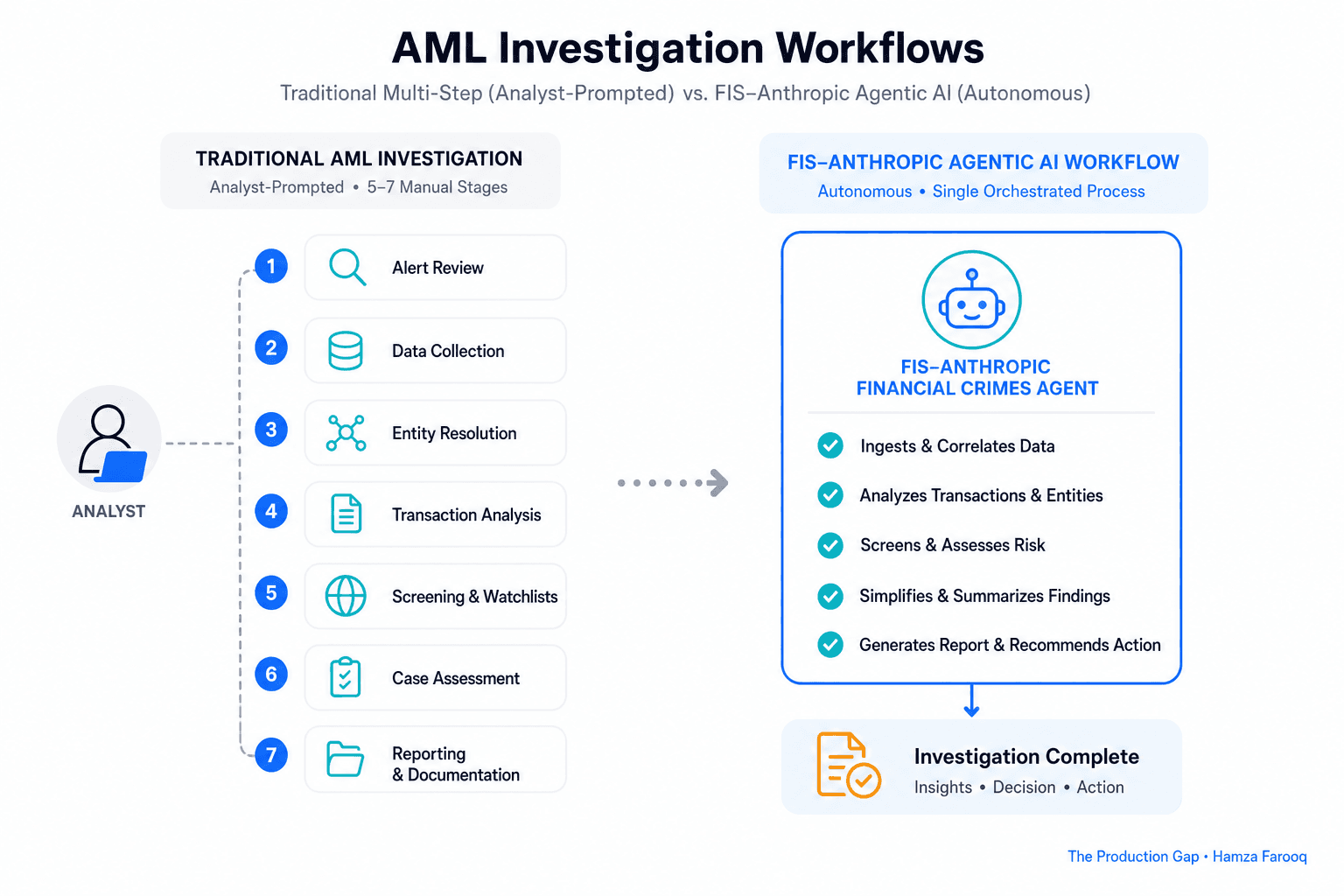
TL;DR: On May 4, 2026, FIS and Anthropic announced a Financial Crimes Agent built on Claude that autonomously executes the full AML investigation cycle, from alert triage through case disposition, without human prompting at each step. BMO and Amalgamated Bank are the first institutions to deploy it in a live, regulated environment. The efficiency case is credible, but no U.S. regulator has issued guidance on human oversight standards for AI-closed cases, creating real retroactive compliance exposure.
Key Takeaways
- Agentic AI is a step-change, not an upgrade: it plans, reasons across data sources, and completes entire investigation workflows without human prompting at each step.
- BMO and Amalgamated Bank are the real proof of concept. As the first institutions to deploy the FIS Financial Crimes Agent in a live, regulated AML environment, their production deployments move this from marketing to a data point worth studying.
- No regulatory safe harbor exists for AI-closed cases. As of May 2026, neither FinCEN nor other U.S. bank regulators have defined adequate human oversight standards for agentic AML systems.
- Auditability is the governance pressure point. Regulators require investigations to be fully reconstructable, and autonomous AI must be built to meet that standard from the start.
How does agentic AI differ from the rules-based and ML systems banks already use for AML?
Agentic AI independently plans a multi-step investigation, reasons across disparate data sources, and executes a complete case workflow without a human prompting each action. That distinction separates it from every prior generation of AML tooling.
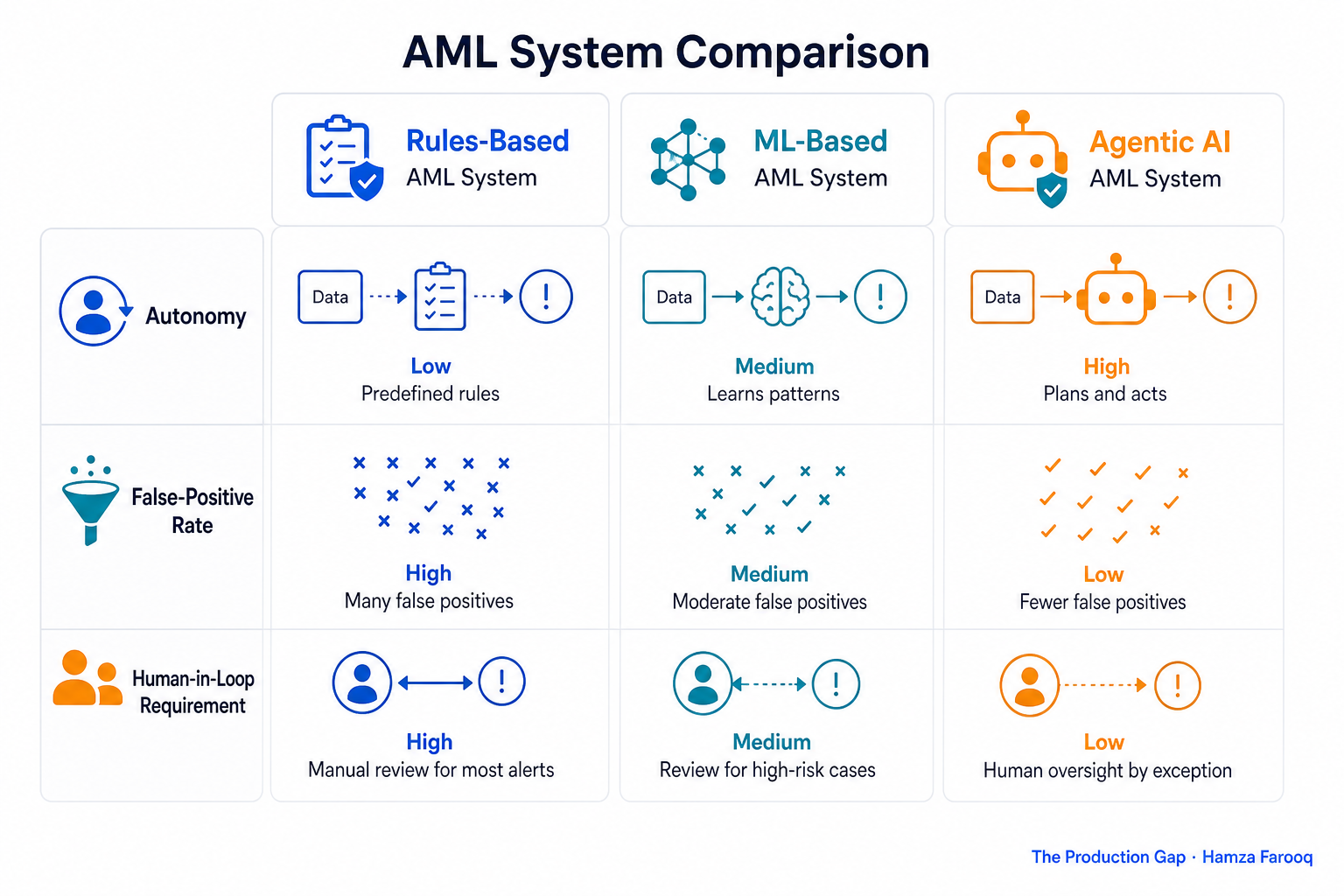
Rules-based systems flag on rigid transaction thresholds, producing false-positive volumes that bury analysts. ML systems reduce false positives through pattern recognition but still require human action at each decision node. Agentic AI plans, reasons, executes, and closes the case as a single orchestrated workflow. The difference is not speed. It is autonomy.
Where an ML system flags a structuring pattern for analyst review, the FIS Financial Crimes Agent autonomously pulls transaction history, checks entity relationships, cross-references watchlists, drafts the investigation narrative, and closes the case or escalates for SAR filing, with no human prompt required between steps.
Table 1: AML System Capability Comparison, Rules-Based vs. ML vs. Agentic AI
| Capability | Rules-Based | ML-Based | Agentic AI (FIS/Claude) |
|---|---|---|---|
| False positive handling | High volume, manual triage | Reduced, analyst-reviewed | Autonomous triage and disposition |
| Multi-step reasoning | None | Limited | Core function |
| Data source integration | Single system | Single or dual | Multi-system, cross-tool |
| Human prompt required per step | Yes | Yes | No |
| Case closure authority | Human | Human | Agent (configurable oversight) |
| Audit trail generation | Manual | Partial | Automated |
What does the FIS Financial Crimes Agent actually do inside an AML investigation workflow?
The distinction worth noting: the agent produces a disposition, not a summary for a human to act on. That single difference creates both the efficiency case and the governance exposure simultaneously.
What do BMO and Amalgamated Bank's early AML AI deployments show?
BMO and Amalgamated Bank are the first institutions to deploy the FIS Financial Crimes Agent in a live, regulated AML environment, as announced May 4, 2026. Their production deployments are the first documented cases of agentic AI operating inside a regulated financial crimes workflow, making them early reference points for a governance model that does not yet formally exist.
That is meaningful. It moves the conversation from theoretical capability to an operational data point. Banks evaluating agentic AI for AML can now point to institutions that have accepted the regulatory exposure and moved forward in a production environment.
What governance gaps remain after the FIS-Anthropic launch?
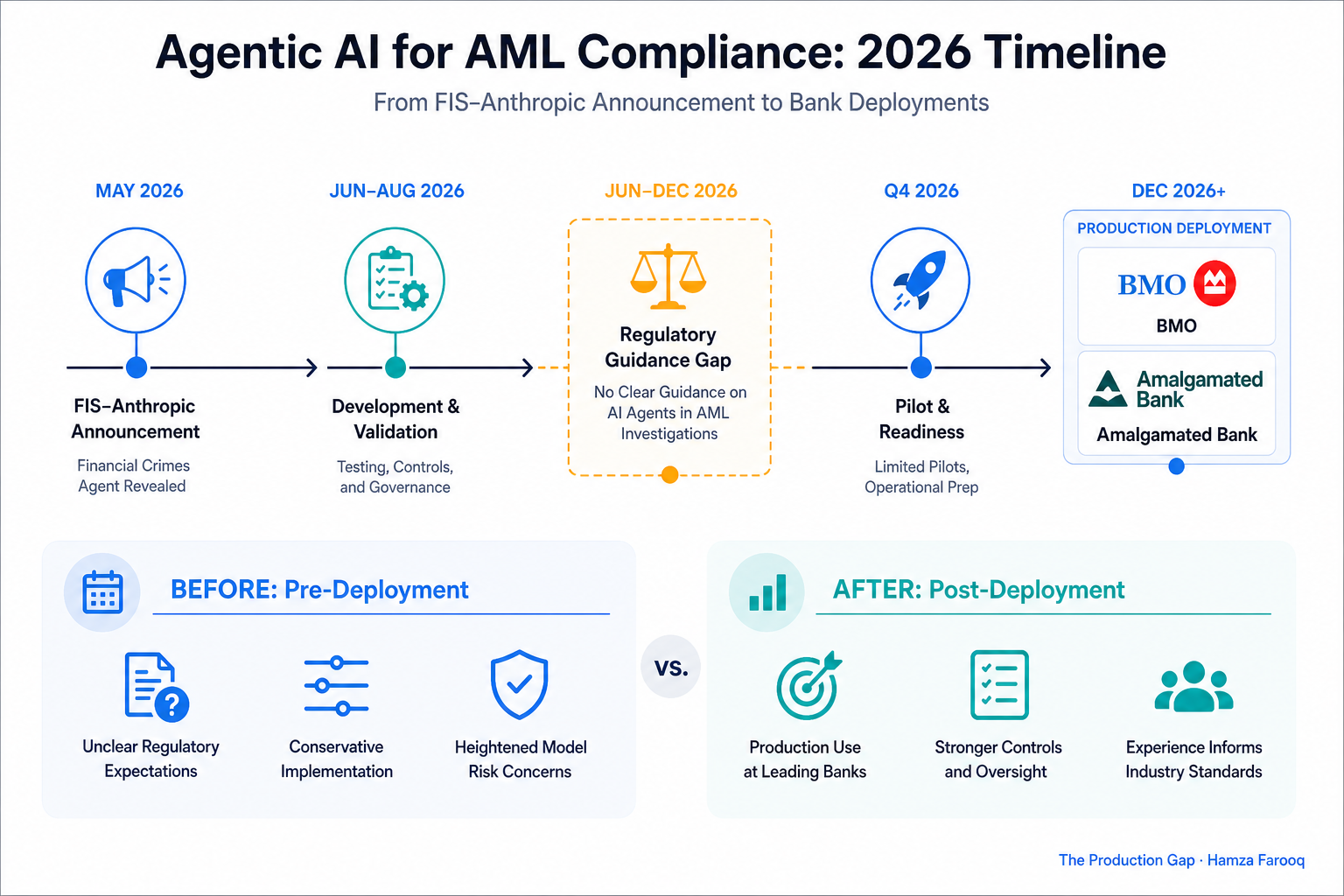
The most important gap is that no regulator has defined what adequate human oversight looks like for an AI-closed AML case. What remains publicly undisclosed about the BMO and Amalgamated Bank deployments is whether the agent holds full case closure authority or operates in a triage-assist mode. Compliance leaders should press FIS directly on that boundary before drawing operational conclusions.
Post-2008 regulatory requirements pushed banks toward larger AML analyst workforces to satisfy human oversight standards. Agentic AI now automates those same workflows. If regulators later determine that AI-closed cases lacked sufficient documented human judgment, banks face retroactive exposure at the same moment their analyst capacity may have been reduced. This compliance labor tension is, as a matter of author synthesis, the most underexamined risk in the current deployment conversation.
What governance risks must compliance leaders pressure-test before deploying agentic AI in AML workflows?
Before deploying agentic AI in AML workflows, compliance leaders should pressure-test four risks: absent regulatory safe harbors, auditability of agent decision logic, retroactive exposure on AI-closed cases, and workforce resilience. The framework below is presented as a practical rule of thumb for pre-deployment review, not as externally validated regulatory guidance.
Risk 1, Regulatory gray territory: As of May 2026, formal guidance on adequate human oversight for agentic case closures has not been issued by FinCEN or other U.S. bank regulators. Vendor SLAs do not protect banks from regulatory findings.
Risk 2, Auditability: Automated audit trails must be interpretable by an examiner unfamiliar with the agent's output format. If an examiner pulls a case closed 18 months prior, the bank must produce a defensible account of every disposition decision made along the way.
Risk 3, Retroactive exposure: Cases closed today become the audit population of 2027 and 2028. The governance framework should be designed to survive a stricter future standard, not only the current one.
Risk 4, Workforce resilience: Automating analyst roles creates operational risk if agent performance degrades and institutional knowledge has eroded. This is not only an HR consideration. It is a regulatory accountability issue.
The FIS Agentic AML Governance Pre-Deployment Checklist below is the framework used in this guide for evaluating readiness before any agentic AML deployment. Compliance teams should be able to answer every gate before go-live.
| Gate | Question to Answer Before Go-Live |
|---|---|
| 1. Regulatory safe harbor | Has counsel confirmed no current guidance prohibits AI-only case closure? |
| 2. Auditability | Can every agent decision node be reconstructed and explained in plain language? |
| 3. Retroactive exposure | Is the current governance framework defensible under a stricter future standard? |
| 4. Workforce resilience | Is human expertise preserved to audit, override, and recover from agent failures? |
Frequently Asked Questions
What is agentic AI in the context of AML compliance?
Agentic AI autonomously plans and executes multi-step financial crimes investigation workflows without human prompting at each step. Unlike ML tools that surface alerts for analyst review, the FIS Financial Crimes Agent completes the investigation itself, from triage through case disposition.
Why did FIS choose Anthropic's Claude over other large language models?
FIS selected Claude because Anthropic built controllability, predictable behavior, and safety-oriented design as core architectural priorities. Those properties matter directly when agent outputs must be auditable by financial regulators.
What is the compliance labor tension created by agentic AML automation?
Post-2008 regulatory requirements pushed banks toward larger AML analyst workforces to satisfy human oversight standards. Agentic AI now automates those same workflows. If regulators later determine that AI-closed cases lacked sufficient documented human judgment, banks face retroactive exposure at the same moment their analyst capacity has been reduced. This tension is the most underexamined operational risk in early agentic AML deployments.
Conclusion
The FIS-Anthropic Financial Crimes Agent is designed to compress investigation timelines significantly, and the efficiency case is credible.T he deployments at BMO and Amalgamated Bank confirm that at least two regulated institutions have decided the operational upside justifies moving forward without a regulatory safety net in place.
Cases closed by autonomous AI today will be the regulatory audit population of 2027 and 2028, and the governance framework that would protect those closures has not been established by FinCEN or other U.S. bank regulators. Waiting for that guidance before building internal governance structures is the higher-risk path, not the lower one.
Map your current AML case closure workflow against the FIS Agentic AML Governance Pre-Deployment Checklist above. Identify which gates you cannot answer before speaking to any vendor. The gaps you find are the starting point for every conversation that follows.
Learn from me
Agentic AI for Product Managers, my Maven cohort. Learn how to design, evaluate, and ship reliable AI systems: the technical fluency PMs need to lead agentic products, no engineering background required. Join the next cohort →
Hire us
Traversaal.ai. We're a team of forward deployed engineers solving the toughest AI problems for Fortune 100 companies: document intelligence, agentic data platforms, and real-time web intelligence, deployed in production. Work with our team to deploy your next agentic ecosystem. Talk to Traversaal.ai →
Join us
Want to solve these problems with us? We're always looking for forward deployed engineers who want to ship production AI. jobs@traversaal.ai
