
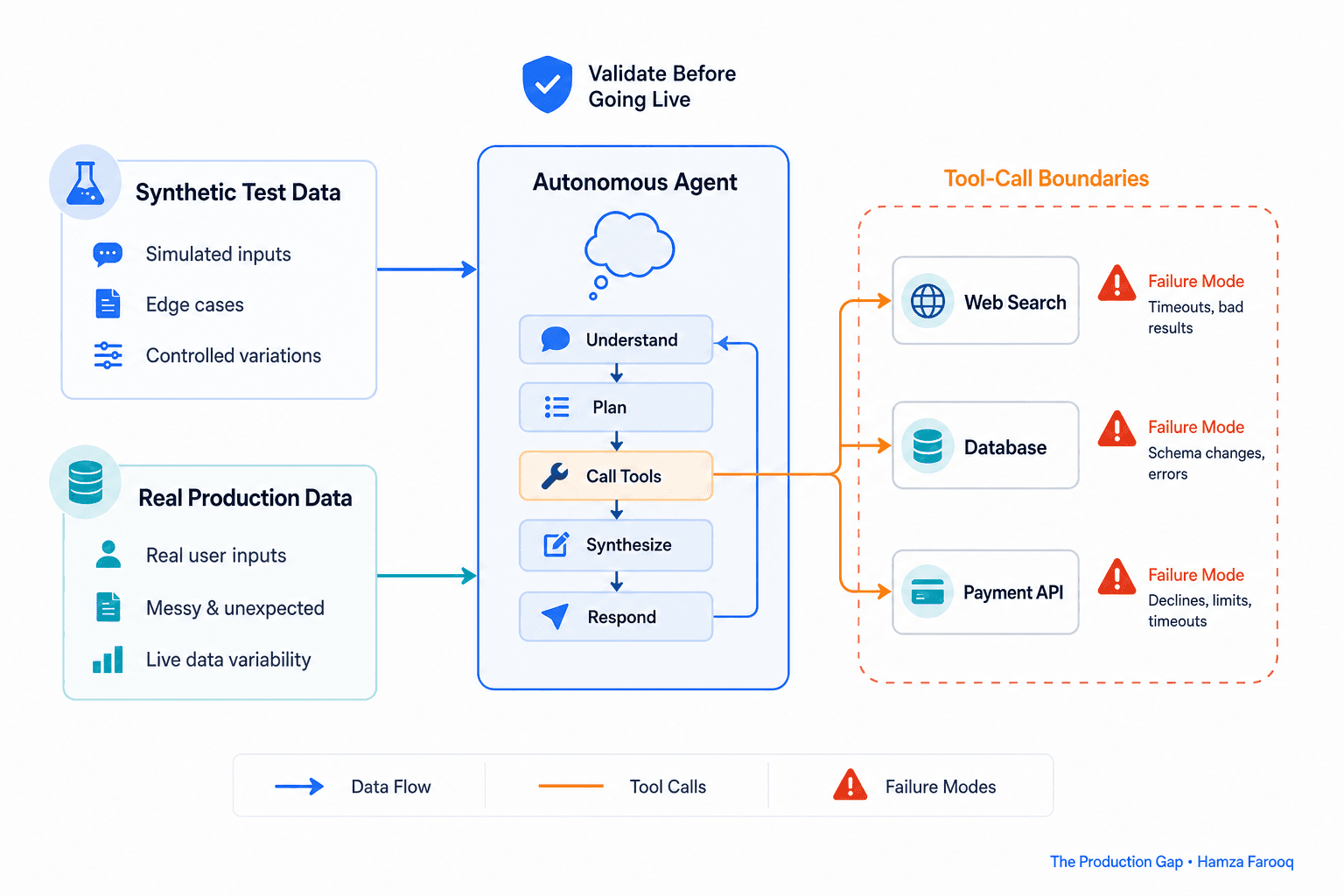
TL;DR: Pre-production testing of autonomous agents fails when it relies entirely on synthetic data, because synthetic inputs cannot reproduce the combinatorial complexity of real tool calls and real API states. Closing that fidelity gap requires replaying real historical production inputs against the agent in a side-effect-suppressed, environment-isolated rehearsal before any live deployment, giving teams evidence of correct behavior rather than a best-guess approximation.
Key Takeaways
- Synthetic data cannot replicate real tool-call complexity. Engineers build synthetic datasets from the happy path, which inadvertently excludes the edge cases production users actually generate.
- Agents can mask tool failures behind plausible outputs. Output-correctness checks alone will miss silent tool-call breakdowns underneath a clean-looking response.
- Historical replay is the anchor step in this guide's framework. Running the agent against real past production inputs surfaces failure modes no synthetic scenario anticipated.
- End-to-end offline rehearsal catches what unit tests miss. Side-effect suppression lets teams observe the full multi-step decision tree without exposing live systems.
- Environment isolation must be enforced at the infrastructure level. Convention-based credential swaps between test and deploy environments are a documented source of production incidents staging never caught.
- Pre-production testing reduces uncertainty; it rarely eliminates it. Deployment timing into low-traffic windows is a sequential risk reducer, not a redundant one.
- Divergence between rehearsal and production behavior is a signal worth investigating. Treat every divergent case as a candidate for review before scheduling deployment.
What makes pre-production agent testing so difficult?
Pre-production agent testing is difficult because a fundamental fidelity gap exists between the synthetic inputs teams can construct and the combinatorial reality of real tool calls, real API states, and real user inputs that only production traffic contains.
A current thread on r/AI_Agents confirms the struggle is not unique to any one team. AI agents can produce plausible responses even when underlying tool calls fail silently, so output-correctness checks alone miss the actual breakdowns. Closing that gap requires anchoring validation to historical production inputs rather than synthetic scenarios constructed from the happy path.
Why does synthetic test data keep failing autonomous agents in pre-production?
Synthetic test data fails autonomous agents because it cannot replicate the combinatorial reality of real tool calls, real API states, and real user inputs that only production traffic contains.
Synthetic datasets are built by engineers who already know the happy path, which means edge cases that production users actually generate are inadvertently excluded. AI agents can return plausible outputs while silently mishandling tool execution underneath, so a clean-passing suite may prove nothing about real failure modes.
Frameworks like Maxim's end-to-end pipeline and StackAI's testing spectrum are sound approaches, but they share a ceiling: ground truth remains synthetic or hand-curated. No framework closes the fidelity gap without replaying real production inputs, and even then, for many teams, production remains effectively the only realistic test environment, with pre-production approaches reducing uncertainty rather than replacing live exposure.
What does a strong offline rehearsal mechanism for autonomous agents actually require?
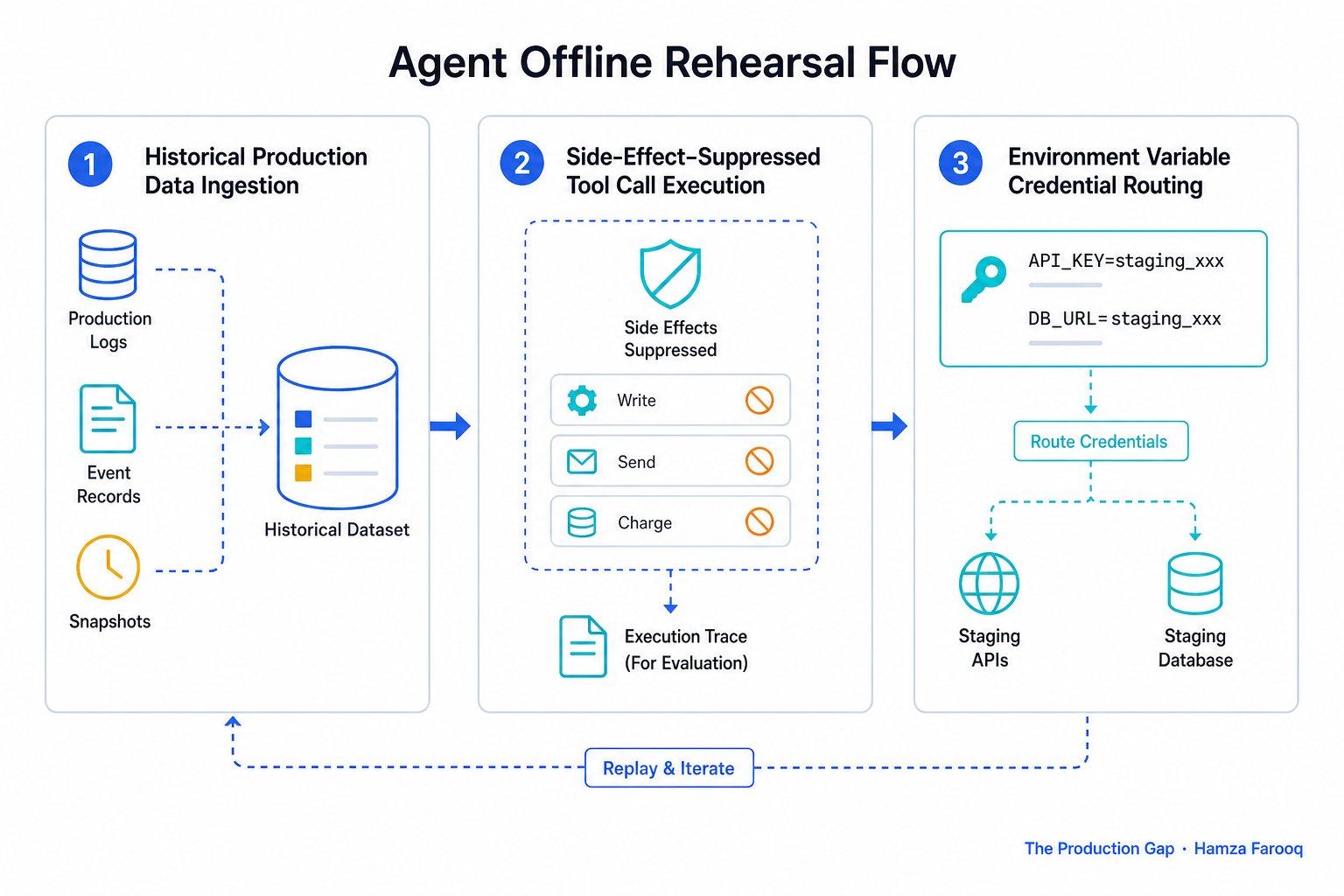
A strong offline rehearsal mechanism for autonomous agents needs three properties working together: it must run against real historical inputs, suppress live side effects during execution, and enforce strict environment isolation so the tested artifact and the deployed artifact are identical.
Historical data replay inverts the standard approach. Rather than constructing synthetic scenarios from scratch, running the agent against actual past production inputs, real tool-call sequences, real user messages, real API payloads, exposes the combinatorial reality that production users already generated. This is the approach that's recommended: test against the exact agent planned for deployment, calling real tools and evaluating against real behavior.
Side-effect suppression makes that safe. The agent should execute its full decision-making logic and fire every tool call, but write operations, emails, database rows, external API charges, must be intercepted before reaching live systems. Teams can then observe the complete multi-step decision tree without live-system exposure.
Environment isolation must be enforced at the infrastructure level, not by convention. Credential swaps between test and deploy environments are a common source of production incidents that staging never caught. Infrastructure-level secret management, where the same named variable routes to staging during rehearsal and to production at go-live, eliminates that class of error entirely.
How do deployment timing and environment isolation complete the pre-production safety picture?
Deployment timing and environment isolation transform rehearsal from a standalone check into a gated release practice. Rehearsal results should clear before the agent goes live, and environment isolation should guarantee the agent never accidentally connects to production resources during validation.
Deployment timing adds a second risk-reduction layer after rehearsal. Even when rehearsal passes, releasing into a low-traffic window means residual risk that survived rehearsal has a smaller blast radius. Rehearsal reduces behavioral uncertainty; timing reduces exposure if uncertainty remains. These are sequential risk reducers, not redundant ones.
Infrastructure-level secret management enforces that the artifact validated and the artifact shipped are identical in configuration. This is the critical property that convention-based approaches routinely break. The StackAI framework flags environment parity as a core concern in end-to-end testing.
Pre-production validation approach comparison Framework
| Stage | Traditional approach | Stronger pre-production approach |
|---|---|---|
| Test data source | Synthetic or hand-curated | Real historical production inputs |
| Side-effect risk | Manual suppression or isolation | Infrastructure-level suppression |
| Environment isolation | Convention-based credential swap | Infrastructure-enforced secret management |
| Release timing | Manual or CI trigger | Scheduled post-rehearsal gate |
| Confidence anchor | Synthetic ground truth | Historical ground truth |
All three properties, historical replay, side-effect suppression, and environment isolation, work as a system. Implementing any one in isolation captures only part of the production-readiness benefit.
How should teams integrate historical replay into an existing agent validation workflow?
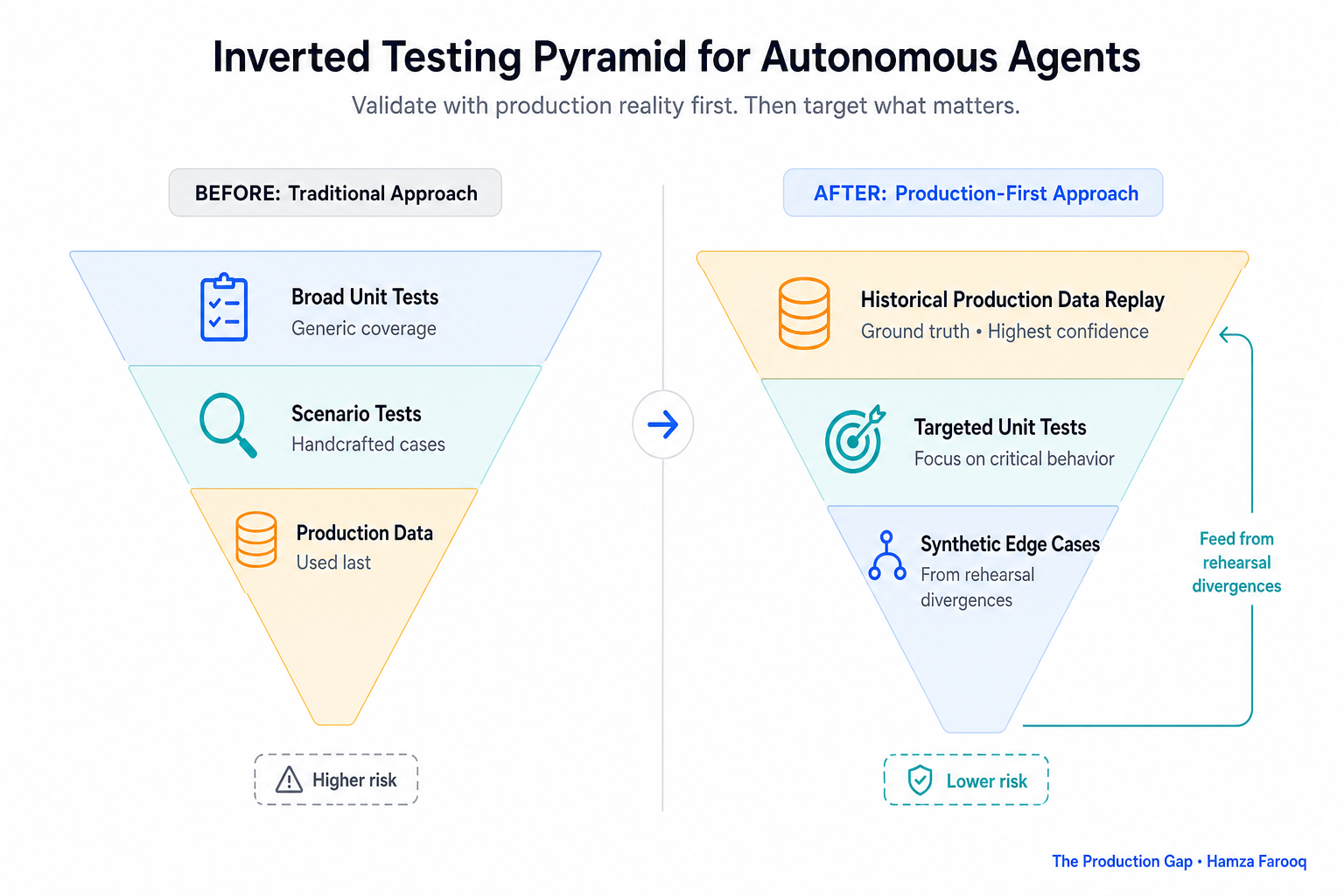
Teams should integrate historical replay as the anchor step in their validation workflow, running rehearsal against historical production data first, then using divergent results to generate targeted unit tests and edge-case scenarios. This inverts the traditional bottom-up testing pyramid and is the practical sequence recommended throughout this guide.
- Select a behavioral-diversity corpus. Pull past production runs skewing toward high-variance tool-call sequences. Unusual chains are where failures tend to live.
- Confirm environment isolation before any data replays. Verify that staging credentials are wired in and that no write paths reach live systems.
- Run rehearsal and treat divergence as signal. A different decision on the same real input reveals what the new version's decision boundary changed, and that is worth investigating before shipping.
- Seed your synthetic dataset from divergent cases. Feed those inputs into your existing Maxim or StackAI framework. Synthetic coverage anchored to real edge cases is more reliable than coverage anchored to imagination.
- Schedule the deployment window after rehearsal clears. Low-traffic windows limit blast radius if residual risk survived rehearsal.
Frequently asked questions
How is historical data replay different from traditional shadow mode or simulation testing for autonomous agents? Shadow mode typically routes live concurrent traffic to a new version in parallel, requiring real-time traffic to be running. Replaying past production data works against history asynchronously, with side effects suppressed and no concurrent live traffic required. This makes offline historical replay usable at any point in the development cycle, not only when live traffic is available.
What does it mean when an offline rehearsal result diverges from the original production outcome? Divergence means the agent made a different decision on the same real input than the previous version did. Treat every divergent case as a candidate for investigation before scheduling deployment, and as a concrete new entry for your evaluation framework. Divergence is informative signal, not automatically a failure.
Can offline historical replay catch non-deterministic failure modes in autonomous agents, given that LLM outputs vary between runs? Running multiple rehearsal passes against the same corpus and flagging cases where the agent's decision class changes between passes surfaces non-deterministic failures worth addressing before shipping. A tool call firing in one pass but not another on identical input is exactly the kind of instability that synthetic suites rarely expose.
How does historical replay fit into a CI/CD pipeline alongside existing prompt versioning workflows? Historical replay fits as a pre-deployment stage gate triggered after prompt version commits and before the scheduled deployment step. Exposing rehearsal results as a pass or fail signal that blocks or allows the deployment job, and feeding divergent cases back into Maxim or StackAI frameworks, closes the loop between rehearsal findings and ongoing synthetic test coverage.
Conclusion
Every pre-production framework anchored solely to synthetic data is anchored to what engineers imagined could go wrong, not what actually did. Shifting the foundation toward historical ground truth, using real production inputs as the widest and most load-bearing layer, makes unit tests the sharpening tool reached for after rehearsal surfaces real edge cases, not the primary confidence source.
This approach does not eliminate the need for red-teaming novel failure modes. StackAI and odvaai.com frameworks remain necessary complements for forward-looking coverage that historical data cannot provide by definition.
A practical starting point: audit your last five production incidents and check whether the root-cause input exists anywhere in your current test dataset. If it does not, that gap is your first historical replay corpus and a clearer view of where your validation workflow needs to be anchored
Learn from me

Claude Code in Practice, my Maven cohort. Master Claude Code from fundamentals to advanced orchestration: skills, subagents, hooks, MCP, and production automation. Join the next cohort →
Hire us
Traversaal.ai. We're a team of forward deployed engineers solving the toughest AI problems for Fortune 100 companies: document intelligence, agentic data platforms, and real-time web intelligence, deployed in production. Work with our team to deploy your next agentic ecosystem. Talk to Traversaal.ai →
Join us
Want to solve these problems with us? We're always looking for forward deployed engineers who want to ship production AI. jobs@traversaal.ai
