
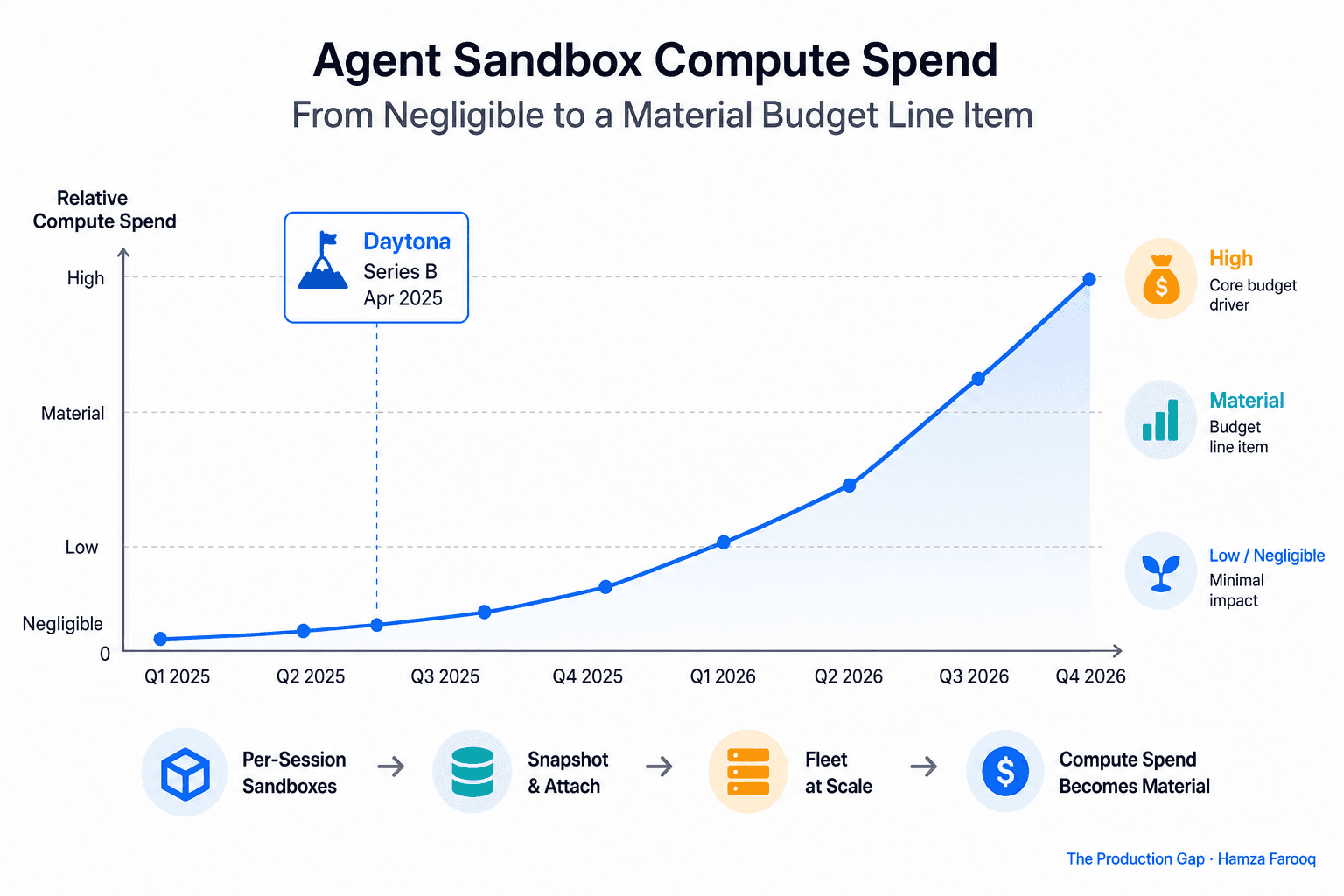
TL;DR: Agent sandbox compute costs are now a discrete budget line because snapshot-attach provisioning collapses cold-start time but shifts that cost from variable to fixed. Size your per-session fleet by calculating CPU headroom per branch, modeling fork costs against snapshot reuse rates, and separating pre-warming from execution capacity to avoid chronic over-provisioning.
Key Takeaways
- Sandbox compute is now a real budget line: track and forecast it separately from general cloud spend.
- Snapshot-attach rewrites cold-start math: pre-distribution collapses provision time but moves cost from variable to fixed, that shift only saves money above a calculable session-frequency threshold.
- Fork sprawl multiplies your bill fast: branching behavior, not raw session count, drives peak compute demand.
- CPU headroom multipliers must be set before rollout: size them from observed branching frequency in staging, not vendor rules of thumb.
- FinOps must split pre-warming from execution: reporting them together hides true unit economics and produces forecasts that consistently run low.
- Verify vendor benchmarks before sizing fleets: require reproducibility specs before any latency figure enters a capacity plan.
Introduction
As of mid-2026, the provisioning model, workload pattern, and cost structure of agent sandboxes have all changed simultaneously, and most FinOps frameworks have not caught up. This guide gives engineering and finance teams a practical framework, the BOW model and the pre-warming/execution cost split, for sizing and budgeting per-session fleets accurately.
How does snapshot-attach provisioning actually change per-session compute costs?
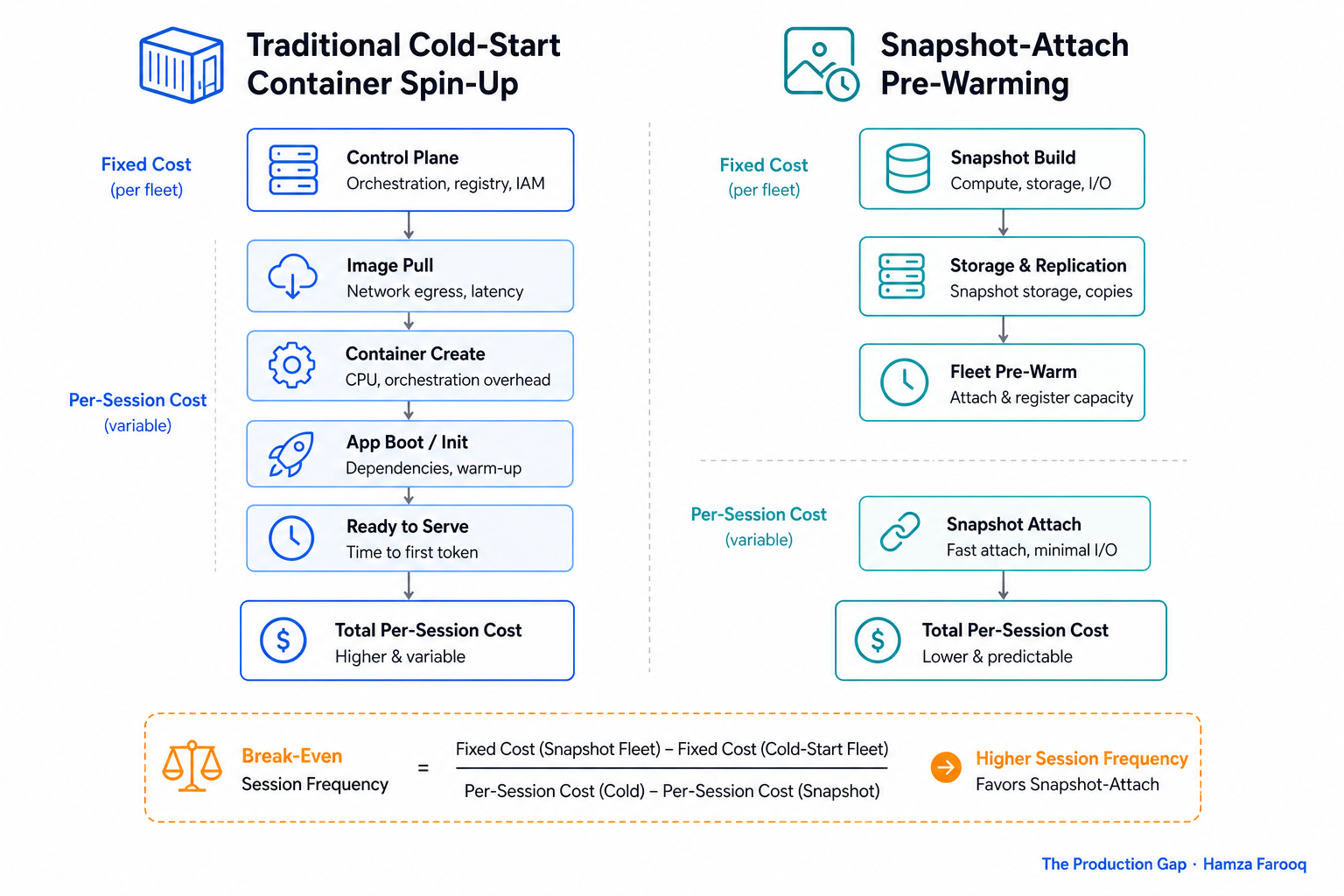
Snapshot-attach eliminates cold-start idle time by pre-distributing machine images across fleet nodes, but it does not eliminate baseline compute spend, it moves that spend from variable to fixed.
Every second a pre-warmed snapshot occupies a fleet node is billable regardless of whether an active session is running. The dynamic resembles reserved-instance baseline spend: you pay whether or not anyone shows up.
Break-even session frequency formula (author synthesis):
Pre-warming cost per node per hour / (cold-start savings per session × sessions per hour) = break-even session rate
Below this rate, cold-start is cheaper. Run this calculation against your own workload data before treating snapshot-attach as the default architecture.
What is fork sprawl, and why does it cause nonlinear memory demand?
Fork sprawl is the uncontrolled accumulation of live cloned sandbox environments created when an agent branches into parallel decision paths faster than earlier branches resolve. Because each live clone carries the full parent snapshot memory footprint, memory demand grows nonlinearly, compounding peak RAM requirements before any fork completes.
A task with multiple sequential decision nodes, each forking several branches, can produce dozens of concurrent live sandboxes if branch resolution lags. Long-horizon tasks consistently violate the "prune early" assumption that makes liberal forking economical.
How do you calculate the right CPU headroom multiplier?
Recommended approach:
- Baseline: size for sequential agent tasks with no branching.
- Add headroom incrementally for each average concurrent branch above one; measure the correct increment in your environment.
- When headroom requirements climb steeply, task decomposition is a better fix than adding compute, the multiplier is a diagnostic signal as much as a provisioning input.
The AWS pay-only-for-use metering model makes per-branch cost attribution tractable, but only if your resource tagging schema is in place before rollout. Retroactive attribution at production scale is unreliable.
How do you separate pre-warming costs from execution costs in your FinOps reporting?
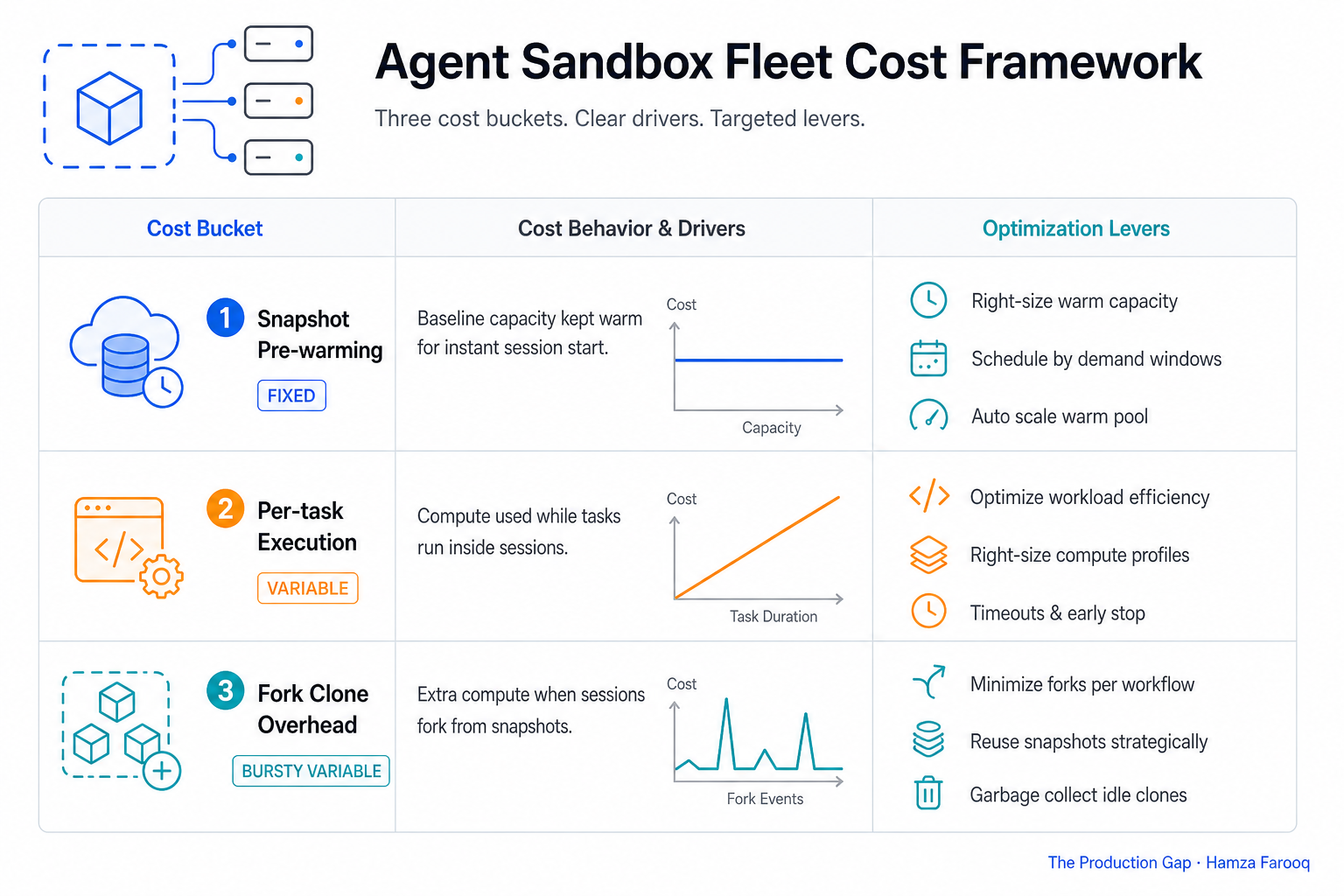
| Cost category | Nature | Primary driver | Optimization lever |
|---|---|---|---|
| Snapshot pre-warming | Fixed, always-on | Fleet node count | Reduce fleet size; increase session frequency toward break-even |
| Per-task execution | Variable | Task count and duration | Task batching; branch pruning policies |
| Fork clone overhead | Variable, bursty | Branching decisions | BOW coefficient limits in agent configuration |
Create these three tagged cost buckets before the first production session runs. Clean cost data cannot be recovered after the fact.
The BOW Model: A Named Framework for Sizing Peak Memory Demand
Formula:
Peak memory demand = (base snapshot RAM) × (average concurrent live branches) × (branch overlap coefficient)
Variable definitions:
- Base snapshot RAM: memory footprint of a single pre-warmed snapshot image at rest.
- Average concurrent live branches: mean number of unresolved forks active at peak load, measured in staging.
- Branch overlap coefficient: a multiplier above 1.0 reflecting how long branches remain simultaneously alive before the earliest ones resolve; long-horizon tasks consistently produce coefficients well above 1.0.
Worked example (author synthesis, illustrative):
Base snapshot RAM = 4 GB; average concurrent live branches = 6; branch overlap coefficient = 1.8. BOW peak memory = 4 × 6 × 1.8 = 43.2 GB. A plan built on 6 × 4 = 24 GB would be under-resourced by nearly half before OS overhead.
No vendor pricing sheet from Daytona, E2B, or Modal, as of mid-2026, models the BOW coefficient explicitly, which is why under-provisioning RAM while over-provisioning CPU is the pattern this framework is designed to prevent. (Author's characterization based on publicly available pricing documentation; not an externally measured industry finding.)
At what fleet size do agent sandbox costs cross into GPU-comparable budget territory?
Agent sandbox compute can cross into GPU-comparable budget territory faster than procurement cycles allow for. A fleet running substantial concurrent sandboxes, each carrying a full snapshot footprint and a meaningful BOW coefficient, can generate burst RAM demand that dwarfs provisioned capacity during planning-intensive tasks. Unlike GPU procurement, that burst arrives without a multi-week runway to respond.
Procurement inflection framework (calibrate against your own BOW model output):
| Session volume tier | Recommended action |
|---|---|
| Low | Absorb into general cloud spend; implement tagging immediately |
| Growing | Establish a dedicated sandbox cost center; apply the pre-warm/execution split |
| Mid-scale | Evaluate reserved capacity or spot-instance hybrid; run the BOW model quarterly |
| High | Treat as GPU-tier procurement: apply contract lead times, capacity reservations, and vendor SLA scrutiny |
Before signing with any sandbox-as-a-service provider, require benchmark reproducibility specs, environment configuration, snapshot size, and network topology. Headline latency figures alone tell you almost nothing useful for capacity planning.
Frequently Asked Questions
What is the true per-session compute cost of an agent sandbox when snapshots are pre-warmed? Per-session cost has two components: a fixed pre-warming allocation and a variable execution cost. Combining them in a single figure understates true unit economics and produces forecasts that consistently run low.
How does snapshot-attach change cold-start budget assumptions? It moves cold-start cost from variable to fixed, you pay for pre-warming continuously rather than per spin-up. That is cheaper only above a minimum session frequency threshold; calculate your break-even rate before assuming the architecture saves money.
What is fork sprawl and why does it matter for budgeting? Fork sprawl is the uncontrolled accumulation of live cloned sandbox environments created when agents branch faster than earlier branches resolve. It drives nonlinear peak memory demand, which the BOW model quantifies before it appears as an unexpected bill.
How should FinOps teams report sandbox spend separately from general cloud costs? Create three tagged cost buckets before the first production session runs: snapshot pre-warming (fixed), per-task execution (variable), and fork clone overhead (bursty). Retroactive attribution at scale does not work.
Conclusion
Snapshot-attach solves cold-start latency but moves cost rather than eliminating it, and creates conditions for something harder to detect: fork sprawl cascading into nonlinear peak memory demand without triggering a CPU alarm first.
The decision sequence: calculate your break-even session frequency, apply the BOW model to size RAM honestly, set your CPU headroom multiplier from staging data, split pre-warming from execution in your tagging schema on day one, and treat high session concurrency as a procurement trigger with its own lead-time requirements.
The latency problem is largely solved. The memory math is not. Run the BOW model against your agent's branching design now, most configurations do not survive meaningful branch overlap, and the bill arrives before the alarm does.
Learn from me
Forward Deployed Engineering Bootcamp for Full-Stack Developers, my Maven cohort. Build and ship complete AI products end to end, from React and Node.js frontends to deployed models with caching and observability. Join the next cohort →
Hire us
Traversaal.ai. We're a team of forward deployed engineers solving the toughest AI problems for Fortune 100 companies: document intelligence, agentic data platforms, and real-time web intelligence, deployed in production. Work with our team to deploy your next agentic ecosystem. Talk to Traversaal.ai →
Join us
Want to solve these problems with us? We're always looking for forward deployed engineers who want to ship production AI. jobs@traversaal.ai
