
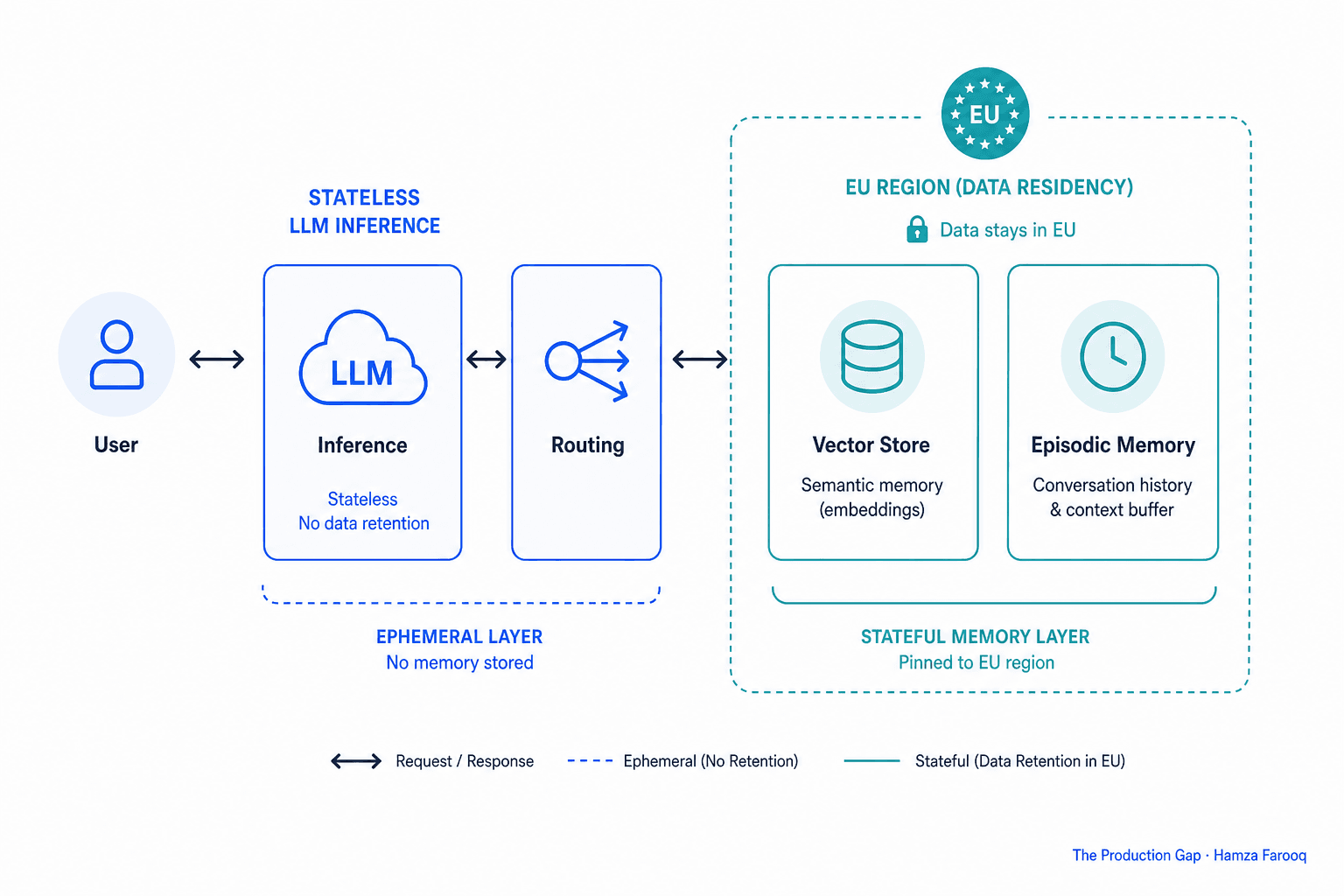
TL;DR: As of July 2026, Agent memory data residency must be governed separately from model compute location because the vector store, conversation history, and retrieved context chunks are themselves regulated data. Storing them outside a mandated region violates compliance obligations even when the inference call routes correctly. Architects must explicitly scope the memory store to an approved geographic region as an independent control, not an assumption inherited from the model endpoint.
Key takeawaysMemory layer, not the model call, holds the data: Compliance controls must target the memory store, not only the inference endpoint.Compute residency contracts have a critical blind spot: Existing agreements may not address persistent agent memory as a separate storage tier.Not all memory types carry equal regulatory risk: Episodic and semantic memory attract far greater scrutiny than procedural state.Region-scoped vector stores are the architectural fix: Pinning the memory store to a specific region closes the compliance gap the inference clause leaves open.Architects need a memory-specific residency checklist: Memory-layer review must be conducted independently of any assessment done on model inference routing.
Introduction
LangChain identifies memory as a discrete architectural concern alongside observability and permissions. IBM confirms that agents track user activity and preferences in memory to power recommendations. That accumulated data is precisely what data residency obligations are designed to govern.
Why is agent memory the real data residency risk, not the model call?
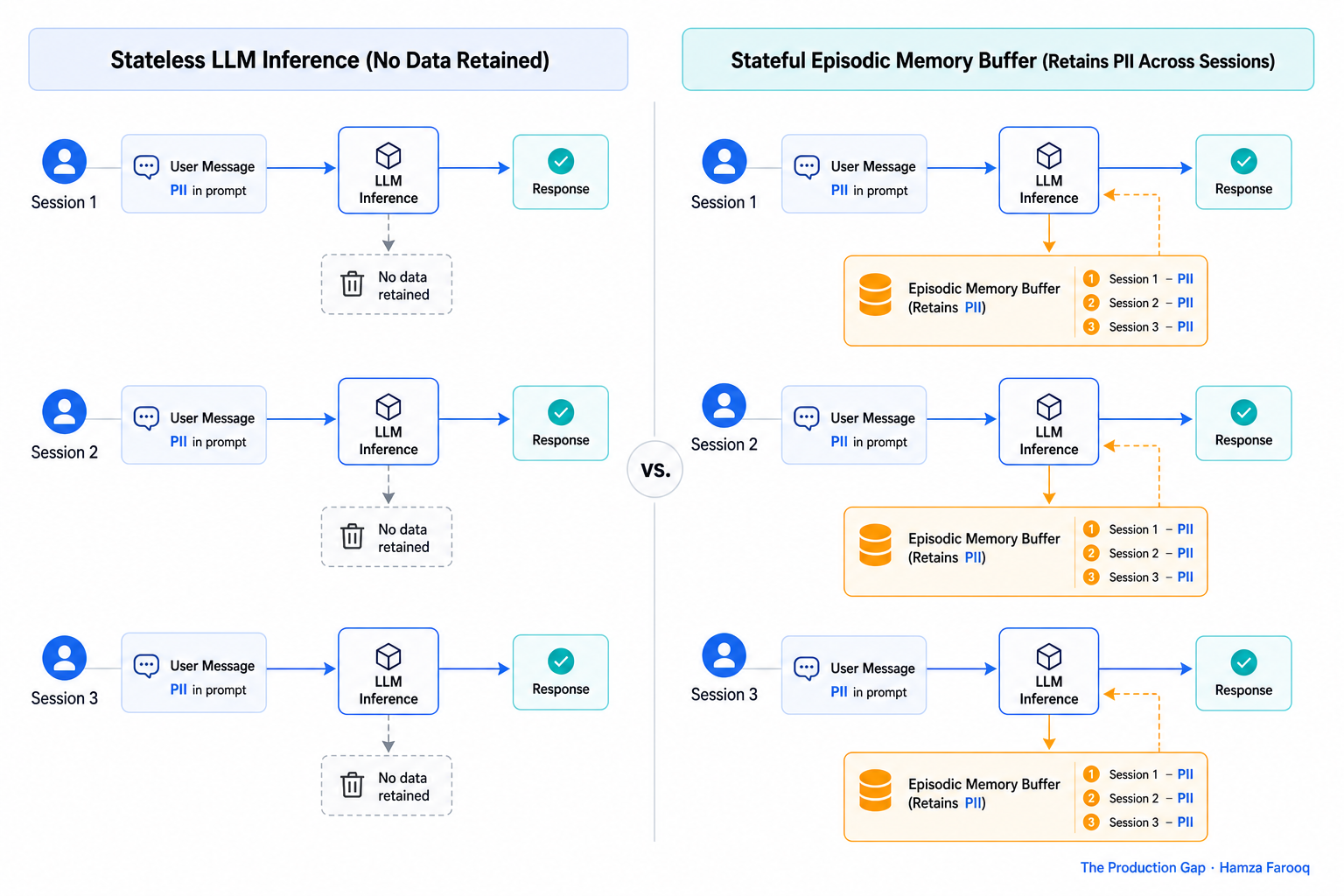
An LLM inference call is stateless: a prompt goes in, a completion comes out, nothing is retained. The memory layer is the architectural opposite, built to accumulate, index, and retrieve user-specific state across sessions. Think of it as the difference between a phone call and a filing cabinet. Data residency obligations attach to the filing cabinet.
The practical consequence: where an agent's LLM call executes may be a separate question from where the persistent agent state sits. The persistent agent state data residency obligation attaches wherever accumulated user history is actually stored, and legal counsel should confirm how that applies to each specific deployment and jurisdiction.
Which types of agent memory carry the highest regulatory exposure?
Episodic memory logs timestamped records of prior interactions, including session transcripts, retrieved document chunks, and decision rationale. A healthcare agent's episodic store may contain symptom descriptions and clinical notes, placing it squarely within the scope of data protection and health data regulations. Organizations should assess episodic memory stores with the same rigor applied to any persistent database of sensitive personal data.
Procedural memory stores workflow templates, tool invocation patterns, and reusable subagent specifications, confirmed by PrimeIntellect's prime-agent architecture. It generally contains no personal data and carries minimal regulatory exposure.
Table 1: Agent Memory Types by Regulatory Risk
| Memory type | What it stores | Regulatory risk tier | Primary regulatory trigger |
|---|---|---|---|
| Episodic | Session transcripts, interaction history, retrieved PII | High | Health data rules, data protection law, sector requirements |
| Semantic | Vector embeddings, user profiles, preference indexes | Medium-high | Re-identification risk, financial data rules |
| Procedural | Workflow logic, tool specs, subagent templates | Low | Minimal, typically no personal data |
What does "compute residency" miss that "memory residency" catches?
This gap can emerge when procurement and legal teams specify inference location without separately addressing the memory layer. Sovereign-deployment contracts that name only an inference region leave vector store defaults entirely unaddressed. Legal teams reviewing inference residency clauses may not realize the memory layer operates as a separately routable storage tier.
Consider an illustrative scenario, offered here as author synthesis rather than a documented case: a financial services firm runs a regulated advisory agent with LLM inference pinned to an approved region per contract, but the vector store backing semantic memory defaults to a different region, entirely unaddressed by the agreement. Every client profile persists outside the agreed jurisdiction. The sovereign-deployment attestation is accurate on compute and completely silent on agent memory store jurisdiction requirements. Firms should audit their own vector store regional defaults against current provider documentation and applicable legal requirements.
Closing this gap requires a separate, memory-specific residency control, not an amendment to the inference clause.
How do you architect a region-scoped memory store for a regulated agentic deployment?
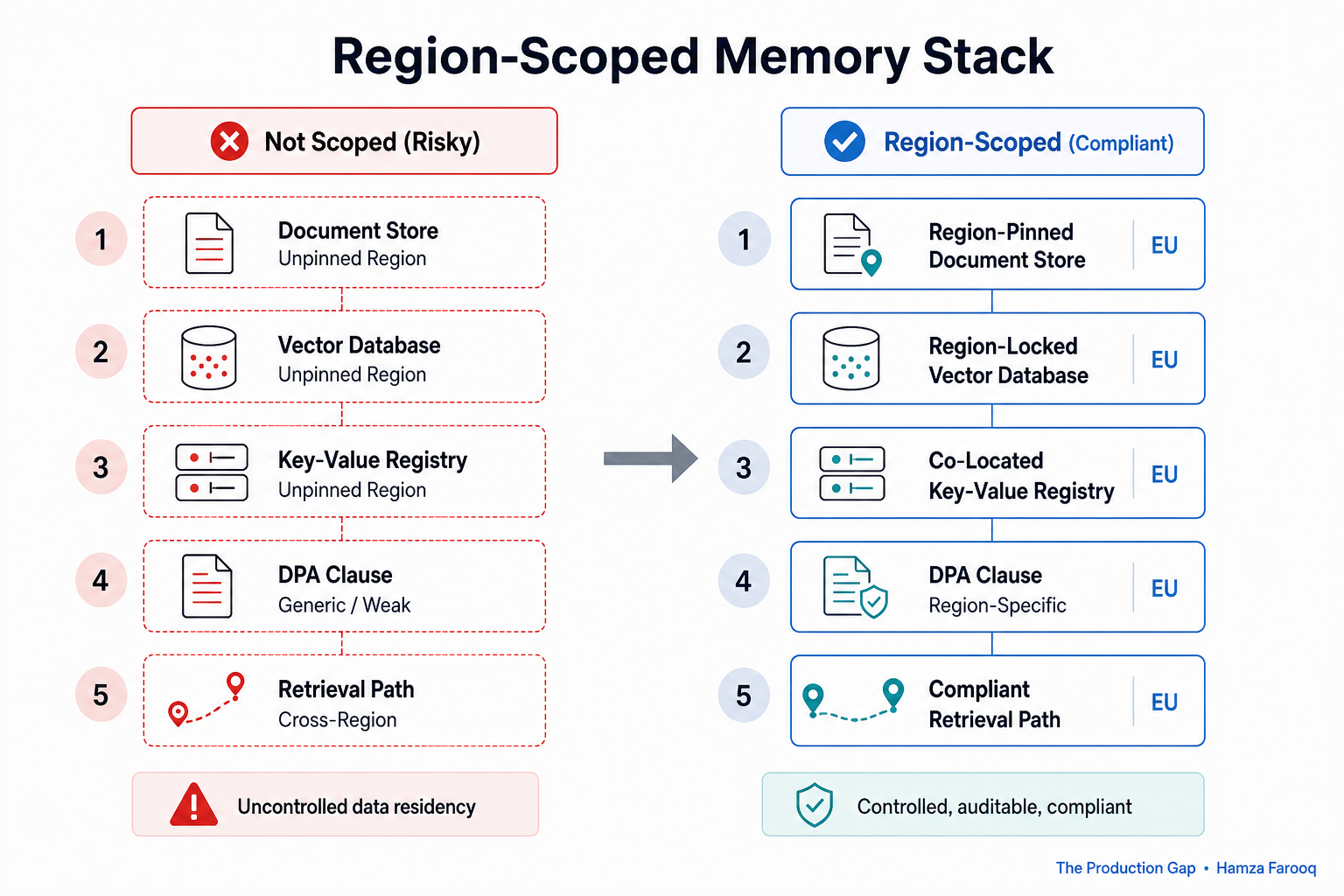
Enforcing agent memory data residency requires pinning each memory store component, including the vector database, key-value state registry, and retrieval buffer, to a specific geographic region through infrastructure configuration, access policy, and contractual data processing addenda. The steps below represent a practical framework used in this guide, not externally validated standards.
Step 1: Isolate episodic memory into a region-pinned document store. Session transcripts must write to a backend with an explicit region lock. Cross-region replication must be disabled or governed so that availability replication cannot override residency compliance. Confirm with your specific provider that backups and index replicas are also region-constrained, as provider infrastructure configurations vary.
Step 3: Scope the key-value state registry to the same region as the memory store. PrimeIntellect's prime-agent architecture confirms that durable state registries hold session identifiers linking directly to episodic records and must share the same region boundary.
Step 4: Add explicit memory-layer language to the data processing addendum. The DPA must name each memory store component and specify the permitted region for each. An inference residency clause alone does not cover the memory layer; each component requires its own specification.
Step 5: Audit the retrieval path, not just the write path. A retrieval buffer querying an in-region store but caching results in an out-of-region layer reintroduces vector store data residency risk at read time, a failure mode that write-path audits miss entirely.
Frequently asked questions
What is the difference between agent compute residency and agent memory residency?
Compute residency controls where LLM inference is processed; memory residency controls where persistent user data, including session history, vector embeddings, and state, is stored between invocations. In most regulated jurisdictions, compliance obligations attach to storage location, making these distinct requirements that should be addressed separately.
Which AI agent memory type stores personal data and triggers data residency rules?
Episodic and semantic memory commonly hold personal data and trigger data protection and sector-specific requirements. Treat both as regulated data systems requiring the same controls as any persistent PII database. Procedural memory carries minimal exposure because it typically contains no personal data.
Can an AI agent's LLM inference call route outside a regulated region if the memory store stays in-region?
Routing inference outside a regulated region while keeping memory in-region may be permissible or prohibited depending on whether the outbound prompt contains personal data, and the answer is jurisdiction- and data-classification-specific. This is an architecture-specific question that depends on what data the outbound prompt contains and the applicable regulatory framework. Confirm the acceptable posture with legal counsel against the specific jurisdiction and data classification before relying on any such arrangement.
What contractual controls are needed to enforce data residency on an agent memory store?
The DPA must explicitly name each memory store component, including the vector database, episodic log, and key-value registry, and specify the permitted region for each. Audit rights should cover memory-layer replication topology, not only primary storage location.
Conclusion
Many regulated enterprises have negotiated model inference location carefully while user interaction history, retrieved documents, and inferred preferences have persisted wherever the vector store defaulted. The Compute-Memory Residency Split is a foreseeable condition of any agentic deployment built on a sovereign-compute contract that does not separately address the memory layer.
A correctly scoped inference residency clause paired with an unscoped memory store is not a partial compliance win. It satisfies one question and leaves a different, equally important one unanswered.
Your next step: Run a memory-layer residency audit using the Region-Scoped Memory Stack framework described in this guide. Treat the vector database, episodic log, and key-value registry as a data processing system entirely independent of your compute residency controls, and produce a separate attestation for each component.
Learn from me

Forward Deployed Engineering Bootcamp for Full-Stack Developers, my Maven cohort. Build and ship complete AI products end to end, from React and Node.js frontends to deployed models with caching and observability. Join the next cohort →
Hire us
Traversaal.ai. We're a team of forward deployed engineers solving the toughest AI problems for Fortune 100 companies: document intelligence, agentic data platforms, and real-time web intelligence, deployed in production. Work with our team to deploy your next agentic ecosystem. Talk to Traversaal.ai →
Join us
Want to solve these problems with us? We're always looking for forward deployed engineers who want to ship production AI. jobs@traversaal.ai
