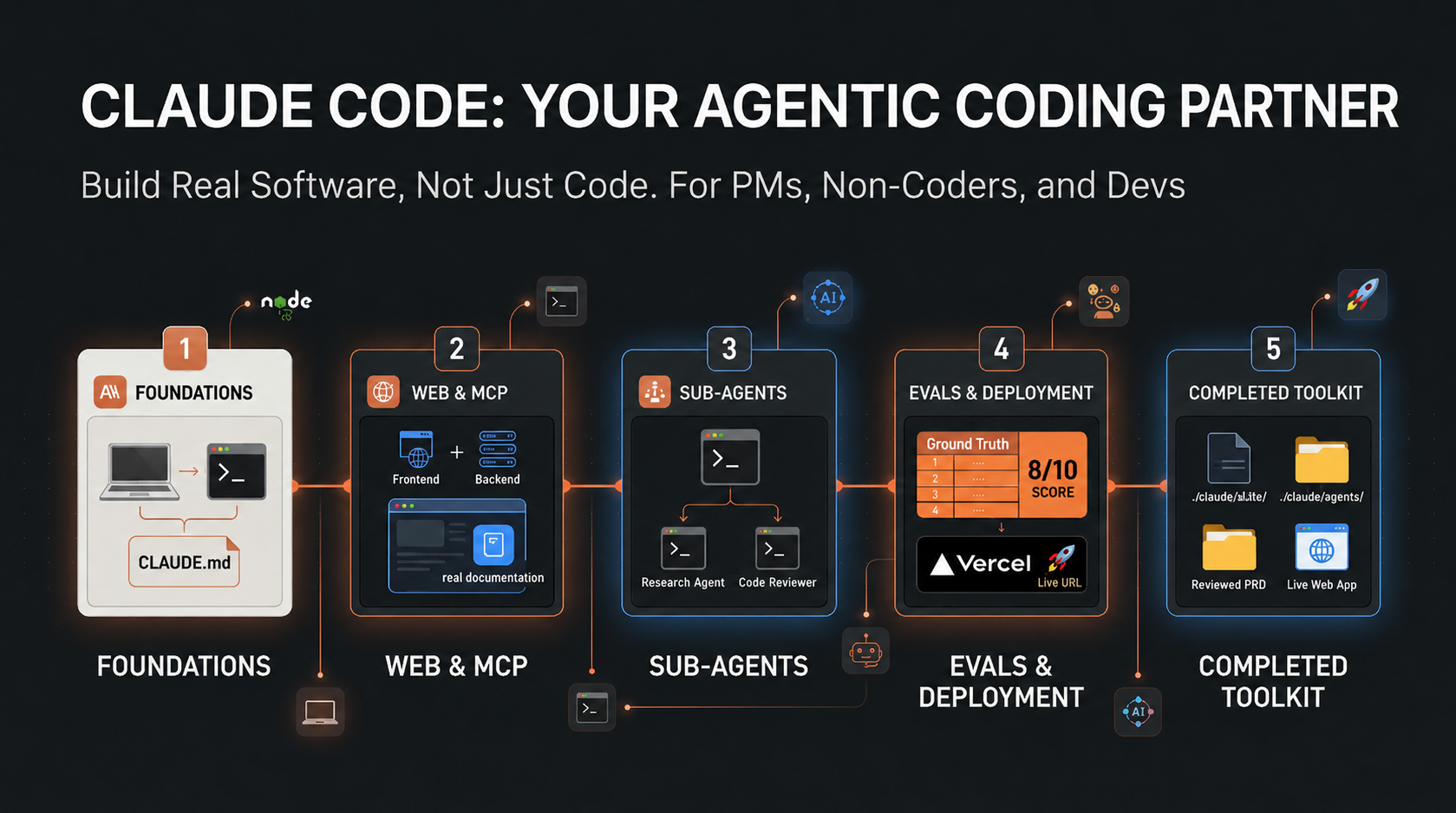
Course Overview: What you will learn in 15 chapters
This is a self-paced, 15-chapter course on Claude Code which is Anthropic's agentic coding tool that runs inside your terminal, reads your project files, and edits them directly. The course is built for PMs, non-coders, and developers who want a working setup, not a theoretical perspective.
Each chapter is one short lesson and one concrete action. By the end of two weeks, you will not just know what Claude Code does, you will have a working toolkit you have used on a real project: a CLAUDE.md, a Skill library, a team of sub-agents, an evaluated workflow, and a deployed application with a live URL.
Who this course is for
- Product managers who want to spec, prototype, and validate without waiting on engineering
- Non-coders who want to build and ship working software with plain-language instructions
- Developers who want to compress research, review, and scaffolding into agentic workflows
- Teams standardizing on Claude Code as a shared way of working
No prior Claude Code experience is assumed. You need a laptop, a terminal, and Node.js.
Learning outcomes
By the end of this course, you will be able to:
Foundations (Chapters 1–6)
- Explain what Claude Code is, how it differs from Claude.ai, and why an agentic harness changes the AI-to-action loop
- Install Claude Code and connect it to your Anthropic account (Pro, Max, or API key)
- Open a Claude Code session inside a real project folder and run your first instruction against actual files
- Write a CLAUDE.md that gives Claude permanent context of your role, project, conventions, and preferences and use
/init to bootstrap one for any new repo
- Install and run a Skill (
/prd-generator) to encode a repeated workflow into a single command
- Produce a structured PRD from a real idea in under 45 minutes and surface its riskiest assumptions
- Run a working application that Claude Code built end-to-end and modify its behavior without writing code yourself
Web mental model and MCP (Chapters 7–8)
- Describe the three layers of a modern web app: frontend, backend, AI backend and reason about where latency, failures, and data live
- Install Playwright MCP and extend Claude Code beyond its training data so it can browse live URLs, read real documentation, and research current sources
- Articulate what MCP is, how MCP servers register tools, and why an agent's usefulness depends on the tools it is connected to
Sub-agents and pipelines (Chapters 9–11)
- Distinguish Skills from sub-agents: when each runs in the main session vs. a fresh isolated context
- Build a research-agent that Claude delegates to automatically based on its description field
- Add a prd-reviewer and a read-only code-reviewer that return structured, actionable audits (risks rated HIGH/MED/LOW, edge cases, scope flags, line-level code findings)
- Chain three agents in one prompt to go from market question to reviewed PRD in roughly five minutes with no manual handoffs
Evaluation and deployment (Chapters 12–13)
- Build a ground truth table of ten real inputs with expected outputs and scoring criteria
- Run
/skill-evaluator to move a Skill from "it seemed to work" to "it passes 8/10 on real cases" and read failures to find structural prompt issues
- Deploy a Claude-powered app to Vercel, set
ANTHROPIC_API_KEY correctly in the deployment environment, and share a live URL with stakeholders for real feedback
Reflection and next steps (Chapters 14–15)
- Audit your own toolkit including CLAUDE.md, Skills, agents, evals, deployed app, and choose the next real problem to apply it to
- Identify which workflows in your role are worth encoding as Skills or sub-agents based on frequency and isolation needs
- Adopt a sustainable habit of using Claude Code on one small, real project per week instead of treating it as a one-off experiment
What you will have built by Chapter 15
- A populated CLAUDE.md that orients every future session
- A
.claude/skills/ directory with /prd-generator, /skill-evaluator, and /deploy-checklist
- A
.claude/agents/ directory with research-agent, prd-reviewer, and code-reviewer
- A reviewed PRD for a real feature idea, with risks flagged
- An evaluated Skill scoring 8/10 or better against a ground truth table
- A deployed application with a live URL that real users can try
How to use this course
Each lesson is short with 5 to 10 minutes to read and 15 to 30 minutes to complete the action. Do them in order. Skipping the CLAUDE.md, Skill, or agent setup lessons leaves later lessons running against an empty project. The setup is what makes everything after it feel useful.
When you finish, take the course assessment in the sidebar. It will show you which ideas stuck, which deserve a second pass, and which lessons are worth revisiting before you start applying any of this at work.
→ Browse the course repo
→ Ready to go deeper? Enroll on Maven (code: claudecode)